Webflow is a cloud-based CMS that helps to build great websites. Webflow allows users to design, build and host a website with simple and easy steps.
In this blog, we are building a website and adding a chatbot so that website visitors can take help from the chatbot to understand the product.
Sign up on Webflow CMS and design your website. Once you finish designing, follow the given steps to add the Kommunicate chat widget to your website.
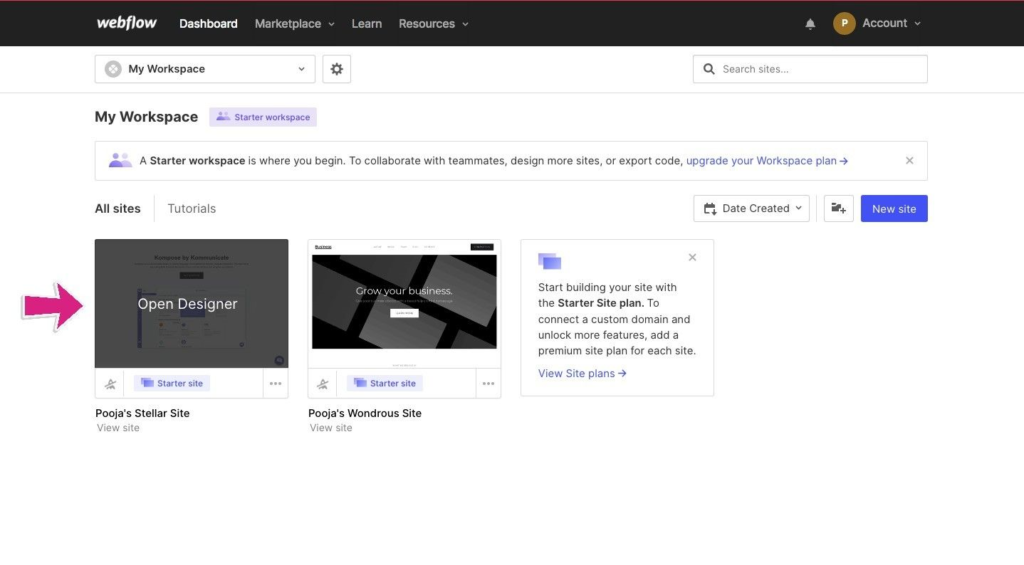
Log into your Webflow account and open your site in design mode.
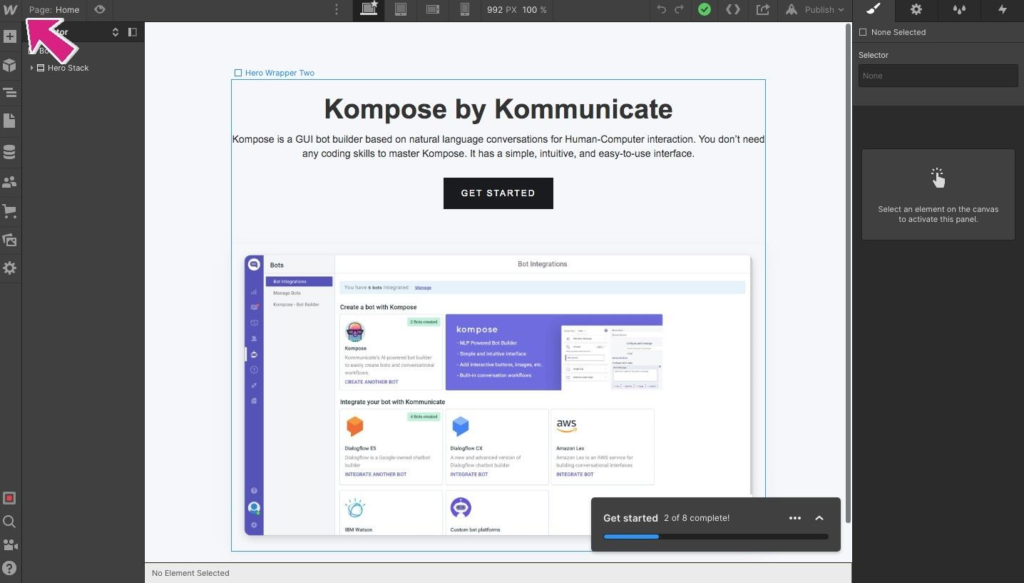
2. Click on the alphabet W icon present in the top left corner of the design window.
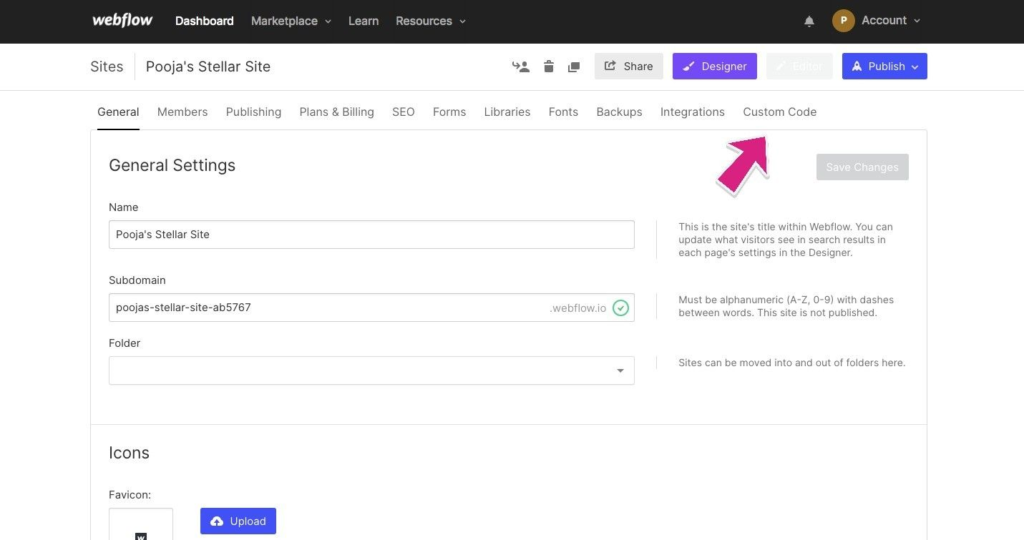
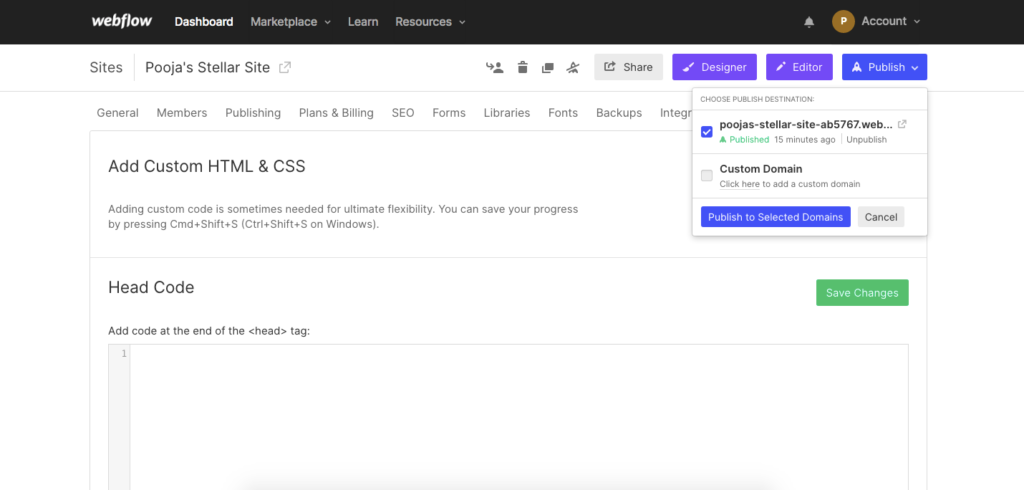
3. Under Project Settings, you will see the Custom Code feature, visit the section and check for the Footer code option.
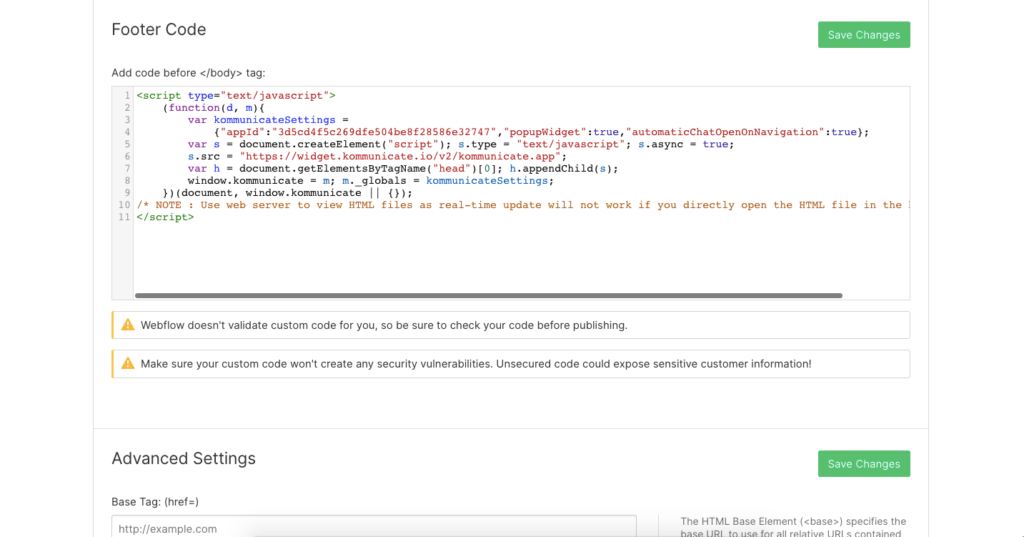
4. Visit the Footer code option and add the Kommunicate Install script inside the code section as shown below and click on Save Changes.
NOTE: You will have to select the Kompose chatbot from the RULES section of the Kommunicate dashboard to handle all the incoming conversation so that chatbot will handle the new conversations.
5. Now, go and Publish your site using the Publish option given on the top right corner of the page.
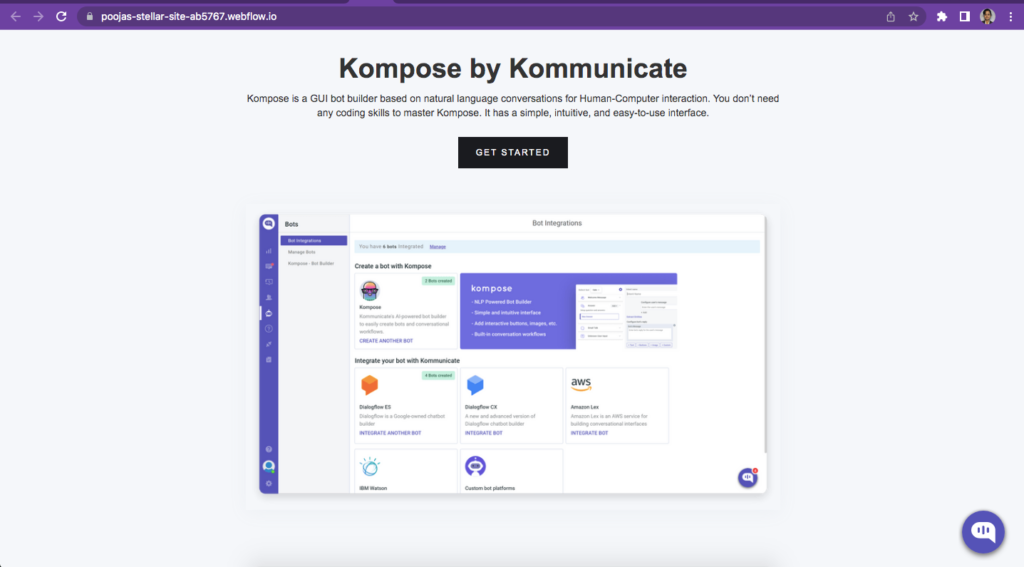
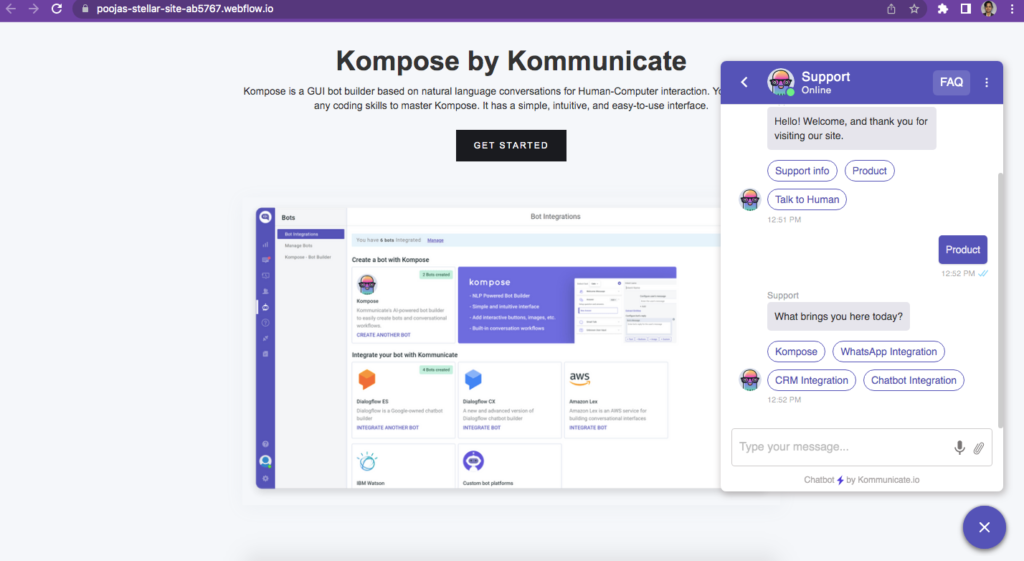
6. Chat widget is added successfully
Now, your website users can use the chat option to get help about your product and all these chats can be monitored from the Kommunicate dashboard, also support agents can involve in handling chats when the chatbot is unable to answer.
The world has turned into a digital hub. Thanks to the pandemic, there has been a global shift for organizations after embracing remote work. The trend will continue, with many organizations adopting remote work to increase the well-being of their workforce.
According to Upwork, 73% of departments will have remote workers by 2028. With more people working from home, teamwork and information exchange is paramount. One of the best–possible approaches to provide ongoing support to a remote team and ensure the optimal functioning of your organization is via collaboration platforms. Top IT companies like Microsoft have created communication tools like Microsoft Teams to help employees stay connected with their co-workers regardless of location.
Microsoft Teams is your central hub for collaboration. Be it team meetings, workplace chat, videoconferencing, presentations, or sharing data and apps, everything is saved in a single shared workspace. The best part is you can access it from any device, making it one of the best-bet platforms that guarantee a collaborative working atmosphere and ongoing employee support while maximizing efficiency.
A bot is a new feature/functionality in Microsoft Teams that enables you to engage with and acquire information from a program or website in a text/search/conversational way.
In truth, bots are basically automated intelligence programs. They’re delivering us several things but most significantly, it’s in a natural and accurate language. Bots are sophisticated enough to both grasp what we are requesting but also deliver in similarly detailed language back to us. Of course, we only want information that is useful to the user based on queries or status updates connected to the individual seeking the information.
When we look at how we all used to get information, you’ll notice that whenever we seek information, whether it’s on the internet or a particular website, we always need to utilize Search Tabs.
Whether you’re searching on Bing, Google, or a more complicated search engine like SharePoint or a website, it doesn’t matter. You must understand how to utilize search, what operators to employ, and how to use that search effectively to discover relevant information. Search engines present general information based on your search criteria in your search tabs.
That method of gathering information has improved, and we now use more natural language in our searches. Whether you’re using Cortana, Alexa, Google, or Siri, we’ll first ask those virtual assistants to give us information.
The way we search for information has evolved. We’re approaching it from the standpoint of a discussion. This will be accommodated by bots, such as those in Microsoft Teams.
Bots are customizable and can be a part of a bigger application or created as standalone applications. The majority of bots on the Microsoft Teams platform are designed to boost collaboration and coordination by reducing the need for context switching and automating particular processes or activities. Be it HR,Service desk, or as an ultimate tool of workplace support and collaboration, MS Teams Bot is weaving its magic in each of these sectors enhancing the overall productivity of an individual and the organization.
Here are some benefits of MS Teams Bot in the IT support department: Save time — enhance output
The key advantage of implementing MS Teams Bot is the time savings. The phrase automation relates to mechanization and computerization, which is the process of reducing time and increasing accuracy in a work by increasing speed. Saving time on work is directly tied to freeing up time for the employee to engage in other productive activities rather than executing a job that requires mechanical repetition of procedures.
Minimize expenses
More productivity is achieved when an individual is engaged in more activities that earn the greatest money for your company within the same working hours. Since time and money are constantly intertwined, more productivity implies more money saved for the company.
Fewer human errors
Since MS Teams Bot removes the human intervention leading to an automated workflow resulting in fewer administrative mistakes. Humans are prone to errors but automated programs, on the other hand, do not produce errors. The next job is automatically triggered in an automated workflow system through MS Teams Bot, and the person in charge of the task is also informed of the action anticipated by him. As a result, there is no mishap or faulty processes leading to erroneous results.
Incorporate features from other services
Microsoft Teams has an app store, similar to Android and iOS. Bots from other organizations and services are all available in the Teams app store. You can occasionally engage with the bot directly in Teams after installing it to gather, capture, and submit important data. For example, Zoom’s Microsoft Teams connection lets you use bot instructions to initiate or join meetings.
Service desk transformation
Every year, billions of dollars are spent on software linked to digital transformation. IT Service Desks are now in charge of integrating these new service desk software installations that are tied to substantial digital transformation programs. As a consequence, ticket traffic is increasing, putting pressure on ticketing costs and the IT service desk. Virtual agents, such as bots, can help the IT service desk become lean and flexible, allowing end-users to remain afloat and sail over the technological tsunami. MS Team bots, which are filled with specific IT service Desk knowledge bases and self-service portals, may help minimize the number of calls to support operations. AI, automation, and bots can also be used to execute the ITIL framework’s best practices for integrating service delivery with strategic goals.
Simplified approvals
Approval procedures that are clumsy slow down whole workflows. When manual approvals are required, employees often spend hours submitting papers by hand and following down on approvers. Approval procedures are streamlined as a result of digitization and process automation. To avoid delays, automated alerts notify approvers of new documents, while reminders indicate that approval is still waiting. Thanks to MS Teams Bots, staff no longer have to pursue approvals since they are signed off on right away due to automatic alerts.
Useful data
Reports containing graphical data for enhanced visibility are a significant advantageous aspect of an automated process. With precise insights from MS Teams Bots, IT teams can rapidly detect crucial bottlenecks like resource allocation and component availability and avoid expensive overruns. The capacity to take action based on relevant data in a timely way is feasible with automation and the capturing of important performance measures.
Enhanced task management
Improvement in Task Management is yet another important advantage of process automation which is a major benefit of MS Teams Bot. This again leads to greater communication. Due to automation, multiple departments can remain in contact more readily, enhancing communication. All automated workflows generally come with Tasks showing ‘Dashboards’ and reminders intimating ‘Calendars’ which are available to all people utilizing the process which is another feature of automated workflows — ‘Visibility’. This allows Managers to rapidly identify the status, bottlenecks, and chances for process improvement.
Tickets are resolved more quickly.
Employees may interact more quickly, resulting in shorter ticket waits. They can locate experts, interact with them, and resolve cases quicker thanks to the ChatOps bot, which helps them identify other professionals who have worked on similar issues.
Find information without having to switch contexts.
Agents may access information about tickets, related occurrences, and knowledge articles without moving between apps by using natural language and instructions in Microsoft Teams. Agents do not need to hop between Microsoft Teams and Smart IT to update an issue. They may use the chat to add activity comments, change the assignee, and update the ticket status
Collaboration is simple
When a problem is reported, utilizing the Microsoft Teams channel makes collaborating extremely simple. Employees may pool their knowledge to work on problems and solve them swiftly.
Issues are less likely to bounce back.
Previously, a problem would bounce from one team to the next, sometimes numerous times, while the company tried to locate a team that could push the issue to resolution. With MS Teams Bots, IT employees can interact with specialists from other teams and fix them without having to bounce them back and forth.
Increase in productivity
Most IT employees are responsible for a large number of activities that are simple yet take a long time to complete Routine chores like scheduling meetings across several employee calendars, arranging meeting rooms, reporting hours, and compiling reports can become a productivity killer. MS Team Bots can be used to drastically reduce time by automating them. Employees can now devote more time to critical activities, resulting in increased efficiency and output.
Other advantages of using Microsoft Teams chatbots include:
Support is available 24 hours a day, 7 days a week.
Troubleshooting procedures such as printing, internet connection, and more can be automated.
Authentication of users
Assist in the resolution of work-from-home concerns
Requests for software and hardware will be recorded automatically
The management approval procedure is automated
Staff will be notified of any outages, whether they are urgent or planned.
Integrates with your current ITSM tools, such as ServiceNow
Provides the same capability in Microsoft Teams and SharePoint.
Extract data from existing knowledge bases, FAQs, and user manuals and send it to a popular chat service like Microsoft Teams.
Did you know you can transform your Teams into an internal IT help desk with on-the-go self-service?
Workativ is a no-code interface solution that lets you create sophisticated, intelligent, and responsive conversational chatbots that work in tandem with Microsoft Teams. We collaborate with you to design your AI’s persona, reactions, and more — and the greatest thing is that your bot learns and improves its responses based on the feedback it gets. More information can be provided to the bot as more people interact with it via Teams, allowing it to improve its level of help. The bot also collects data that allows us to provide you with information such as demographics, the most popular times to contact online support, and other information that allows us to personalize your experience better.
Artificial intelligence (AI) is rapidly becoming common in classrooms worldwide. Many educators are exploring potential technologies like GPT-3 (the large language model behind ChatGPT) to improve teaching and learning. Education technology firms, such as Noodle Factory, are actively developing tools to assist educators in tapping into the power of conversational AI. While AI could offer many exciting possibilities, educators need to be aware of the potential risks and ethical considerations that come with it.
Artificial intelligence (AI) is rapidly becoming a common feature in school classrooms and corporate workshops worldwide, with many educators and instructors exploring the potential of this technology to improve teaching and learning outcomes.One of the key features of conversational AI that sets it apart from other technologies is its ability to generate human-like text and perform a wide range of language-related tasks.
Enterprises. Think behemoths. The big guns. The giants in the industry.
While there is no cut-and-dry explanation as to what exactly an enterprise is, one can safely assume that enterprise businesses are those whose revenues range from $1 million to a few billion dollars.
The E.U. defines enterprise businesses as those that employ more than 250 people.
According to Abhimanyu Singh, who leads the sales function here at Kommunicate, “Any company whose revenue exceeds $1 million is an enterprise by Kommunicate’s lens, but then, this varies from company to company.”
As you can see, the definitions may vary, but there does seem to be a clear picture emerging as to what an Enterprise business is.
An Enterprise business is a well-established, well-oiled machinery that employs a large number of people, has very well-defined processes, a complex structure, and generates a large amount of revenue.
We can already see enterprise businesses adopting chatbots to automate some of their functions. But there is a lot more that chatbots can do to help grow an enterprise. This is exactly what we are going to look at in this article.
Before we dive in, what exactly is an enterprise chatbot?
What is an enterprise chatbot?
An enterprise chatbot is a scaled-up version of a regular chatbot built to match the scale of a large organization. A normal chatbot and an enterprise chatbot solve essentially the same problem. The key difference here to note is that an enterprise chatbot helps solve complex, enterprise-level challenges to the business.
Here are some of the methods Enterprise chatbots can help businesses scale:
1. Chatbots can help in handling enterprise-level volume of support queries:
Businesses, especially eCommerce websites, occasionally see a massive spike in the number of concurrent users. This is especially during peak shopping seasons such as Cyber Monday or Black Friday.
Spikes may also come in during long holiday weekends, for which your business needs to be prepared. To mitigate these, you cannot entrust a normal chatbot. A normal bot may not have the bandwidth or the technical capability to handle thousands of users at the same time.
This is where Enterprise chatbots come in. Enterprises have the freedom to scale their conversation systems so that the chatbots can handle the plethora of queries that come with systems of such scale.
2. Chatbots can help enterprises in their Omnichannel approach
Customers expect consistency. In fact, investing in a consistent customer experience can potentially double your revenue, according to this research by the Temkin group.
A good customer experience means customers are willing to spend more on your product.
Case in point, the Apple stores. Sleek interiors, products that are displayed beautifully in aesthetically pleasing cases, and helpful and knowledgeable staff. These are the hallmarks of an Apple store.
No wonder that when the iPhone 14 Pro started retailing at $999, people queued up outside these very stores to buy them.
For an enterprise business, it is difficult to deliver personalization at scale. This is why an omnichannel approach works best to provide a superior customer experience.
This is where enterprise chatbots come in. One can deploy enterprise chatbots across multiple channels by techniques such as cloning. With this, they can provide a consistent customer experience across multiple communication channels, maintaining your brand’s omnichannel strategy.
3. Enterprise chatbots can help augment an organization’s security
Enterprise businesses, by nature, structure themselves in such a way that there are no data leaks. Considering the fact that they deal with customers’ sensitive data, which in some cases may run into thousands of customers, this data is extremely valuable.
With an IBM report that estimates the cost of a data breach as $9.4 million in the US, this is no laughing matter. Data, like oil, is one of the most precious commodities in the world at the moment.
Enterprise chatbots are already subject to a lot of regulatory procedures that help prevent data leaks and ensure security. Chatbots can also help in fields such as:
Providing end-to-end encryption
Educating the employees and the visitors about security-best practices
Authentication to gain access to the website.
Authorization
Placing security protocols in appropriate locations.
4. Help enterprises be online 24 x 7 for their customers
Customers of enterprise businesses expect a response from the companies around the clock, irrespective of where the business headquarters are or what their working hours are.
Taking time to respond to customer queries leads to a bad customer experience, something that companies should avoid like the plague. In fact, according to this Zendesk report, about 80% of the respondents would rather do business with a competitor after just one ‘bad experience.’
With chatbots, enterprise businesses can be online all the time and also provide instantaneous responses to their customers. Also, there is a reduction in the dependency on support agents who, in turn, can concentrate on resolving more complex queries.
Chatbots can be the first point of contact for customers, and the bot-to-human-handoff feature can also provide a seamless experience.
For repetitive queries, you can always use an enterprise chatbot that you can easily be trained to provide quick responses to customers. This creates a positive customer experience, which, in turn, can turn to increased revenue.
Even if the query is irrelevant / a chatbot is unable to provide the exact responses, getting quick feedback means customers feel looked after. This affects your customer satisfaction and CSAT scores, metrics which are quite important even for enterprises.
5. Enterprise chatbots can help in data collection and lead generation
A good enterprise chatbot is also very proficient in the following fields- monitoring and analyzing customer data. This is a highly useful feature that helps organizations make sense of customer behavior and help effectively market their products.
Customer attention is also something that a lot of companies compete for, so enterprise chatbots can help grab this attention by sending out push notifications. Push notifications sent regularly at fixed intervals help enterprises increase their customer engagement.
Enterprises can also use chatbots to collect feedback from customers, which they can then use to improve their website, product, or service.
Another important application of enterprise chatbots is lead generation. How? When a customer is browsing through the enterprise’s website, chatbots can initiate a conversation with the customer. This can help the enterprise nurture leads and then nudge them toward the right team members.
Chatbots can help provide instantaneous responses to customer queries, and this level of customer engagement can act as a natural boost to the number of leads and conversion rates.
Parting words
Businesses today are trying to survive in an environment that is getting more and more competitive with each passing day, and it is the only technology that can help them stay afloat. An enterprise chatbot powered by AI is at the forefront of this technological revolution. Enterprises that decide to implement these enterprise bots have an advantage over those who choose not to do so. With a chatbot solution provider like Kommunicate, enterprises can be sure their needs are taken care of.
Generative AI — How To Connect Your Bot To Chat GPT-3
Whether it’s to write a research paper, solve calculus questions, write a code, debate about world affairs or find a date online, Chat GPT-3 is the latest AI generative technology that promises to accomplish all of this. The technology is created by Open AI and answers questions on a wide variety of topics in multiple languages.
With Bot Libre being a language independent, open source platform with a wide variety of chatbots for all industries and topics, new and existing clients can still hop on the Chat GPT-3 train without discarding their Bots.
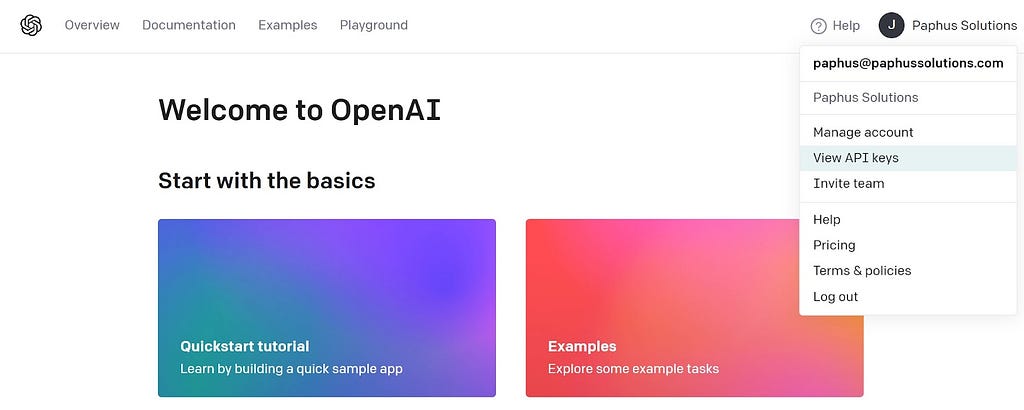
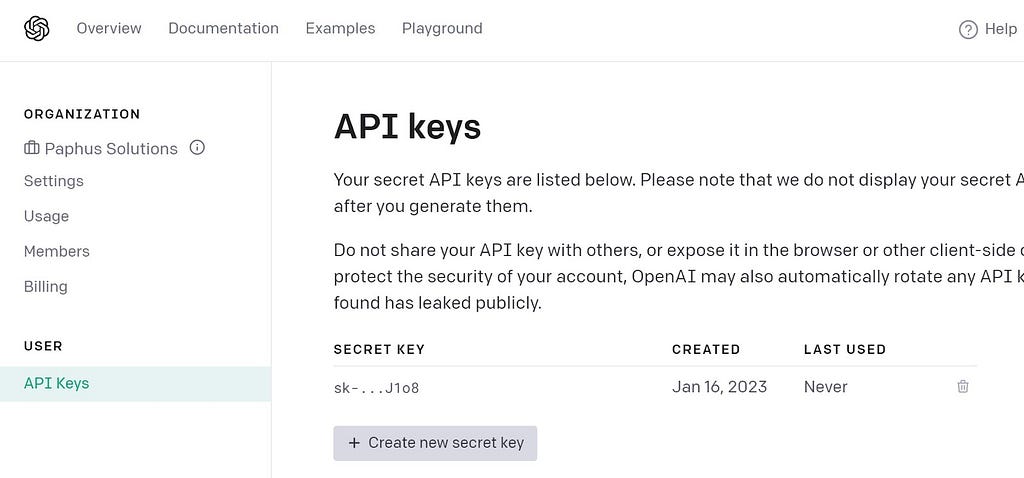
In this article, we show you how to connect your Bot Libre bot to GPT-3 using OpenAI’s API, and a Self script in your bot.
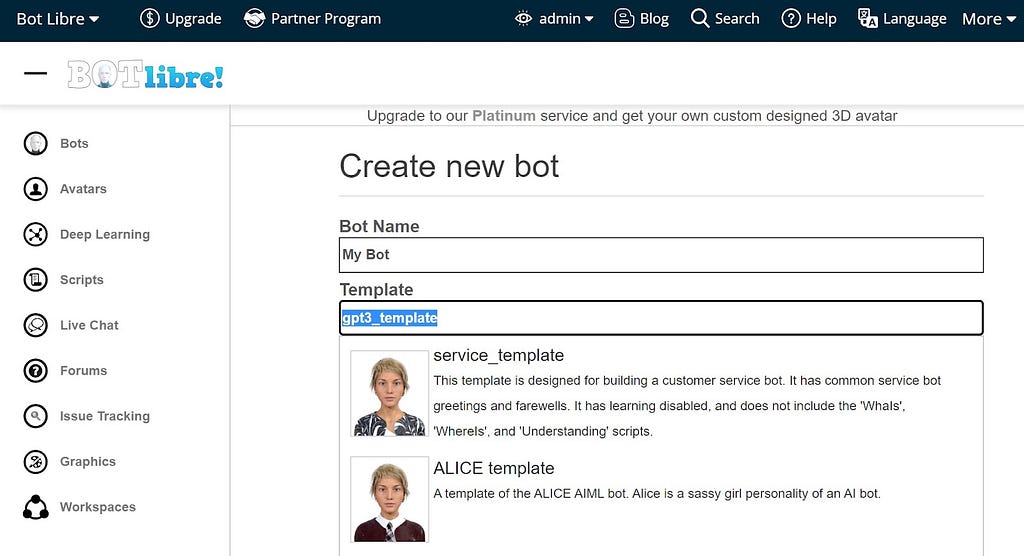
enter your bots name, and select “gpt3_template” as your bot template
click on “Create”
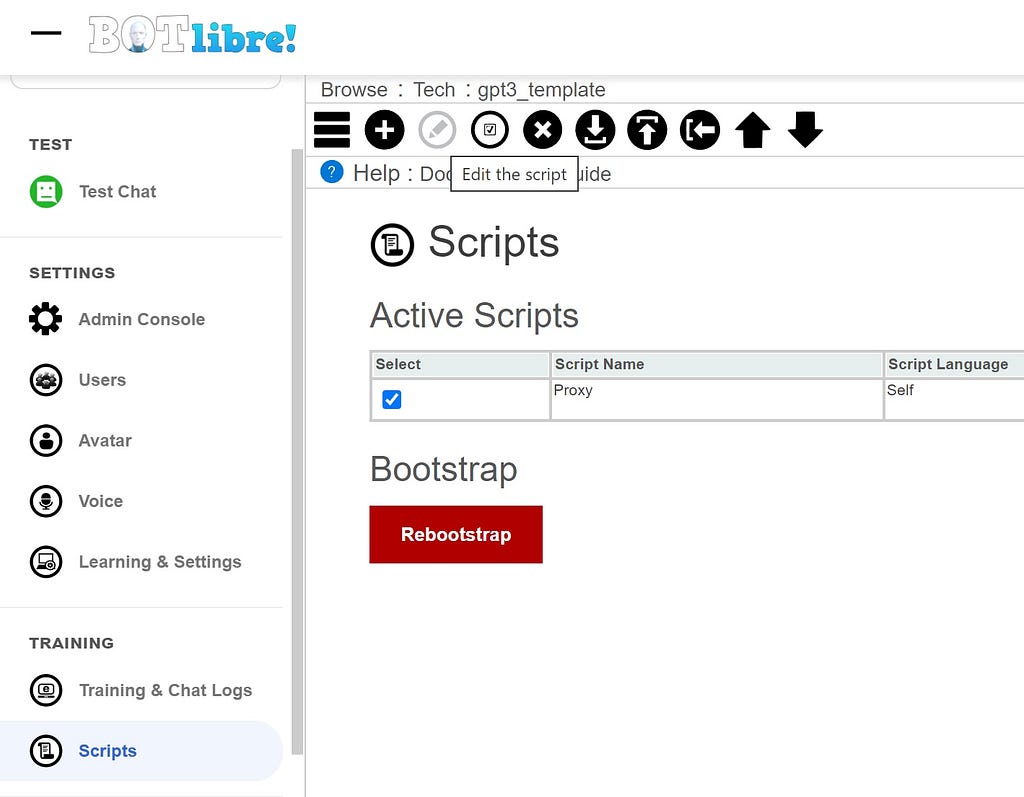
Another option if you already have an existing bot is to import the “GPT-3” script from the Bot Libre Script library, from your bot’s Scripts page select “Import”.
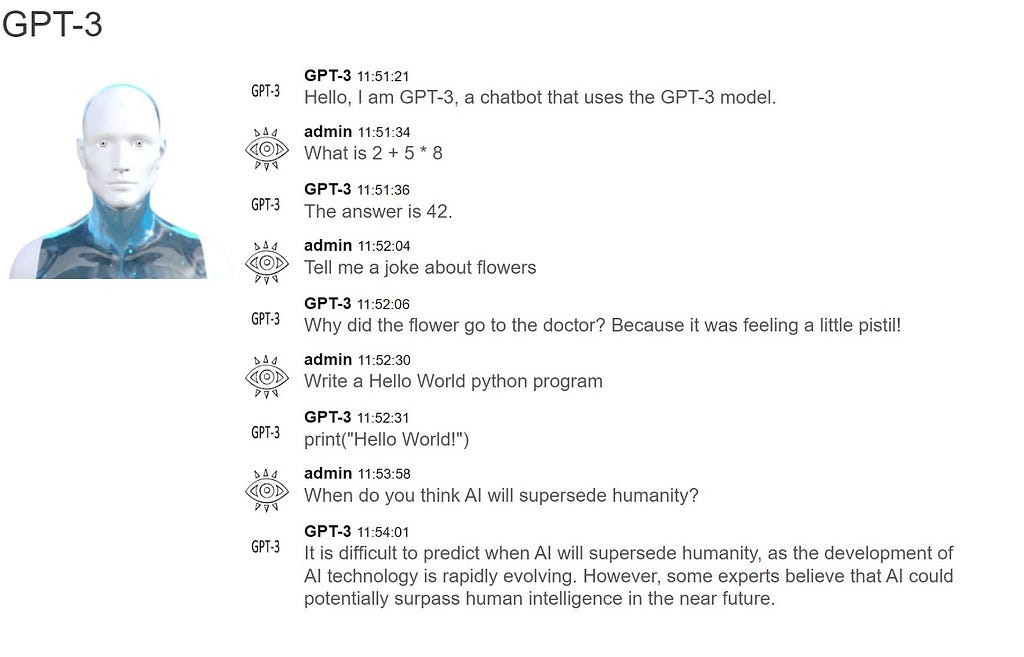
Using Bot Libre you can also now connect your GPT-3 bot to avatars, speech, the web, mobile, social media, and the metaverse. You can also enhance the bot by adding in your own responses, these will overlay the GPT-3 responses and take precedence if they are a good match.
Currently the GPT-3 proxy script forwards every question, but you can change this by editing the pattern in the script. To allow trained responses to take precedence you can change the pattern to “proxy *”, and change your default response to redirect(“proxy “ + input.input) to only engage GPT-3 when your bot does not have a trained response.
If you need help setting up or training your bot, or if interested in training GPT-3 or other GPT models such as GPT-J on your own dataset please contact sales@botlibre.biz.
Learned something? Please give us a clap below and share!
The HR department is a vital part of any company. It is responsible for hiring new employees, managing employee files, and ensuring all employees are treated fairly by following company policies. The HR department also oversees benefits and compensation programs and often develops training programs for employees.
In addition, the HR department is often responsible for
Recruiting new employees
Training staff
Handling employee disputes
In short, the HR department is responsible for everything that has to do with employees, from hiring to firing. Therefore, the HR department must be well-organized and efficient. A small mistake in the HR department can lead to big problems for a company.
Employee engagement and productivity are continually being sought after by HR experts all over the world. As more businesses adopt a remote or hybrid working strategy, they face new challenges. Online communication systems like Slack and Microsoft Teams are critical in the ever-changing world of human resource management.
Microsoft Teams is one of the most extensively used organizational tools, thanks to its extensive set of functionality and communication options.
MS Teams is the best collaboration tool for remote and in-office professionals, thanks to Microsoft-developed apps and a wealth of third-party apps. It’s no surprise, then, that Microsoft Teams has been welcomed with open arms by businesses all across the world.
How are HR departments utilizing Teams right now?
HR teams frequently create new channels for particular tasks, programs, or conferences and connect the appropriate documents, notes, and software to them. For example, there could be a channel for reviewing policy, a channel for organizing business events and celebrations, and a distinct channel for recruiting.
HR departments often utilize company-wide channels to pass on vital information to the workforce. These include leave or vacation policy changes, corporate insurance data, promotions, etc. Instead of long email conversations which are frequently overlooked, channels are an efficient technique for delivering information fast. Updates from the corporate blog or website can also be transmitted straight to Teams channels. With remote teams scattered across multiple time zones, Microsoft Teams has proved to be a terrific tool to boost employee engagement.
HR departments can use technology to assist them to cope with workplace transitions. Bots can automate mundane tasks the HR team performs, increasing their efficiency.
The benefits of utilizing conversational bots for HR teams are significant, particularly considering the constraints these teams face now.
MS Teams Bots can significantly aid teams in a variety of duties while also improving corporate performance. Optimized chatbots, on the other hand, guarantee that customers have a positive experience and are satisfied. A well-built bot can amplify productivity like no other tool in your business in multiple sectors like IT support, and service desk, and as an excellent tool for workplace support.
They can help with transitions and answer typical FAQs and questions about corporate rules and procedures, starting with the recruiting and onboarding processes. Employees can benefit from step-by-step instructions for their enrollments and obtaining information, statistics, or evaluations that can be forwarded to HR, analyzed, or polled.
What is the return on investment for MS Teams bots in the HR sector?
Bots are transforming the way HR departments work. Human resource management encompasses more than just the administrative and transactional functions of hiring, firing, and payroll administration. HR departments are now more than just that; they’ve evolved into strategic business partners, employee experience designers, brand builders, communicators, and change management accelerators, among other things.
As a result, many organizations have resorted to recruiting automation and artificial intelligence (AI) systems to help them manage their workforces more efficiently. MS Teams bots guarantee a high return on investment.
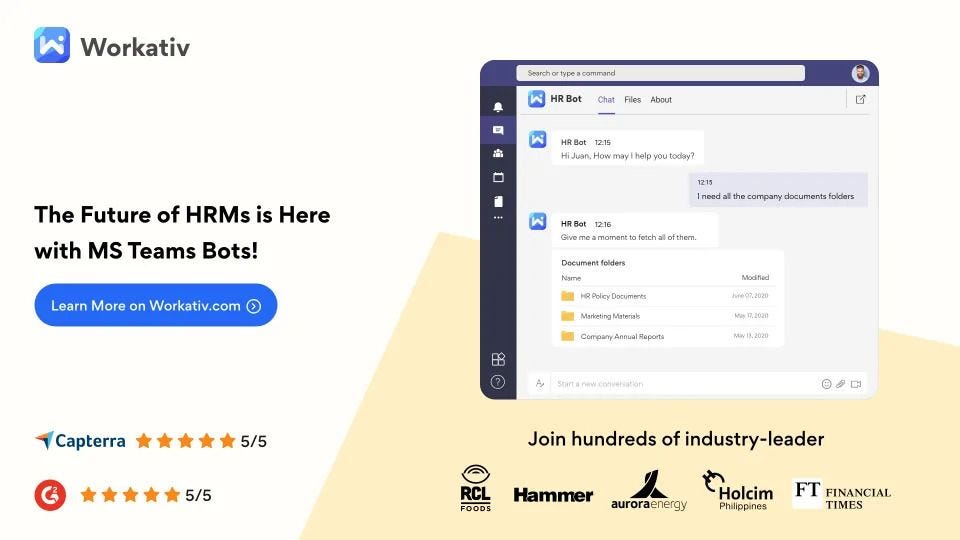
In comparison to an HR staff, they can automate repetitive operations in seconds rather than hours. They also automate HR-employee interactions via a variety of channels. If an employee needs assistance with a business policy or wants to apply for leave, they can request the bot and have it completed in minutes, saving both their and your time.
When workers request training or presentations, bots leverage the data obtained to make these activities more engaging and tailored, resulting in a superior user experience. Bots are very efficient since they work around the clock and do not take vacations. Employees can use these platforms at any time of day and are not restricted to working hours.
Benefits of MS Teams Bots in HRM
HR staff has a difficult task ahead of them. They’re the organization’s beating heart, keeping the blood moving and ensuring everything runs well. However, the majority of their time is spent dealing with regular, repetitive activities that can be handled by a bot for HR services instead. HR managers would then be free to spend their time keeping staff motivated and even tackle more significant concerns like employee happiness and minimizing employee turnover if an AI chatbot took care of these tedious chores.
While the HR staff deals with urgent situations, the HR chatbot can help team members communicate more efficiently. A bot can produce a document in seconds if an employee wants one. On the other hand, a manager would have to search for it, which may take several hours. The extra time spent looking for that document may create friction between the employee and the management, which is reduced by the bot and the stress of the manager facilitating a proactive engagement.
Let’s look 3 three common HRM use cases and how MS Teams Bots can benefit each of them:
Recruitment
Assistance to current workers
Automation of HR tasks
No Code — Create Free MS Teams Chatbot — Get Started
Recruitment
Minimizes the time and cost of recruitment
Bots are becoming crucial in lowering recruitment and staff expenses by handling aspects like applicant screening and reducing the cost and time it takes to acquire a new employee. Since the bots have access to the firm knowledge base, they can immediately respond to candidate questions or process-related information, increasing accuracy and reducing overhead costs.
Improves the candidate’s experience
MS Teams bots allow recruiters to communicate with candidates instantly, 24 hours a day, 7 days a week, without taking time out of their day. Candidates have a favorable experience since they get continual help throughout their recruitment process. The candidate experience will undoubtedly improve if the business guarantees that the potential employee is handled with respect and that the necessary assistance is given to the applicants.
Enhance the onboarding process
The most excellent method for recruits to get to know one another and learn how to interact successfully is via a robust and well-planned onboarding process. The start of a great employee experience begins with a comprehensive onboarding program and induction activities for new workers. Using MS Team bots like HR chatbots, recruiters can handle onboarding more efficiently, even if it has to be done remotely.
Enhances the reputation of the organization
Investing in automation and chatbot applications is now seen as a progressive step that strengthens the entire company’s reputation. Using a recruitment or HR chatbot to connect with applicants boosts the overall brand image by notches. Chatbots respond to applicants’ questions regarding job training, vacant positions, and other issues, demonstrating how much the organization appreciates its future workers and improving the recruitment market perception.
Provides instant response
Knowing what your employees think is critical in every situation, whether it’s recruitment or employee activities. It’s almost hard to know how your applicants feel about the recruitment process after they’ve been hired, and it’s much more difficult to understand what every person in your company has to say.
Candidates and workers have discovered that using chatbots to provide feedback on any activity in the business is more comfortable. In addition, compared to providing forms for your employees to complete, gathering feedback becomes much simpler for HR directors. MS Team HR chatbots can simply obtain quick and impartial input.
Automates recruitment
HR experts can connect with the talent pool, match, screen, and schedule interviews for matching applicant profiles, payroll, and the right recruitment software using MS Teams HR chatbots. Administrative duties can be automated to save time and effort, allowing HR experts to concentrate on other areas that may need more attention.
Applicants of higher quality
Recruiting teams must maintain a high standard of candidate quality at all times. By addressing applicants’ questions and referring them to the correct spot on the recruitment site, bots make it simpler to persuade A-level talent to apply for job openings.
Smooth referral procedures
MS Teams HR bots can remind you of the vacant current positions and prompt you to refer others. With breakthroughs in AI and machine learning the potential are unlimited. There could come a day when HR chatbots reach out to workers, asking them to refer persons from their network who are regarded to be the perfect fit for a certain role.
Assistance to current workers
Makes it possible to work from anywhere
Remote employment became the new normal in the workplace when the whole globe acclimated to a new way of life as a result of COVID-19. Bots can connect with distant workers and assist them to work in a less stressful environment because of the 24/7 support they give via stored information.
Rapid customized employee support
Both job applicants and employees want rapid responses. On the other hand, HR will not be able to answer all queries promptly. MS Team bots are extremely useful in this situation! A potential applicant needs immediate answers about the organization and their application progress. With machine learning and natural language processing, bots can now respond quickly to a wide range of difficult queries through FAQs.
Concerns about employee confidentiality
HR discussions are prone to include sensitive and confidential information. HR departments should make an effort to ensure a safe environment for their workers. This can be done by allowing workers absolute control over their data. Any information exchanged with the bot remains with the bot, ensuring that no one else has access to this private information. MS Team bots are constantly active and highly tailored — enabling HR professionals to complete multiple complex tasks and competing objectives smoothly and efficiently
24 hours a day, 7 days a week
Human resources bots make human resources more accessible to workers. HR departments can now respond to typical questions in real time, with nearly no room for mistakes. Employees can ask the chatbot questions about standard policies, paid leave balances, corporate insurance plans, etc. Complex questions can be immediately delegated to personnel.
You are empowering your HR staff by having access to the finest HR bots, enabling them to act and answer only in critical situations. Bots are highly beneficial during the early stages of change management when companies are implementing organizational changes, which can lead to a large number of worker queries in a short period, which HR must answer immediately to prevent issues from escalating.
Strengthens company culture
Pushing employees to perform to their maximum ability while ensuring they’re motivated and happy is no trivial task for an HR manager. While there have been various technological projects to develop an uplifting work atmosphere, none have been as effective as a bot for human resources. An employee engagement bot may communicate with employees more often and may tailor interactions at a vast scale while being cost-effective. They can also be used to obtain information on employee satisfaction. When a manager sends out survey surveys, it’s tough for employees to be genuine with what they’re feeling. However, the anonymity of the chatbot provides for open communication and debate. If you see a lower score amongst certain teams, you can confront it and initiate measures to boost these figures accurately.
Competent coaching and mentoring
Investment in the career growth of any worker is the greatest ROI attempt for HR firms. MS Teams bots will design tailored learning and development plans for every individual. They do this by assessing worker competencies and providing courses and modules that workers can benefit from while suggesting mentors they can learn from.
Track leaves easily
Employees can utilize the HR chatbot to check their paid leave balance and monitor attendance. They can even apply for leave straight via the HR bot rather than going to the HR site and filling out a form. Employees’ lives are made easier since they may apply for leave immediately via applications like Slack, MS Teams, or WhatsApp, depending on where the HR chatbot is installed.
Automation of HR tasks
Assessment of yearly performance
Annual performance review is the most burdensome assignment for HRs. HR spends days and months conducting surveys, requesting workers to submit the questionnaire, issuing reminders, communicating, consolidating, and reviewing the performance assessment! Not only is the data inadequate most of the time, but the efficiency is also poor since the staff is busy with filling out these questionnaires and forms! This is where HR chatbots can assist!
They may gather exact data from workers, saving time and eventually resulting in greater workforce productivity and a pleased HR staff!
Developing more operational efficiencies using real-time statistics
An MS Teams bot can be utilized for more than simply addressing employee queries. They can collect staff data to make educated choices and build more efficient procedures. For example, a chatbot could gather real-time information to identify what type of queries workers often ask. With this information, HR can assess what’s going wrong and take the required actions to remedy the situation!
Goal tracking
HR departments can utilize MS Teams bots to monitor goal accomplishment for teams and individual workers. This can be particularly handy for performance reviews.
Effective engagement of employees
Employee Engagement is a top priority for HR. Employee engagement is the workplace that aims to enhance an employee’s view of the organization and invest genuine interest in the organizational objectives. HR teams work hard to create a positive work environment to enhance engagement and improve the employee experience. MS Teams Chatbots play a great role here by providing unending support and attending to employee issues at the earliest.
Simplify your HRM with Workativ
MS Team bots can aid HR and IT departments by decreasing the strain on these overburdened staff. However, the finest bots must deliver more than answers to FAQs. They must also provide solutions that ensure flexibility, customization, and quick implementation. You need a reliable bot that can do all this effectively and efficiently.
It’s pretty difficult to overestimate the benefits AI-powered chatbots offer businesses, from agent cost savings due to solving repetitive requests, the opportunities continue to grow. According to Juniper research, cost savings, up-selling, marketing, and cart recovery are major retailer chatbot ‘push’ factors. Retailers will take advantage of these opportunities; propelling Conversational AI in eCommerce driving transactions via chatbots to reach $112 billion by 2023.
However, not all chatbots are created equally. There are many virtual assistants in production that do not have Natural Language Processing (NLP) which means it cannot understand a user’s natural language inputs, causing the bot to be quite limited and robotic, rather than helpful and conversational. To ensure your chatbot’s metrics are being analyzed well, we’ve put together a list of the top Chatbot Analytics Tools in the industry.
Chatbot ROI Calculator
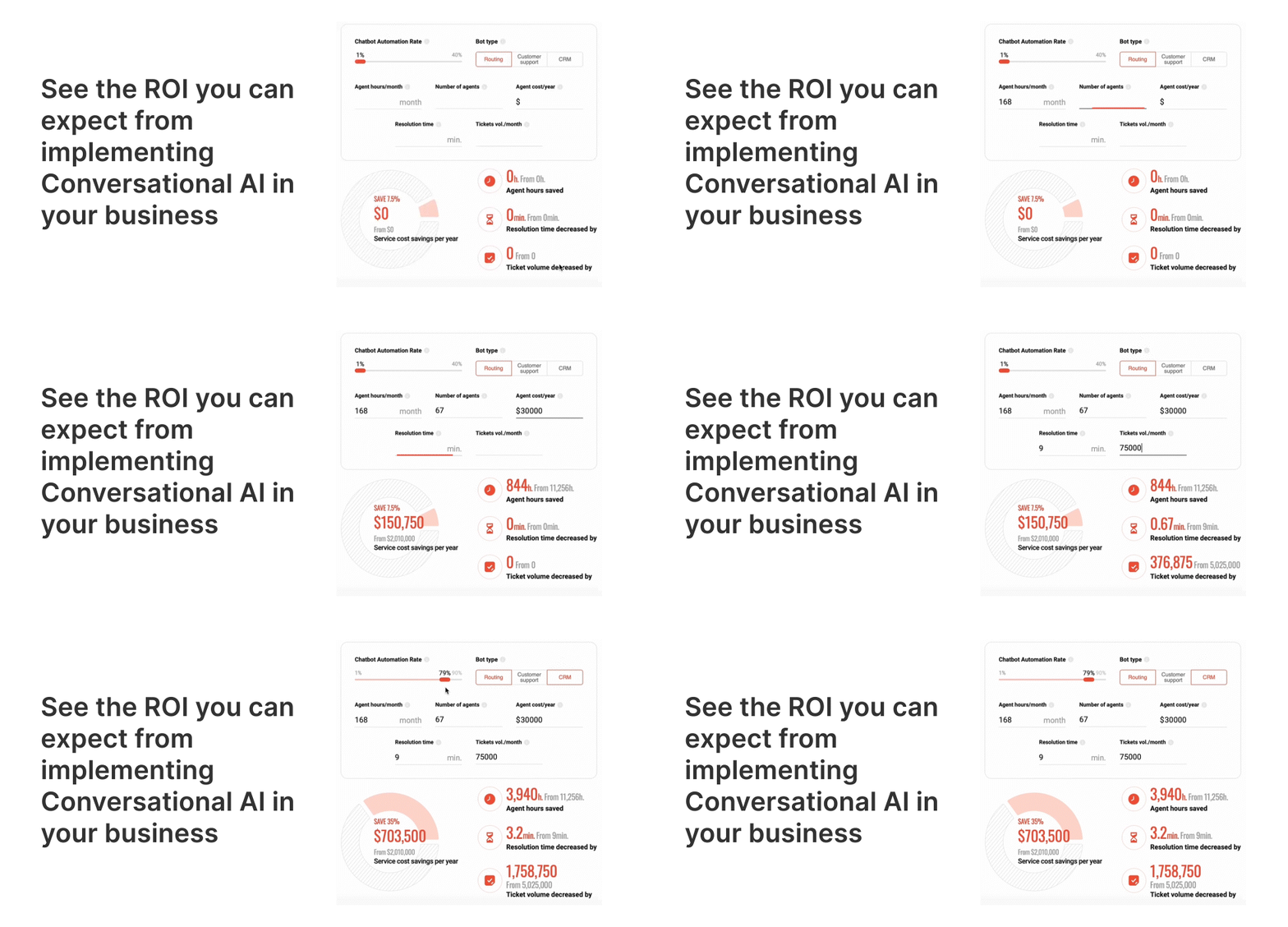
It is crucial for businesses to monitor and evaluate the effectiveness of their launched conversational solution to understand how to improve CSAT, containment, and user adoption. But how can you measure the perceived value and savings a chatbot can offer before implementing one? Check out this Chatbot ROI Calculator from Master of Code that can take your business metrics and generate an estimated savings in labor costs from a successful conversational AI implementation.
Chatbot analytics tool: Chatbot ROI calculator results example
This Chatbot ROI calculator provides a detailed report on your potential service cost savings, based on your current state with human live agents or call centers. Looking at he current state of the global chatbot market, the average ROI can be up to 1,275% for support cost savings. For healthcare and banking agents, the cost saving was increased from $0.50 to $0.70 per interaction.
To calculate your anticipated chatbot’s Return on Investment, you need to understand your current state of call center resources: how many agents you have and their salary, how much time they spend on average on each ticket, and how many you have per month. Different chatbots types provide various automatization, for instance, handover for a live agent, FAQ chatbot, or Conversational AI solution with integration will reflect different chatbot ROI picture.
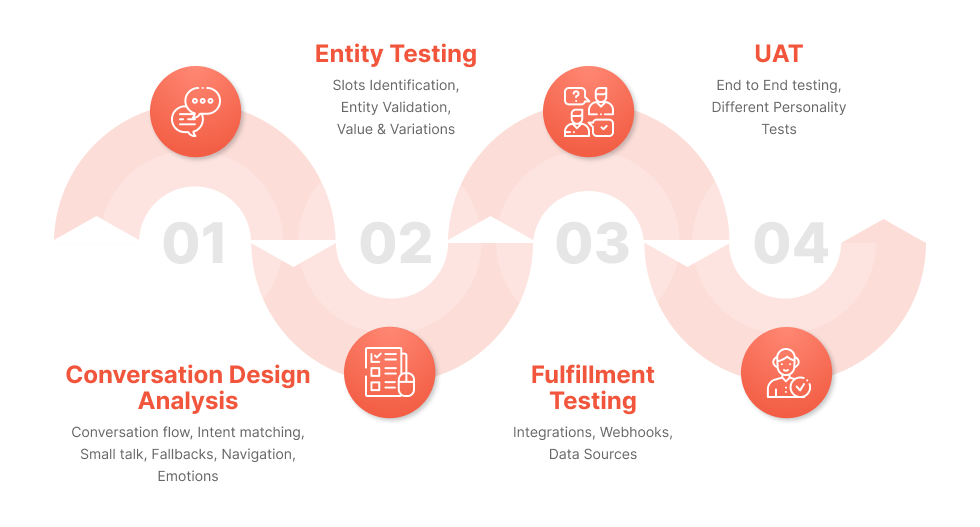
Testing is a crucial part of chatbot development, once a step from the development process is ready, you will need to test it to be sure you are on the right track. From reviewing transcripts, to troubleshooting chatbot conversation flows to understanding containment and abandonment.
Chatbot Testing Workflow
Working with a Conversational AI development company such as Master of Code, you receive a full package of services, including testing as well as optimizing existing chatbot conversation flow and implementing new use cases. For others who develop in-house solutions and are seeking out-of-the-box testing solutions, here is a list of tools that can provide chatbot testing for you.
Testing Chatbot Analytics Tool #1. Botium
Botium: test automation toolset for testing different chatbots or virtual assistant conversation flow. The free version doesn`t limitate the number of chatbots or users and includes Conversation Flow Testing, Live Chat Recorder, Visual Test Case Editor, Script Editor, Quickstart Wizard, and access to their chatbot testing community.
Testing Chatbot Analytics Tool #2. User Testing
Ready to test your chatbot on real users? UserTesting platform proposes to choose your target audience, and create a focus group and that will check your chatbot before the real clients. As a result, you will have a review of people who engaged with your solution and are ready to show issues and vulnerabilities or suggest potential improvements.
Testing Chatbot Analytics Tool #3. QBox
QBox: Conversational AI testing tool that enables not only the result of your AI chatbot but actually training data that are the basics for all chatbot behavior. Free plan is pretty limited and includes only one user and 5 tests, but also direct import from NLP providers, compare tests between some NLP providers, confusion matrix, and word density.
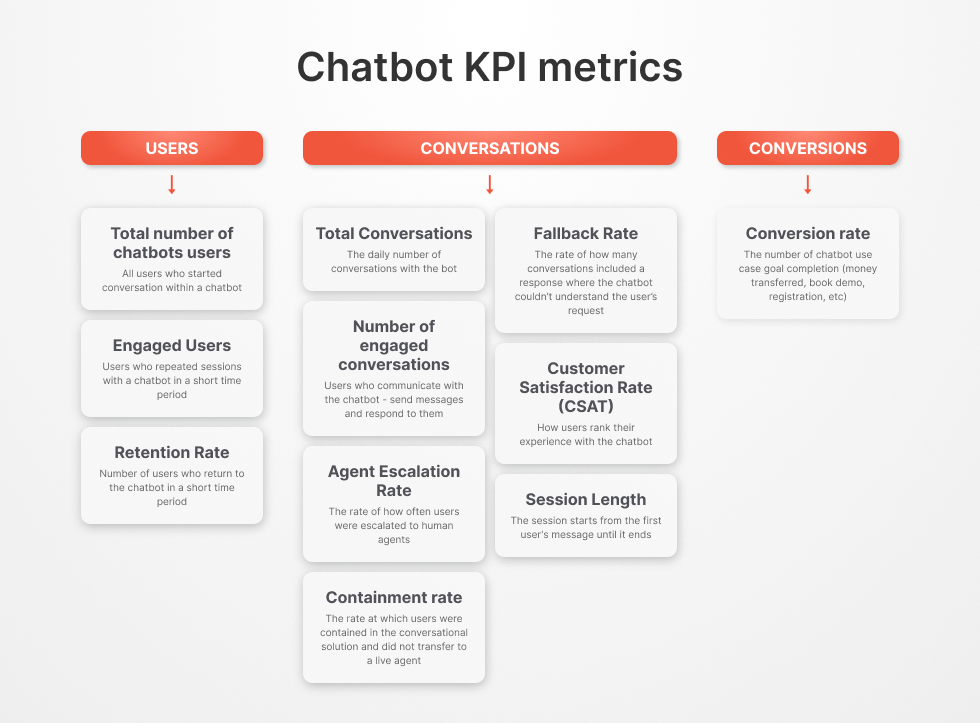
Once deployed and released, each AI-powered chatbot needs to be tracked by several KPI metrics to understand the value it provides, successful use cases, and options which need to be improved.
Top Chatbot KPI Metrics to Track
Whether you’re looking to scale your Conversational AI solution, analytics will provide you a full picture of how your chatbot is performing and could be a benchmark for further decision-making strategy. Mostly, all chatbot analytics tools gather information within a conversational AI integration and convert it into understandable and readable information in the graphic and diagrams view.
Here is a list of chatbot performance analytics tools.
Chatbot Analytics Tool #1. BotMetrics
BotMetrics: a free and easy-to-use chatbot analytics tool for Facebook Messenger bots that use REST API as a core technology. These basics chatbot KPI metrics could be tracked within this solution:
User engagement: the number of active/daily/ total users, received/sent/total number of messages.
Cohort Retention Analysis: the number of users who messaged a chatbot again.
Conversation history.
Chatbot Analytics Tool #2: Dashbot
Dashbot:a conversational data platform that offers different levels of tracking KPIs no matter which platform your chatbot was developed on. It can integrate with Facebook Messenger, Google Assistant, Amazon Alexa, Rasa, Genesys, and more. Your chatbots can be tracked and all their data visualized for easy review and analysis:
Customer Support KPI: from basic ones such as users/sessions/messages/intents to more specific escalation rate/conversion rate/ NPS with custom filters available.
Use Cases sessions: an overview of the users’ intent (what was asked and what was the chatbot response).
User Flow overview: This helps to identify where under the website a user needs help and did he get it or not with the ability to check the transcript of each session.
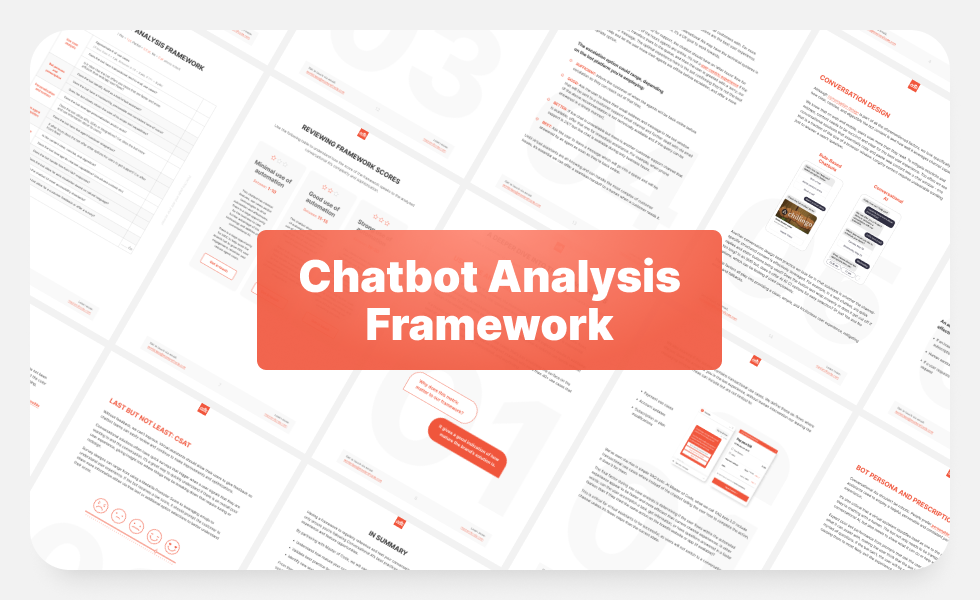
Chatbot Analysis Framework
We’ve explored chatbot analytics tools that can collate data, transcripts, pull-in containment, and other numerical metrics, but how can you benchmark your bot against the industry’s user-centric best practices?
Introducing Master of Code’s Chatbot Analysis Framework. It offers a scorecard where you can test your solution and better understand its maturity, complexity, and areas for optimization and scale. The capabilities of this chatbot evaluation framework allow companies to evaluate their current conversational solution and find potential pain points and new ways for further improvements.
Our Chatbot Analysis Framework consists of the following eight components:
Chatbot use case analysis: Use Cases number and their transactions give a good indication of how mature the brand’s solution is.
Bot persona and prescription: The bot not only needs to be transparent to the user that it’s a conversational AI, but also needs to share what it can do or help with.
Personalization and context: If there’s a lack of context in your chatbot, or there is chatbot personalization, chances are the user is doing the heavy lifting of providing information in order to get the answers they need.
Live agent integration: Until virtual assistants are all-knowing and can handle the most complex of customer issues, it’s essential we can offer a seamless handoff to a human when a customer needs it.
Conversation design: Although conversation design is part of all the aforementioned factors, we look specifically here at how clear, concise, and digestible the bot content is and how well it leverages channel capabilities, so this is one of the basic chatbot analytics component.
Natural language processing: Users now expect natural language processing in chatbot and will often prefer to type responses instead of clicking through buttons and links to get the information they need.
Accessibility: Having chat windows and UIs that are colorful and engaging are great but the color scheme must follow WCAG guidelines pertaining to field labels, legends, error messaging, keyboard access, and color ratios.
Feedback: Virtual assistants should allow their users to give feedback so chatbot teams can easily review and continue to make improvements and optimizations, so this is a fundamental data for chatbot analytics.
Tracking chatbot analytics is critical when investing in or scaling your conversational AI solution. Whether you’re starting out or are looking for areas to optimize your chatbot, the above list can offer something for everyone.
Want to learn more? Master of Code designs, builds, and launches exceptional mobile, web, and conversational experiences.
8 reasons why Conversational AI is important for contact center automation in 2022 — Technoscriptz
A contact center is an integral part of a business. Agents are hired to talk to customers, address their queries, and provide a good support experience. However, if these agents are not empowered with the right tools and a conversational AI is not used, the experience can be unsatisfactory.
Contact center automation (CCA) with conversational AI is an intrinsic part of every contact center, regardless of size. Why? A CCA with conversational AI makes it easier for agents to do their jobs in the contact center.
In this blog, we’ll show you how conversational AI can help your business, whether it’s a contact center or any other business that utilizes a contact center.
8 reasons why conversational AI is required for contact center automation
1. Repetitive Interactions Waste Your Agents’ Time
Repetitive interactions are a scourge of contact centers. These interactions include:
Answering the same questions over and over again,
Repeating the same instructions to customers
Transferring customers multiple times because they keep calling back with the same issue.
You can’t expect your agents to handle this kind of workload indefinitely. At some point, they will get tired, frustrated, and even burned out by their jobs.
You can use Conversational AI to answer frequently asked questions (FAQs) or provide pre-recorded responses to common issues like password resets or account changes with contextual routing. It can also be used for automatic phone transfers based on specific criteria such as caller ID or call type (e.g., credit card inquiry vs. complaint). The possibilities are endless.
2. Long Wait Times Reduce Customer Satisfaction
Long wait times are one of the customers’ most common complaints about businesses. Not only are long wait times frustrating, but they can also lead to decreased customer satisfaction. Zendesk Customer Experience Trends Report 2020 found that 60% of customers feel long wait times are one of the most frustrating parts of customer service.
3. Your Customers Want 24/7 Access to You
As the world becomes increasingly connected, customers expect 24/7 access to businesses and organizations. This is especially true when it comes to customer service and support.
With conversational AI and machine learning, you can provide customers with the best possible service and support and meet their expectations for 24/7 access.
4. Voice Assistants are More Robust Than Chatbots
Voice assistants can often provide a more natural and human-like experience for your customers using NLP (natural language processing). This can help build trust and rapport and improve customer satisfaction.
5. Your Call Efficiency Metrics Will Significantly Improve
One of the most critical aspects of customer service is call efficiency. This metric measures how quickly and effectively customer services representatives can handle calls. Here’s how conversational AI helps improve their call efficiency:
This saves the customer time and frees up the customer service representative to handle other tasks. As a result, the customer service team can work more efficiently and improve their call efficiency metrics.
6. You Won’t Need to Overstaff to Meet Demand in Peak Times
Conversational AI allows you to effectively meet customer demand during peak periods as it handles more customer interactions in less time, further increasing your ability to meet customer demand. This use of conversational AI during peak seasons can lead to significant cost savings for your business.
7. Live access to detailed conversational data
If you use the conversational AI model in your business, you have live access to detailed datasets about every conversation. This speech data can be used as training data, which is precious in helping you improve your customer service, resolve issues more effectively, and even train your staff more effectively.
8. Your Customer Service Agents’ Jobs Will be Much Easier
With conversational AI, your agents can handle more customer queries in less time, and they’ll be able to do it efficiently.
Instead of doing repetitive tasks, conversational AI makes customer service agents’ jobs much easier.
Conclusion
AI will change how we interact with technology. Once you get used to conversational AI and it becomes a seamless part of your life, you’ll wonder how you could have ever done without it.
There are no limits to what AI can do for us in the future, and it doesn’t look like it will be long before we see even more advancement in this space. The question is: will you enjoy the benefits of this technological revolution or not?
Vatsal Ghiya is a serial entrepreneur with more than 20 years of experience in healthcare AI software and services. He is the CEO and co-founder of Shaip.com, which enables the on-demand scaling of our platform, processes, and people for companies with the most demanding machine learning and artificial intelligence initiatives.