 |
submitted by /u/ADSPLTech7512 [link] [comments] |
Blog
-
Chatbot trend
-
How to maintain chatbot regression tests with minimum effort

The biggest and the most hateful challenge in software development is writing test cases and maintaining them. This is no different when it comes to chatbot development. At Botium we don’t write the regression tests, we generate them. This article shows you how we do this with the least amount of effort invested.
To reach the best coverage you have to define all possible conversations of your conversation model. To implement and maintain it manually is really time consuming and sometimes a boring task, not to mention the human mistakes which can easily happen even in the case of a pretty simple chatbot. We have implemented a Crawler tool which will help you to do it in a very simple way.
Botium Crawler concept
The Crawler detects the buttons and the quick replies and makes conversations along them. The conversation tree is traversed by a little bit customized depth first algorithm. Each time the Crawler reaches an open-ended question (which means no button or quick reply is found), then the conversation is ended, the path marked as visited and a new conversation is started from the beginning (from the ‘conversation start message’) to keep the context of the conversation safe. (The Crawler process starts the conversations with the messages which are defined in the ‘conversation start messages’ parameter.) When all paths are visited in the conversation tree, then the session is ended and you get all the possible conversations as result so you will have a full regression test. Let’s see how it works in practice in Botium Box.
Register a Crawler project
For better understanding I use a very simple banking chatbot example, which is mixed with buttons and open-ended questions.
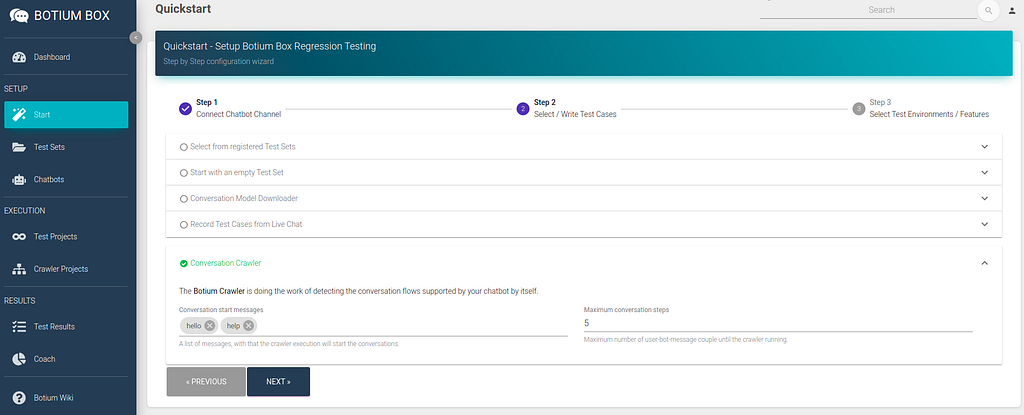
With quick start you can define a Crawler project in three simple steps. In the first step you have to choose or register a new chatbot. Then in the second step you can configure some basic settings of the conversation crawler. In the third step you can save the Crawler project or you are able to start the first Crawler session immediately.
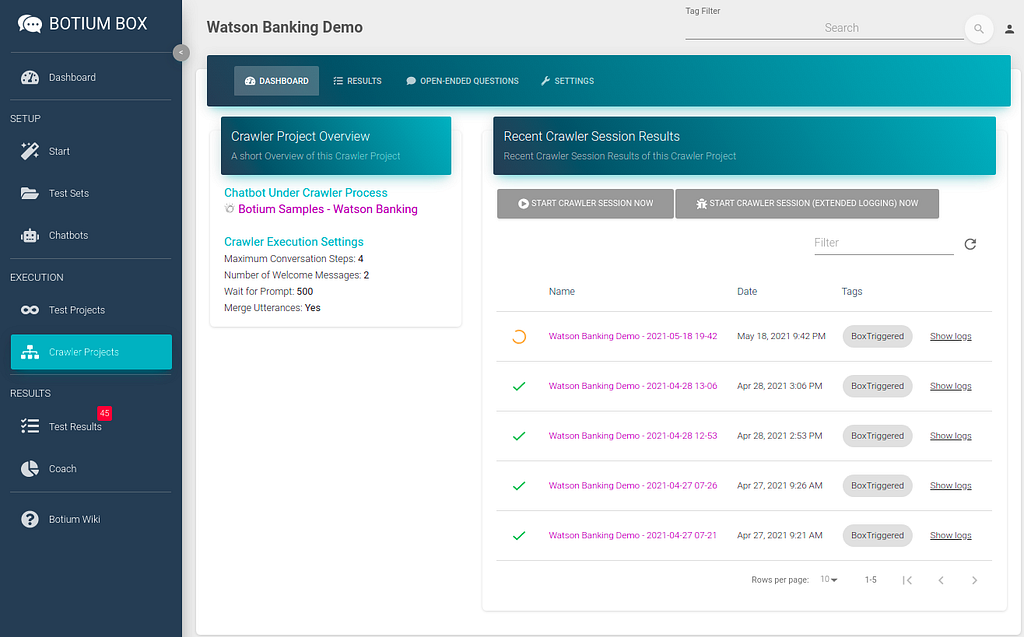
Finishing the registration you will be redirected to the dashboard of your Crawler project. Here you can see the previous Crawler sessions and the current execution settings.
Crawler session result
During a Crawler session as many parallel processes are going to be started as many ‘Conversation start messages’ are defined in the execution settings. These processes will detect all possible conversations along buttons and quick replies as it was already mentioned in the Crawler concept.
The example banking chatbot has bot initiated conversations. The Crawler is able to detect the buttons and quick replies in the welcome messages as well, so in this case we can let the ‘Conversation start messages’ field empty.
Trending Bot Articles:
2. Automated vs Live Chats: What will the Future of Customer Service Look Like?
4. Chatbot Vs. Intelligent Virtual Assistant — What’s the difference & Why Care?
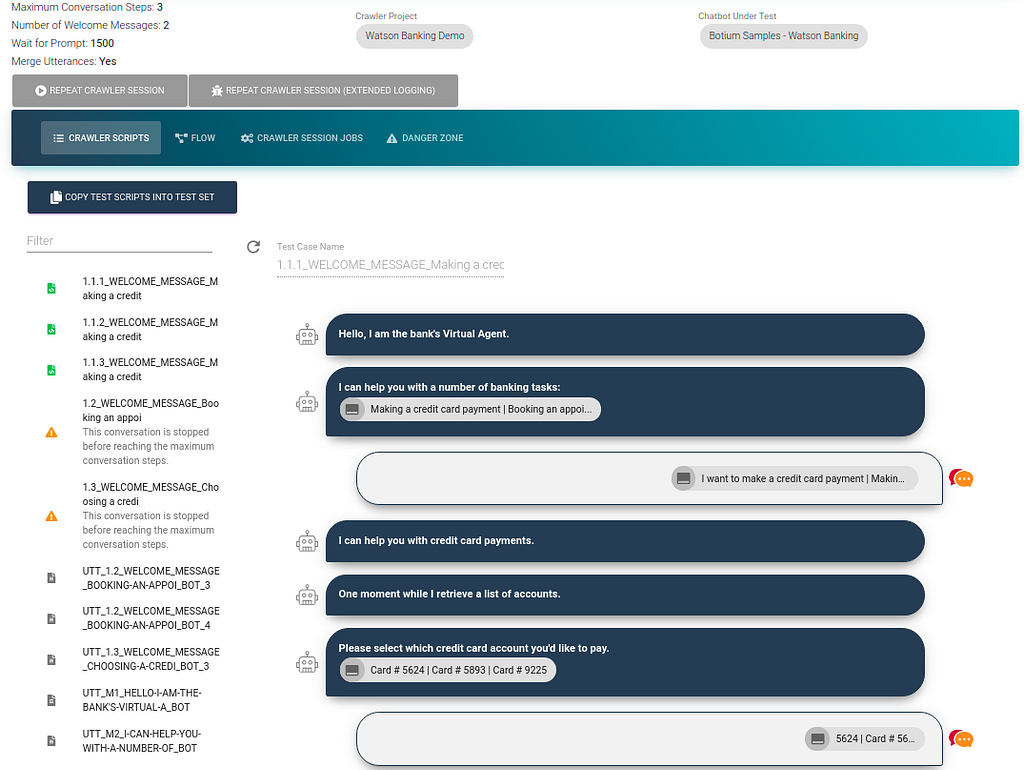
And here is the biggest value of the Crawler: the generated conversations. This chatbot is pretty small and simple, so in this case we have just five conversations generated as a result. In case of a more complex chatbot hundreds of test cases can be found, which is enormous work to do manually.
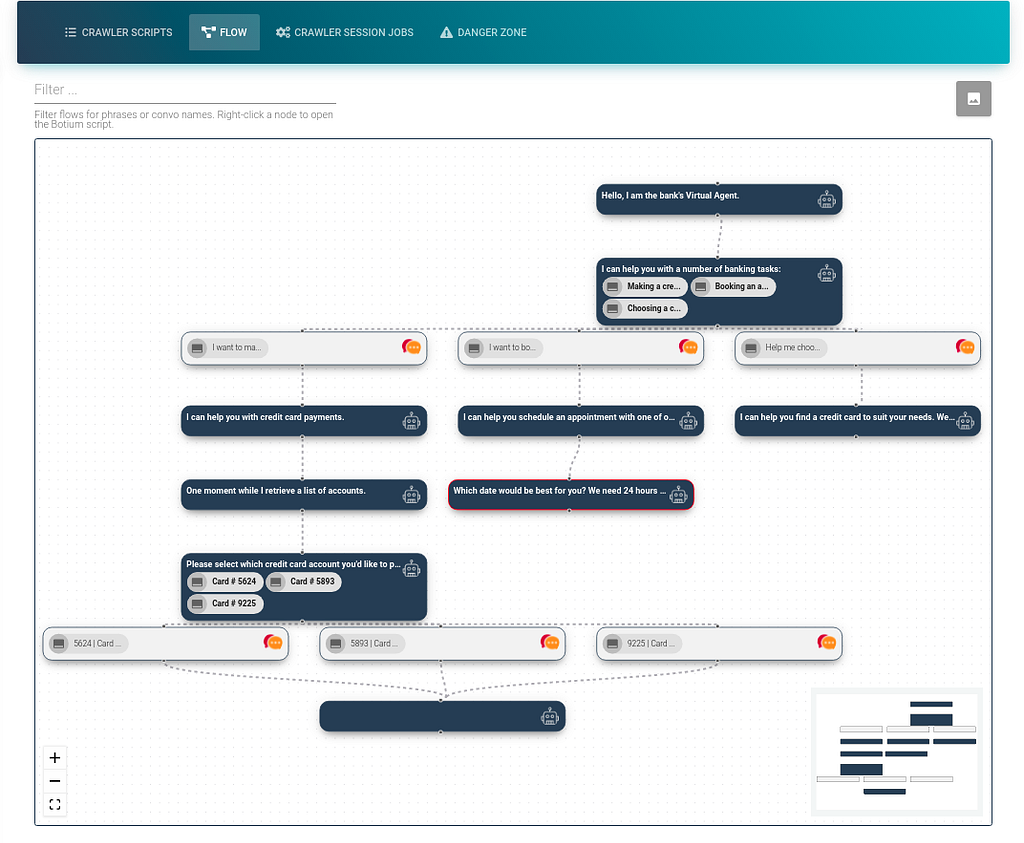
The other feature, which is as useful as the generated conversations, is the flowchart, which shows the whole detected conversation tree in visual form to get a big clear picture about your chatbot.
Open-ended questions
As you can see in the previous section at the bottom of the flowchart there are ‘open-ended questions’ like ‘Which date would be best for you? We need 24 hours …’. In this case the conversation is stopped from Crawler point of view, but with human interaction it could be continued. We have a solution for this problem as well.
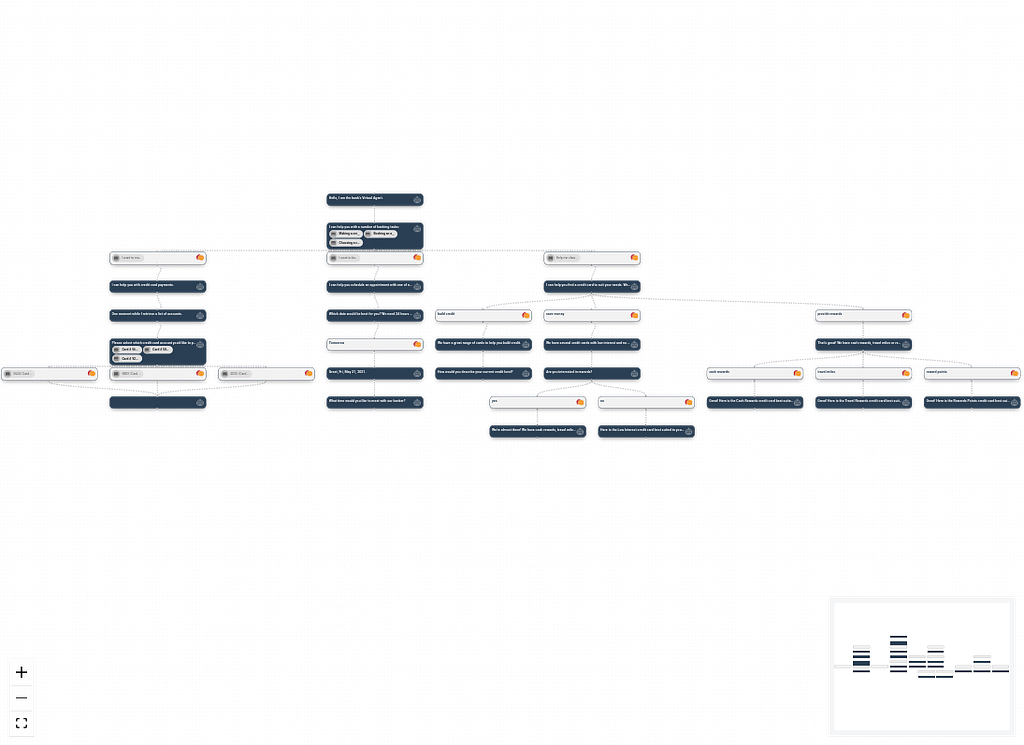
For ‘open-ended questions’ you can define multiple user answers. These responses will be recognized in the next Crawler session as if they would be buttons. After adding some user response at the end of non-finished conversations the flowchart became much bigger and the generated conversations were doubled.
How to use the generated conversations
As you can see with some minutes of easy work we generated ten conversations for this bot. In case of a fully button based bot, you have even less work, just press the start button and wait for some minutes.
But what can we do with these conversations? In other words these are test scripts. Clicking on ‘Copy Test Scripts into Test Set’ you are able to copy them into a new or an existing test set.
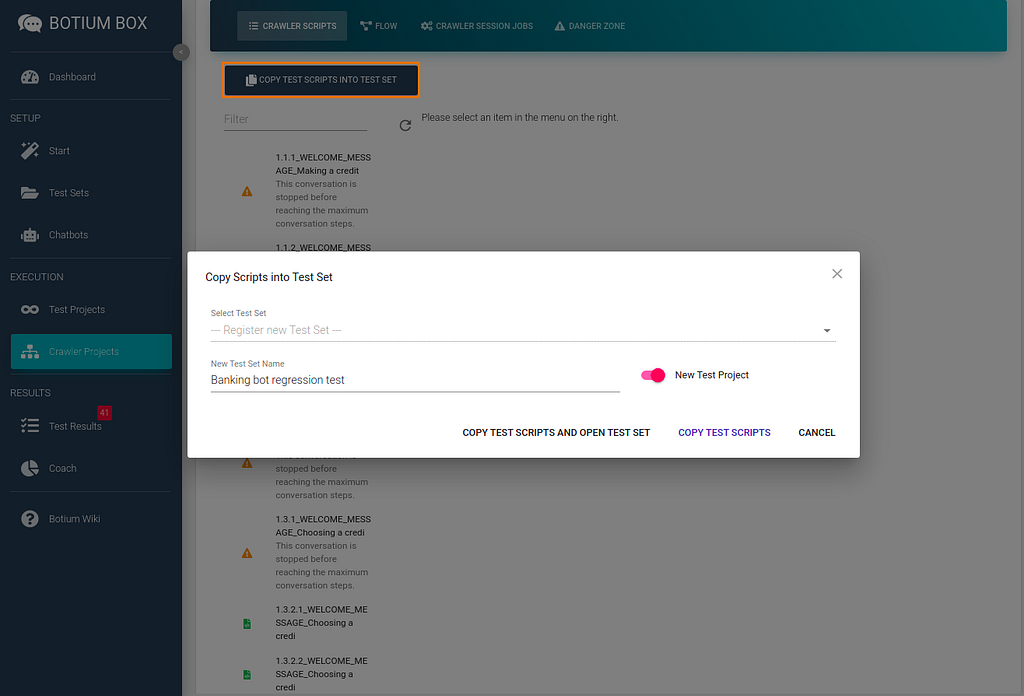
A test set is a collection of test cases which can be added to a test project. At this point the regression test with a pretty good coverage is ready for this bot.
Crawler configurations

-
Conversation start messages
These are so called conversation start messages, which the Crawler starts the conversations with. As many start messages you have, as many parallel jobs will be started. -
Maximum conversation steps
This is the depth of the conversation in the conversation flow. (One step is a user-bot message pair.) When the configured depth is reached then the conversation is stopped and marked as successfully ended. -
Number of welcome messages
There are chatbots which initiate the conversation without user interaction. In this case you have to specify how many welcome messages will be sent by the bot.
If the bot has a welcome message(s) and you don’t specify any start message, then the Crawler tries to find quick replies and buttons in the welcome message(s), and start the conversations along them. -
Wait for prompt
Many chatbots answer with multiple bot messages. In this case you can define a timeout until the Crawler has to wait for the bot messages after each simulated user message. -
Exit criteria
In case of a complex chatbot it occurs often that we want to test only a certain part of the conversation tree. In this case you can define exit criteria to exclude some part of the tree.
If the text of any quick reply/button matches any of the exit criteria, then that conversation is stopped there and marked as successfully ended conversation. -
Merge utterances
All text messages are saved as utterances. The Crawler can recognize the non-unique utterances and merge them into one utterance.
Conclusion
Botium Crawler is a very powerful tool for creating regression tests. It’s able to generate all test cases on a happy path without user interaction in case of fully button based chatbot and with minimal user interaction in case of partially button based chatbot. With the flowchart you can overview your chatbot conversation tree and detect circles.
It’s a brand new tool, so there is still a lot of room for improvements, and we already have many ideas. For example we would like to introduce different tree traversal algorithms to reach more effective performance so you will be able to choose the best fit algorithm for your chatbot. Furthermore you will be able to add RegExp as exit criteria, we are planning to make the open-ended question feature more handy, and so on.
Without proper tools you will be lost. The Crawler feature is the part of our flagship product Botium Box which helps you in your path to successful chatbot testing.Don’t forget to give us your 👏 !

How to maintain chatbot regression tests with minimum effort was originally published in Chatbots Life on Medium, where people are continuing the conversation by highlighting and responding to this story.
-
Conversation start messages
-
How technical are APIs?
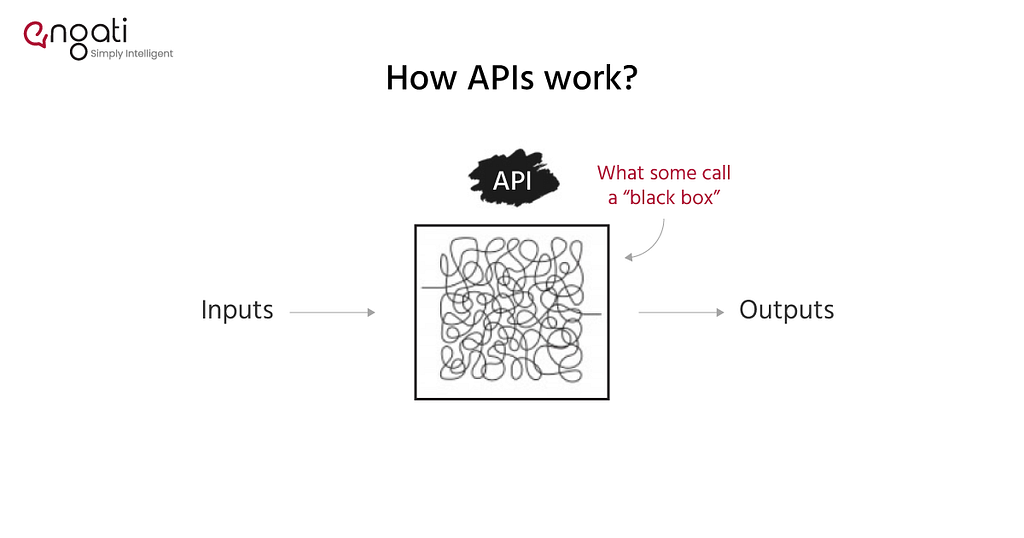
The driver for this article is not to start a debate on what things need technological prowess to understand versus the logical components of a highly scalable SaaS-based platform. We intend to help you fit a complex system into a logical block in a way that a layperson can understand.
API means Talking
Let’s take an example where you are talking to your friend. If the two of you speak in the same language, it’s convenient for one person to understand what the other is saying.

But imagine having the same discussion with a person who doesn’t speak the language. It seems tricky, right?

Replace the people in these pictures with systems. APIs can be thought of as the communication medium across the system. Let’s take an example. You have two systems; System A is Engati, and System B is a ticketing system. Say you’d like to create a ticket using System B through Engati. To achieve this, both systems need to communicate in one language; They need to follow one API standard.
Now you must be wondering if there are different languages to communicate between these systems. Of course, there are. Similar to how languages like English, French, Italian, and Hindi exist, there are multiple ways to communicate, like HTTP REST, SOAP, GraphQL, Sockets, etc. And just like English is a language that most people try to talk to communicate globally, systems often tend to support REST API-based communication (then again, there is always a group of people who don’t like to speak English)!
Trending Bot Articles:
2. Automated vs Live Chats: What will the Future of Customer Service Look Like?
4. Chatbot Vs. Intelligent Virtual Assistant — What’s the difference & Why Care?
What is a REST API?
Just like how every language has grammar, syntaxes, and dos and don’ts, communication between systems has its own set of rules. Let’s look at the details of the parts of speech/grammar equivalence for a REST API.
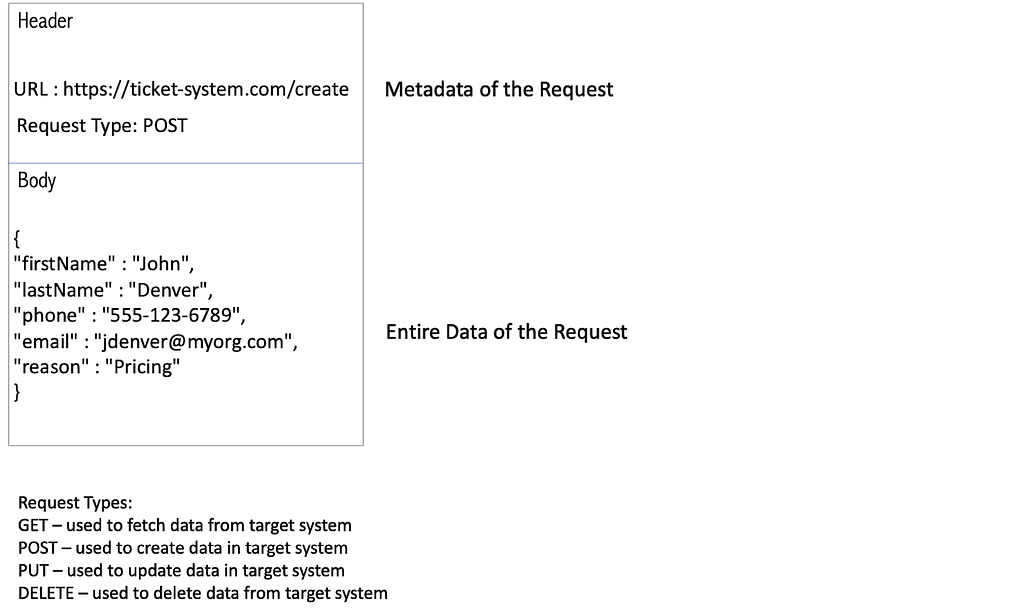
Going back to our example of Engati attempting to create a ticket in the ticketing system, that is a create operation. Hence Engati will have to invoke a REST API in the ticketing system. To invoke the API, you would need to know the parts of speech/grammar equivalence, i.e., the URL, Parameters, Request Type (which ideally should be POST), Request Body.
So a logical diagram would look like this:
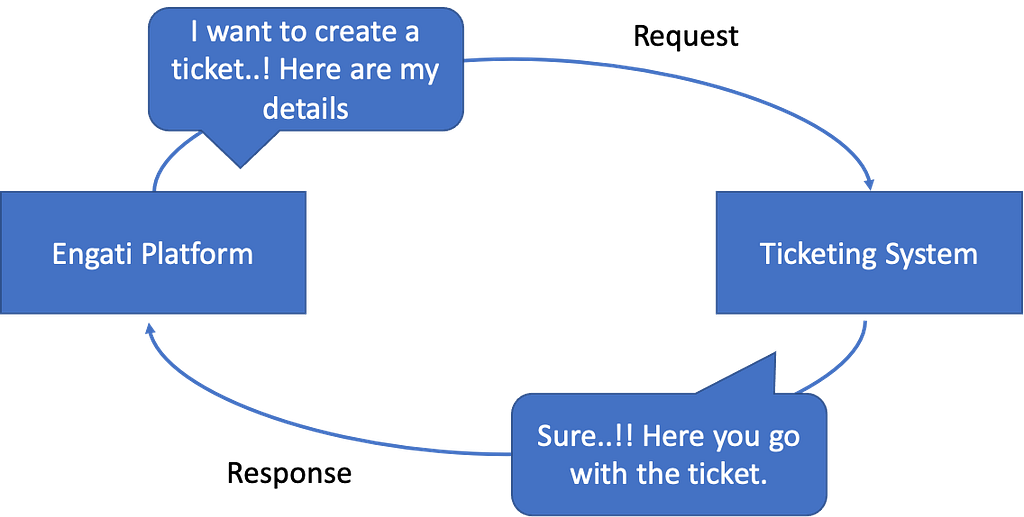
Similar to how you use a language dictionary to understand the words of the language, we need to look at the documentation of a system to understand the request and the response formats. What details will be sent and what will be received are more specific to each system that we talk to.
The next time you are looking for an integration between two systems, remember that APIs are just two people (systems) talking to each other under all the technical layers.
Engati’s extensive documentation page can help you navigate through APIs to create extensive functionality around the platform.
This article was originally published in Engati blogs.
Don’t forget to give us your 👏 !
How technical are APIs? was originally published in Chatbots Life on Medium, where people are continuing the conversation by highlighting and responding to this story.
-
Building a Weather Bot using Bot Framework Composer- Part 2

The first part of the tutorial can be found here — https://chatbotslife.com/building-a-weather-bot-with-bot-framework-composer-fa62b7cc9623
A dialog contains one or more triggers. Each trigger consists of one or more actions which are the set of instructions that the bot will execute. Dialogs can also call other dialogs and can pass values back and forth between them.
In this tutorial, you learn how to:
- Add dialogs to a basic bot.
- Run the bot locally and test it.
Prerequisites
- Completion of the tutorial Tutorial: Create and test a bot
- Knowledge about dialogs in Composer
What are you building?
The main function of the bot is to report current weather conditions.
To do this, you will create a dialog that:
- Prompts the user to enter a postal code to use as a location for weather lookup.
- Calls an external API to retrieve the weather data for the specified postal code.
Create a new dialog
- Start Composer.
- Select the weather_bot bot project from the Recent bot list on the homepage.
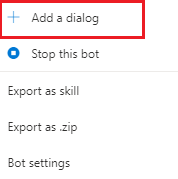
- Select the three dots next your weather_bot bot project. Then select + Add a dialog.
- In the pop-up window, enter the following:
- Name: getWeather
- Description: Get the current weather conditions.

- Select OK to create the dialog.
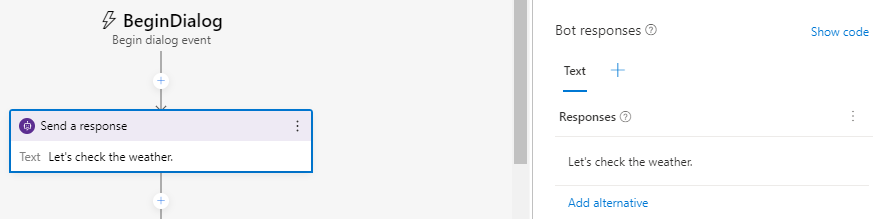
- Now select the + button under the BeginDialog dialog event in the center of the authoring canvas. Select Send a response.
- On the right in the response editor, enter the following:
- Bot responseCopy
- Let’s check the weather.
- We will add more functionality later, like retrieving the weather forecast, but first we need to connect the getWeather dialog to the bot with a trigger.
Trending Bot Articles:
2. Automated vs Live Chats: What will the Future of Customer Service Look Like?
4. Chatbot Vs. Intelligent Virtual Assistant — What’s the difference & Why Care?
Connect the new dialog
You can break down a conversation flow into different dialogs and then connect them. The following steps explain how to connect the newly created getWeather dialog to the main dialog.
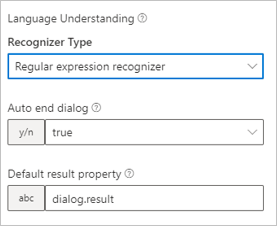
- Select the weather_bot dialog. Then go over to the right and change the Recognizer Type to Regular expression recognizer.
- Now select the three dots next to the weather_bot dialog on the left and select + Add new trigger.

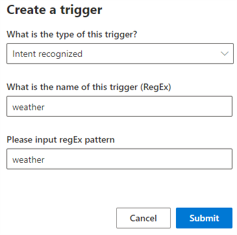
- In the Create a trigger pop-up window, enter the following information:
- In both What is the name of this trigger (RegEx) and Please input regex pattern text boxes, enter weather.
- Select Submit.
- Note
- This tells the bot to look for the word weather anywhere in an incoming message. Regular expression patterns are generally much more complicated, but this is adequate for the purpose of this example.
- In the center of the authoring canvas, under the weather Intent recognized trigger, select the + button.
- Hover over Dialog management and then select Begin a new dialog.
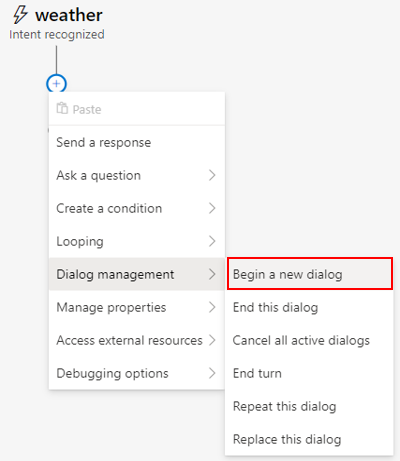
- On the right, under Dialog name, select getWeather. Now your weather bot is connected to the weather trigger.
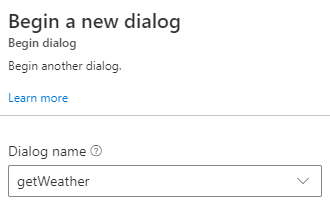
You can now test your bot, and the trigger and dialog you added to it.
Test the bot
- Go to the top right of Composer and select Start bot. It may take a few moments for your bot to start.
- Note
- If the bot is still running from the previous tutorial, you can select Restart bot. This will update the bot runtime app with all the new content and settings.
- The Local bot runtime manager will open. Select Open Web Chat. The Web Chat pane on the right will appear.
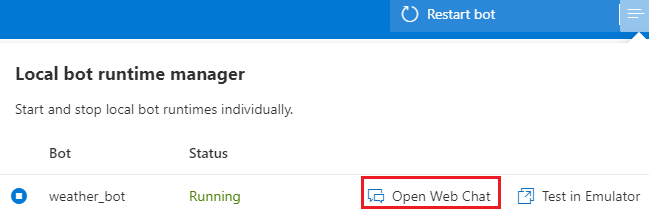
- Now test some different phrases. Notice that the bot will send the message in the getWeather dialog if the word weather is in your response. Otherwise the bot will send the message in the Unknown intent trigger.
Don’t forget to give us your 👏 !
Building a Weather Bot using Bot Framework Composer- Part 2 was originally published in Chatbots Life on Medium, where people are continuing the conversation by highlighting and responding to this story.
-
The Winning Combination of Humans and Bots for a Seamless Customer Experience

AI has been revolutionizing the face of customer service globally- more so during the pandemic- with AI-powered chatbots and other virtual agents taking the center stage. An increasing need to offer streamlined end-to-end customer experience is the primary reason why more and more firms are aggressively investing in modern technology to improve their customer support. However, traditional ways of providing customer service- which was solely based on humans- proved to be tedious both from the employee as well as from the customers’ perspectives.
While customers (especially the millennials and gen-z users) were tired of pressing buttons to avail themselves different kinds of services, service reps also considered that answering the same questions repeatedly was monotonous. This is why most organizations in recent times have decided to switch to virtual agents, which use AI, ML and other tools to frame and deliver customized responses to different types of customer requests and queries.
However, total dependence on such virtual agents is not feasible yet, and recent surveys have revealed that most customers are not quite happy with their overall experience with bots.
There are two major problems that customers face when dealing with chatbots:
1.Before making critical decisions (for example, buying a high-involvement product), customers often seek answers to complex questions from the brands, which usually involve several follow-up questions. This category of questions- which take longer periods for resolution based on the level of complexity or amount of information involved- are not handled well by bots.
The virtual agents either give up and redirect the customer to human service reps or display links that the customers can wade through to resolve their queries by themselves, something that they might have already tried. Hence, it can be inferred that bots do not have the capability to identify tasks that customers have already performed via other channels on the website, and this is one of the reasons why bots might fail in handling complex customer issues.
Trending Bot Articles:
2. Automated vs Live Chats: What will the Future of Customer Service Look Like?
4. Chatbot Vs. Intelligent Virtual Assistant — What’s the difference & Why Care?
2. Another area where virtual customer service agents are not performing adequately is in understanding human emotions accurately. We cannot ignore the fact that even the most sophisticated AI tools will not be able to replicate the complex range of human emotions. With the recent integration of sentiment analysis, companies have been able to solve this issue up to a certain extent. Conversational chatbots backed by sentiment analysis technology can determine the emotions and tonalities that are hidden behind a customer’s message (voice or text), and accordingly frame and deliver the right responses.
Nevertheless, sentiments are highly subjective in nature and vary from person to person, which often reduces the accuracy of sentiment analysis. Emotions like irony, sarcasm, humour etc. cannot be comprehended by this tool, which results in higher detachment of the customer from the organization and creates a negative impression about the brand. Case in point: Indigo’s (unintentionally) hilarious response to a dissatisfied customer’s tweet which was laden with sarcasm. (For the uninitiated, you can read about the fiasco here).
Problems like these necessitate the need for employing a combination of human and virtual customer service agents by organizations. While most of them would prefer talking to chatbots to get their issues resolved fast, customers also need to know that there are human agents available if their queries are too complex for the chatbots to resolve. There should be a logical escalation from bots to human agents. Handoff should be timed in a manner so that it occurs as soon as the bot fails to resolve the customer’s issue the second time.
The human service rep should also get a summary of all the tasks that the user has already performed when it was conversing with the chatbot so that he is updated and takes off from there. This will avoid repetition and thereby save time. Such practice will reassure the customers that the company or the brand actually cares for them. An example of an efficient chatbot would be one whose problem-solving capability is clearly specified to the customer before he starts using it. If the chatbot makes it clear to the customer right in the beginning that in case it is unable to resolve his/her issue, he/she would automatically be redirected to human service reps, it will be able to earn the customer’s trust. Therefore, through proper expectation setting, the customer is less likely to get disappointed.
Customer support is the section over which a company has more control in framing a positive brand perception in the minds of the customers. By designing efficient bots and by training service reps to communicate with users in a manner that perfectly aligns with the overall brand value proposition, the company will be able to retain happy customers and convince them to keep using its services.
Don’t forget to give us your 👏 !
The Winning Combination of Humans and Bots for a Seamless Customer Experience was originally published in Chatbots Life on Medium, where people are continuing the conversation by highlighting and responding to this story.
-
The Future of Business and Chatbots

The future of marketing is here, and it’s not just the robots that will be writing content for you. It’s artificial intelligence, or ai. You may think that this isn’t possible because robots can’t do things like emotional resonance and creativity but ai has been around for a while now. I’m talking about chatbots– computer programs designed to simulate conversation with human beings through text or speech interfaces to solve problems, answer questions, or fulfill customer requests via various digital channels like social media platforms. This article will explore how Chatbots and Ai are the future of marketing and why they’re crucial for your business.
How it all began…
The history of artificial intelligence dates back to ancient times when Greek philosopher Aristotle purportedly created the first known written dialogue for artificial intelligence. Then, in 1950, Alan Turing published a paper on computing machinery and intelligence. He proposed what is now called the ‘Turing test’ -a way of measuring how ‘intelligent’ a computer is by communicating with it over a text-based channel.

In 1991, IBM’s Deep Blue became the first computer chess-playing system to beat a reigning world champion (Garry Kasparov). Since then, several other world champions have lost against computers such as Watson, built by IBM. In addition, the appearance of artificial intelligence applications has changed our lives in ways that are hard to imagine; self-driving cars and humanoid robots are just two examples within the scope of AI.
Looking at the past, we see that artificial intelligence helps us solve complicated problems by sharing our knowledge with an ai application. In general, these applications can do more than just one thing. A good example is myJarvis (an AI-powered personal assistant), which combines chatbot technology with Google Assistant to become a powerful virtual companion for anyone who needs help organizing their work and life. With MyJarvis, you can request information on anything from calories to currency conversions, send messages or emails, create reminders, set alarms, and access skills like language translation and local weather updates. It’s also great for business because it cuts down time spent opening multiple apps to answer questions.
Trending Bot Articles:
2. Automated vs Live Chats: What will the Future of Customer Service Look Like?
4. Chatbot Vs. Intelligent Virtual Assistant — What’s the difference & Why Care?
In the past couple of years, we’ve seen a significant shift in how businesses interact with customers. Automation tools like chatbots are becoming increasingly popular as they make our lives easier, provide solutions to problems that seem unsolvable, and free up human resources so business owners can focus on more important tasks than answering simple questions. Relying too heavily on automation can lead to feelings of anxiety or rejection when bots fail-but it’s better to get this right before your competitors do! Some naysayers claim chatbots aren’t intelligent enough to replace humans. Still, luckily new technologies like machine learning can work hand in hand with artificial intelligence to give users the perfect balance of automated systems and human interaction.

Chatbots are helpful in so many ways, and you can create one with software like ManyChat. ManyChat is a tool that makes it easy to design a chatbot for your own business. Currently, ManyChat allows you to build chatbots for Facebook Messenger and Instagram Private Message (both for business pages), and it even integrates with many other platforms.
Remember that when it comes to chatbots, they are only as good as the people who build them. But luckily, tools like ManyChat help make building chatbots easier, and with the use of ai, you can even make them smarter. Automated chatbots are a welcome addition to any business, and they come in handy by helping us filter through unnecessary information and giving us instant answers.
There are plenty of people who think that chatbots are here to stay, but others say this is just another fad. The truth probably lies somewhere in the middle-chatbots aren’t going anywhere, especially if you consider how many daily questions can be solved easily with an ai application.
Facebook’s Chatbots Index reported that over 90% of users feel “truly engaged” by bots, and this technology is only going to get more intelligent and more helpful in the future.
Artificial intelligence has been around for decades, but recently its use has exploded because businesses can see its apparent benefits. AI helps companies perform faster and be smarter with their customers’ data without wasting valuable human resources. Facebook’s Chatbots Index reported that over 90% of users feel “truly engaged” by bots, and this technology is only going to get more intelligent and more helpful in the future. Businesses have to be patient.
Undoubtedly, AI changed the world of business over the years, but let’s examine how it can work for you: Automation with ManyChat saves companies 50% time on their customer service department to focus on building relationships with their clients. Creating chatbots using ManyChat does not require any experience or complicated programming language; they’ve already helped thousands of people succeed with this technology. Automating your business gives you a clear advantage, and it allows you to serve more customers than ever before, all while getting an important task out of the way so that you can concentrate on other things.
You can get started using ManyChat to build man-made (not ai) built chatbots for free and even take my free ManyChat Foundations course at https://stellar.tips/Foundations.
Try ManyChat for yourself https://stellar.tips/ManyChat
And if you want to make your ManyChat chatbot even more innovative, you can do that by integrating ai tools like Watson Assistant and DialogFlow.
Automation is not only here to stay, but it’s going to grow even stronger in the future as AI gets smarter. Businesses of all sizes worldwide have already used ManyChat, and now they’re focusing their efforts on creating chat automation for Instagram! This opens up many new possibilities for small businesses that want to reach larger audiences without spending a fortune on marketing campaigns. In addition, automated solutions are great at doing repetitive tasks or answering simple questions like “how much does shipping cost?”
In conclusion, ai is changing the way companies do business for the better. It helps businesses get smarter, be faster and develop stronger relationships with their clients. Creating chatbots will soon become second nature to companies worldwide because it makes sense to leverage technology to become more efficient and effective than ever before. Automation will always be necessary for our quickly evolving society. Still, luckily there are ways we can use technology to make things better for everyone involved without taking away or replacing human jobs entirely. Are you ready for a bright future? Let’s build chatbots with ManyChat so that we can all lighten up our workload and get down to the business of making money!
Sources:
A Brief History of Artificial Intelligence. https://askthecandidates2012.com/a-brief-history-of-artificial-intelligence/
Fun Fact: 90% of this blog post was written by ai! Can you believe that. I used a tool called Conversion.ai to save a ton of time by using the power of Jarvis and machine learning to help write this article. Sure I needed to tweak it a bit but what a HUGE time saver. If you want to try Convesion.ai out for yourself give it a whirl for 7 days free and if you sign up you can get 10,000 credits on me! https://stellar.tips/ai
Don’t forget to give us your 👏 !
The Future of Business and Chatbots was originally published in Chatbots Life on Medium, where people are continuing the conversation by highlighting and responding to this story.
-
Can AI be your life coach?
We all know that there is always a perfect balance between things we know and things we don’t know. This balance is important to make…
-
Turn your comments into Restaurant customers with Tap The Table.

Welcome to the new world of doing business. If you are a Restaurant or an agency that works with restaurants, take note…a growing majority of customers do not want to call your business but would instead message you and interact with your restaurant online. Are you ready for this cultural shift?
Over 80% of restaurants turn to technology — like online ordering, reservation and inventory apps, and restaurant analytics to help them run their business and bring more people into the restaurant. But even if you have adopted things like QR codes on your tables to access menus or online reservations through tools like Opentable, you could still be losing out on a huge opportunity.
55% of companies that use chatbots generate more high-quality leads
This is why I am excited to share a platform built for Restaurants that want to be successful now and going into the future.
Tap the Table is an all-in-one marketing automation platform created to help restaurants grow more profitable relationships with their customers by connecting everything you think is possible and even things you didn’t know you needed.
Not only can Tap the Table help you go touch-free in your place of business, but it can help manage your messages across Facebook, Instagram, Google, WhatsApp, Telegram, even your website. And you and your staff don’t even have to be “on” all the time to answer inquiries. In addition, it can bring in new customers and build up your returning customer base. Tap The Table can even help you take back business that comes through apps like GrubHub and Postmates. These apps love to keep customer information away from you, making it impossible to control your repeat business marketing. With Tap The Table, you can have your cake and eat it too. You will be able to use 3rd party app if you would like to tap into their extensive network and marketing reach, but harness the power of QR codes and automation to snag your customers back when they order.
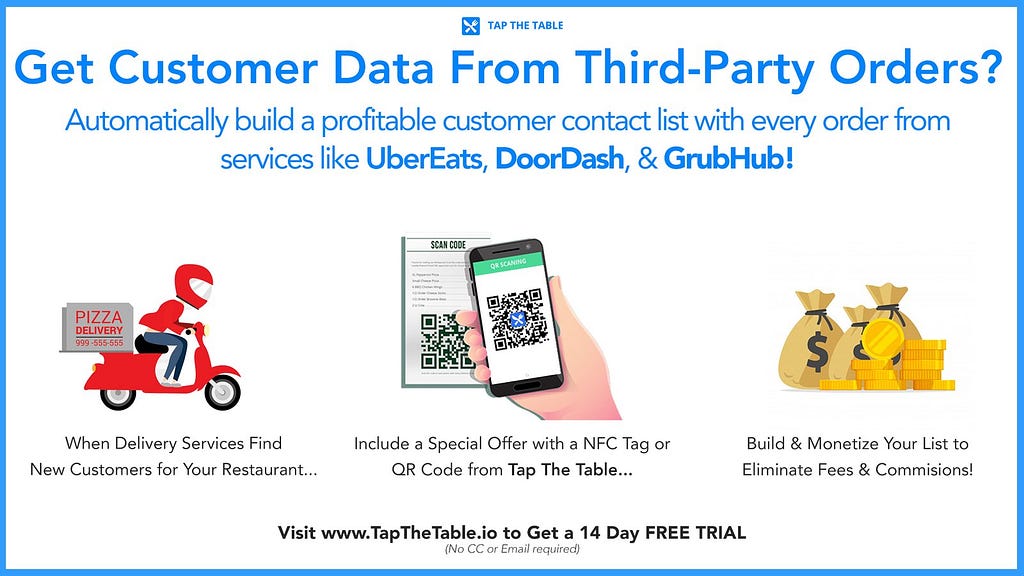
Let me break down the top features that make Tap The Table unlike any marketing and automation platform out there and help you see that this is a must-have tool to run your restaurant business and turn comments, messages, and online engagement into customers!
The main feature that makes Tap The Table so powerful is it uses chat automation and ai to answer inquiries, take orders and help leads and customers get what they need. And before you try to fight me on the use of chat automation for your business, consider this:
- There are currently more messaging app users globally than there are social media users.
- 55% of companies that use chatbots generate more high-quality leads
- People who use chat spend on average 60% more per transaction than ‘non-chatters.’
Trending Bot Articles:
2. Automated vs Live Chats: What will the Future of Customer Service Look Like?
4. Chatbot Vs. Intelligent Virtual Assistant — What’s the difference & Why Care?
That’s right, not only is the population of people who prefer chat over the phone or email dominating, but if you employ technology that compliments chat, you will make more money!
But Tap The Table is not like any other chatbot-building platform out there. Like I said before, it is built with restaurants in mind, helping to meet their specific industry needs.
Tap The Table can handle food orders for an in-store touchless experience and online ordering for carryout or pickup, depending on your business needs or wants. By using your ordering platform, you can save thousands on what you would pay 3rd party ordering apps. Studies show that 70% of consumers say they’d instead order directly from a restaurant, preferring that their money goes straight to the restaurant and not a third party. This makes the value of a native online ordering solution that much more important for restaurants. Tap the Table can even integrate or completely replace your POS system, complete with ticket printing!
Studies show that 70% of consumers say they’d instead order directly from a restaurant, preferring that their money goes straight to the restaurant and not a third party.
But you may be wondering, how do you get people into these chat channels? Tap The Table can help with that as well. By using QR codes, NFC, Social Ads, and post a comment to message tool, you will dominate your market. Not only filling seats but also get contact information from your customers quickly and effortlessly so you can follow up via email and SMS, all using Tap The Table.
Imagine this. Someone comes into your restaurant and scans a QR code or taps their phone on an NFC sticker, and all of a sudden, they are presented with a fully customizable experience for ordering, signing up for rewards, leaving reviews, and getting help with FAQs. And that is just for those people who step into your place of business.
With Tap The Table, you can also have a post on your Facebook page or a message on Instagram turn into a conversion engine. It is a platform that turns comments and messages into customers. See how adding a Tap The Table growth tool to a single post can generate business right away through chat automation. Leads comment on your Facebook post, and BOOM, the automation starts the magic of making you money!
Through an ad on these campaigns and it is like throwing gasoline on a flame. Watch your business blow up in all the right ways!
Sixty percent read reviews before going out for a meal, a habit that takes precedence over getting directions to a restaurant or looking at food photos. (Source: ReviewTrackers)
Once an order is placed, Tap The Table does not stop there. It helps your restaurant automate the process of gaining great reviews on Yelp and Tripadvisor. Twenty-five percent more people turn to consumer reviews on sites like OpenTable, Yelp, and TripAdvisor than those who rely on reviews by professional food critics. Sixty percent read reviews before going out for a meal, a habit that takes precedence over getting directions to a restaurant or looking at food photos. (Source: ReviewTrackers)
So do you have an automated and proven way to build reviews from people you KNOW have ordered from you recently? If not, Tap The Table can do that too.
Plus, Tap The Table can help automate your follow-up, so customers continue to come back, time and time again. Built-in email and SMS features make it so easy to manage your marketing.
You can find all this and more on this one platform. So there is no wonder why more and more businesses are turning to Tap The Table to make their restaurants thrive.
So if you are a restaurant or an agency that works with restaurants, you can’t afford to check out Tap The Table. Check out Tap The Table for yourself at https://app.tapthetable.io/
Use promo code “Kelly” to get 50% off the first 12 months. The offer ends July 30th, 2021, at midnight.
Don’t forget to give us your 👏 !
Turn your comments into Restaurant customers with Tap The Table. was originally published in Chatbots Life on Medium, where people are continuing the conversation by highlighting and responding to this story.
-
How can chatbots help create better online experiences?
In 2020, a significant shift in focus towards online customer experience occurred due to the pandemic. We witnessed a turning point in online experiences that brought about a whole new set of customer problems. Online customer experience is a critical aspect for every business.
Having a seamless online customer experience is one of the biggest challenges that has been highlighted by the covid-19 pandemic. Businesses have had to face the difficulty to create significant online experiences. Delivering experiences that truly connect with and resonate with customers is fundamental. Yet companies are still striving to engage with their audiences online.
Delivering a great customer experience is something that every company strives for but let’s face it, companies can’t rely on a traditional approach. In 2021, businesses can’t leave customers out of the conversation. Chatbots technology blowing now allows businesses to produce experiences that mesh with their audiences’ expectations.
How companies approach customer service and how customers interact with brands online is a real stake when physical stores are closed. While I don’t think AI will substitute in-store customer experience, I believe it has an important role to play in helping companies have better online experiences with customers. AI is key to stay relevant and competitive especially thanks to chatbots. How can chatbots help create better online experiences?
Trending Bot Articles:
2. Automated vs Live Chats: What will the Future of Customer Service Look Like?
4. Chatbot Vs. Intelligent Virtual Assistant — What’s the difference & Why Care?
Proven successful in automating tasks, chatbots have been around for a while. By combining machine learning, cognitive computing, and natural language processing, AI is suited to both identify the needs and engage customers in conversation. Chatbots help you find data faster, automate customer support, and even automate part of your marketing.
Finding the right information about the return policy or finding the right crop top can be extremely time-consuming. Chatbots can solve this problem perfectly by providing quick and relevant responses that keep users engaged. While online customer experiences can be fun and exciting, they also can be annoying if the information isn’t easy to find or if you simply have no idea what to look for.
According to a recent survey by the agency Prophet, 93% of consumers will consider making a purchase after completing an online experience that suits them well. Indeed, online customer experiences play a crucial role in how customers perceive a brand. As a consequence of the pandemic, online customer experiences are with greater reason at the heart of their business strategies.
Modern chatbots are increasingly used by brands to stand out. They are strengthening the online customer experience by engaging with their customers in a seamless way. As e-commerce is very competitive, businesses must do more than a “Recommended for you” section. Brands need to offer unique and personalized online experiences and make customer service easier. AI has evolved from a service that helps customers make decisions through researching products or services through having a real conversation with a bot that emulates your style and personality.
To conclude, I’ll emphasize the point that chatbots are engaging with customers on a more personal level increasing brand awareness. Capable of handling a huge number of conversations per day, they are used in multiple industries. Indeed, chatbots have matured and enable companies to automate complex tasks and processes.
Now performing specific tasks and personalized conversations, chatbots are not replacing customer service but complimenting it. Engaging and intuitive, they analyze data from your purchase history, information, and behavior patterns so you can have the best online customer experience possible. Chatbots are already making a difference for businesses by driving customer engagement at an unprecedented scale!
Don’t forget to give us your 👏 !
How can chatbots help create better online experiences? was originally published in Chatbots Life on Medium, where people are continuing the conversation by highlighting and responding to this story.
-
How To Start Your Own Chatbot Marketing Agency: A Step by Step Guide

There are many different routes that can be taken to help you get started on your own, and this blog post will cover each of them in…


![[link]](https://i.redd.it/a1kgw5wckv871.jpg)