Reading, comprehending, and summarizing long documents won’t be that difficult from now because linguistic startup AI21 has unveiled a tool that will automatically summarize, comprehend and read any long document in just a few seconds. This new Wordtune Read will make managing important documents easier for any kind of commercial and enterprise use.
Word and Wordtune
The company is considering this Wordtune Read as an important tool to save a lot of time for enterprises as it automatically detects and analyzes texts from a link or a given pdf and then summarizes, highlights, and identifies important phrases. Also, there’s a new feature called Spotlight that will allow Wordtune Read to reexamine and summarize with a different emphasis.
This Wordtune read has been created by AI21 intending to make it a part of its larger developing language models.
“ Our mission at AI21 Labs is to fundamentally reimagine the way people write and read, so we thought it was high time to share our vision for the reading part of that equation. Underpinned by our sophisticated language models, Wordtune Read was specifically designed to help professionals across a range of industries and academia navigate the issue of information overload,” AI21 stated in a Blog Post.
In every business, it is important to understand your customers but no more so than in the world of finance — where the stakes are comparatively much higher. For a bank, each customer presents a risk, especially when it comes to loaning money. Bad loans are full of risk, good loans are not. Ultimately, deciding whether that risk is worth taking is a decision of paramount importance and can affect the bank balances of people the world over.
With this kind of responsibility at stake, banks tend to analyse their customer’s finances with the utmost scrutiny. Loans are granted — only — when an applicant meets certain criteria. But for people outside of the financial sector, these characteristics often seem mysterious, tangled and daunting.
We were interested in finding the characteristics of loans that were most important to banks and lenders.
Aside from a person’s credit history, there is a multitude of factors that help banks make decisions on the suitability of a loan. Factors including whether or not someone is a homeowner, a person’s age, their direct debit history, and how much they earn all contribute to a risk profile.
But disclosure of these characteristics, how applicants are scored and which features make it more or less likely for loan applications to be approved, are not as transparent as many of us would like them to be.
Due to the privacy with which datasets of loan applications are protected, the challenge of finding a dataset to explore proved to be more difficult than usual. We had to change our angle … and our time period. Putting on our beaded necklaces and frayed jeans, the team began to look into a dataset of loan applications … from 1970.
Putting on our beaded necklaces and frayed jeans, the team began to look into a dataset of loan applications … from 1970.
Our team decided to build a project using the features of an application to predict whether an applicant would have a good or bad risk rating. This meant reverse-engineering the features of a loan application in order to understand how they related to the loan’s risk rating. With Graphext, you can do this using the visual editor in under 10 minutes.
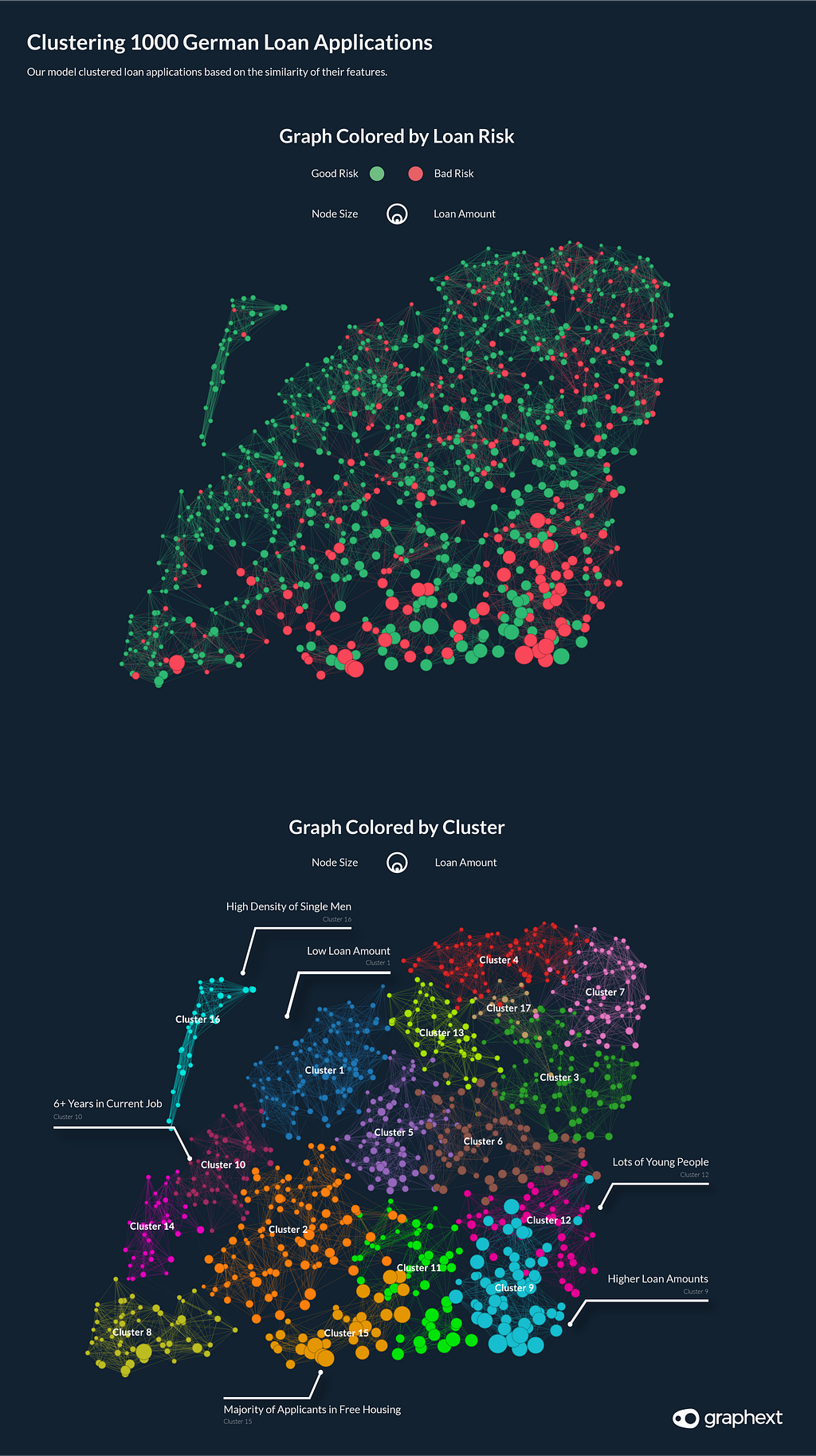
Our model used Risk as it’s target variable and every other characteristic of a loan application as factors, clustering loan applications based on the similarity of these factors. Our intention was to uncover the constitution of high-risk or low-risk applicants.
A Successful Model
A model’s error tells us whether the model was able to recognise a relationship between the factors and the target variables.
After executing the model, the team started to inspect the Graph, the network visualisation wherein loan applications were grouped together into clusters. A models accuracy — or error score — is important. This helps us recognise whether the model was able to recognise a relationship between the factors and the target variables.
The model we built had a low error score — 57 incorrect risk predictions out of a dataset of 1000 loan applications. It seemed to be clear that the model was able to understand which factors were most significant in leading to a risk rating. Next, using the Graph, we set about analysing the data to identify the factors most strongly contributing towards a bad risk rating.
Value Distribution in the Dataset
Cluster 9: A Bad Risk Cluster
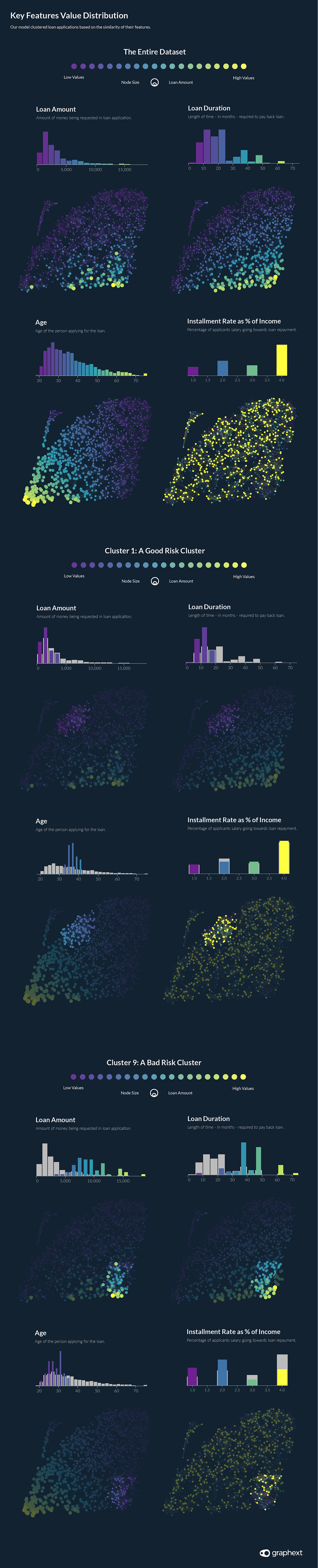
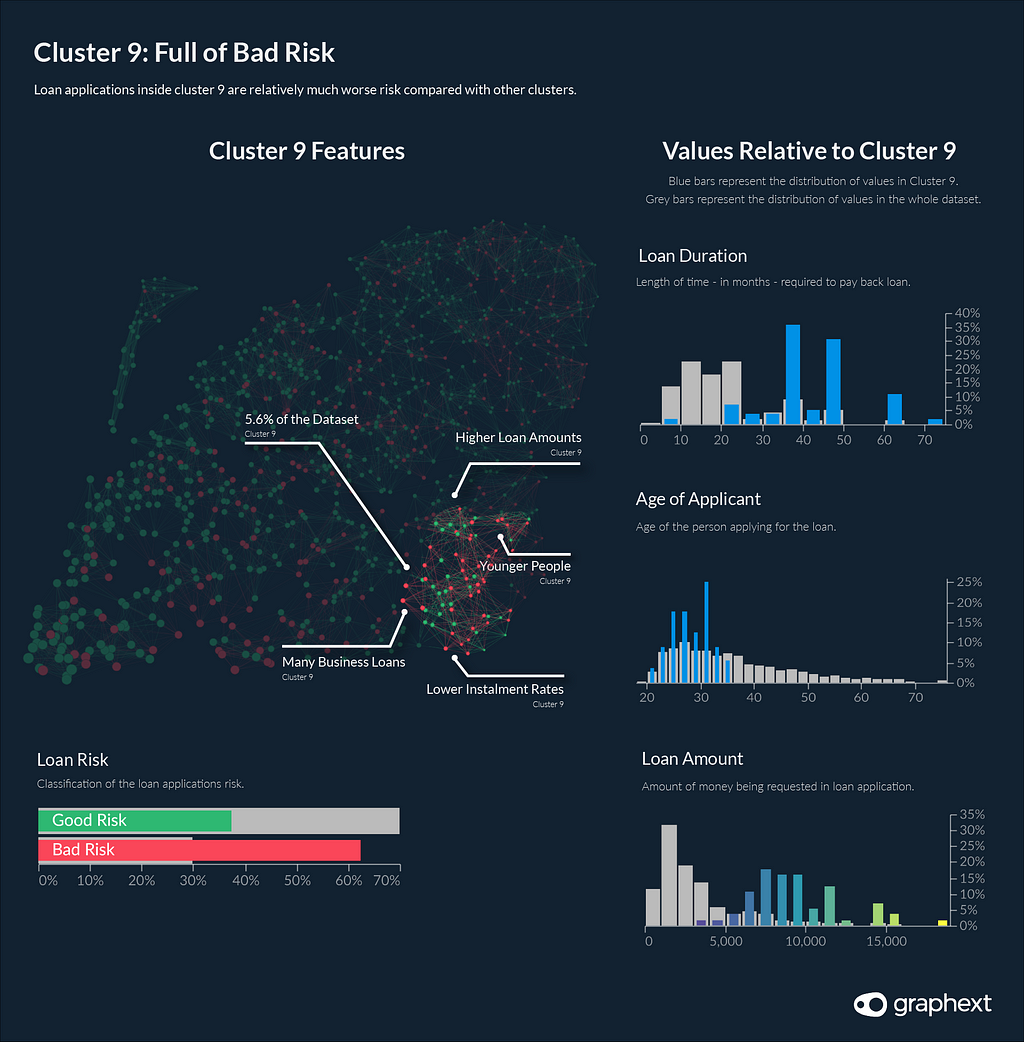
With Cluster 9 making up just 5.6% of the dataset but having double the average score for bad risk, we started to inspect this important cluster in order to analyse the make up of a bad risk applicant.
After filtering our project to select data inside cluster 9, we could explore the features of this cluster dynamically. Cluster 9 loan applications are for higher sums of money and for long payback periods with smaller instalment rates. Moreover, applicants are generally younger people between the ages of 20 and 36 looking to start a business.
Cluster 1: A Good Risk Cluster
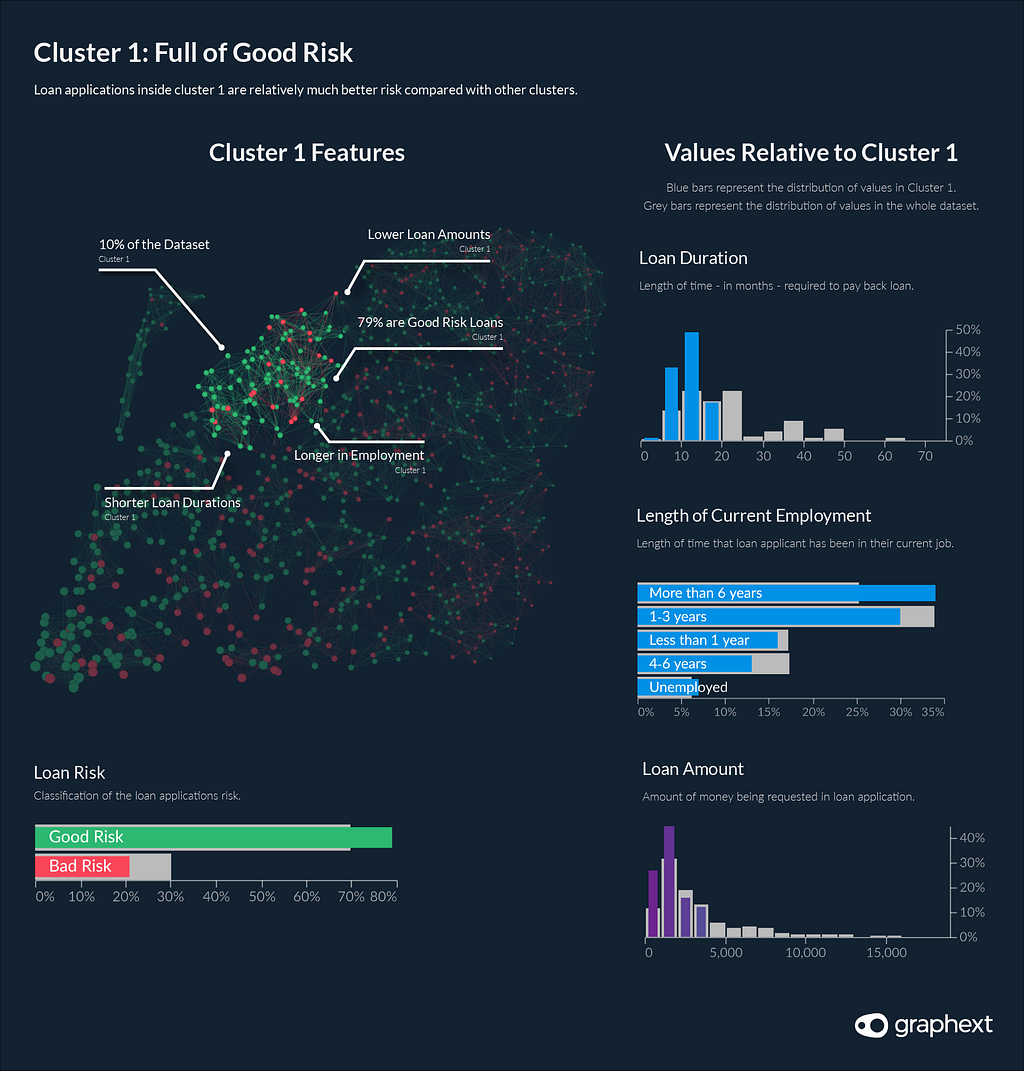
In order to evaluate the reverse of this, we could see that Cluster 1 had the highest number of good risk applications. It made up 10% of the dataset and in this, 79% of applications were classified as being good risk — 10% higher than everything in the dataset.
This cluster was predominantly made up of people in their thirties who were single. I found the fact that single was a positive factor for good risk very interesting, as I would consider that two incomes would be better than one, however this may be influenced by a lower likelihood of a married couple having two incomes in the 1970s.
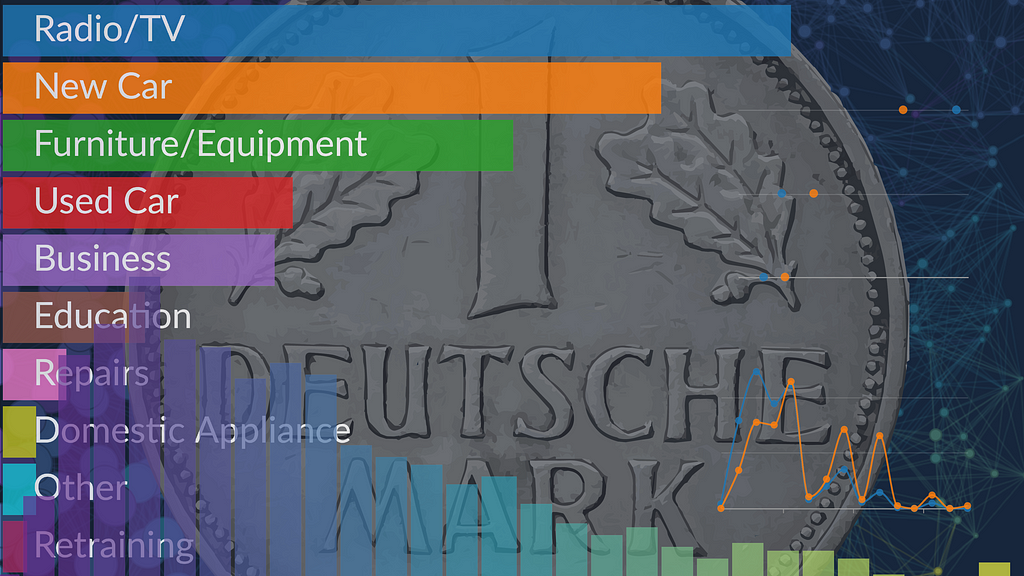
The features of cluster 1 confirmed a few suspicions I was beginning to have about the dataset. Loan applications here were for short durations and low amounts. Additionally, the purpose of the loan was to buy either a TV or radio. Can you imagine taking a loan to buy a radio these days?
Social vs Financial Factors
The characteristics of a loan application can be seen as either financial or social factors. Age and status are variables relating to an applicant’s social status, whereas savings account and loan duration are variables relating to their financial status.
Social Factors
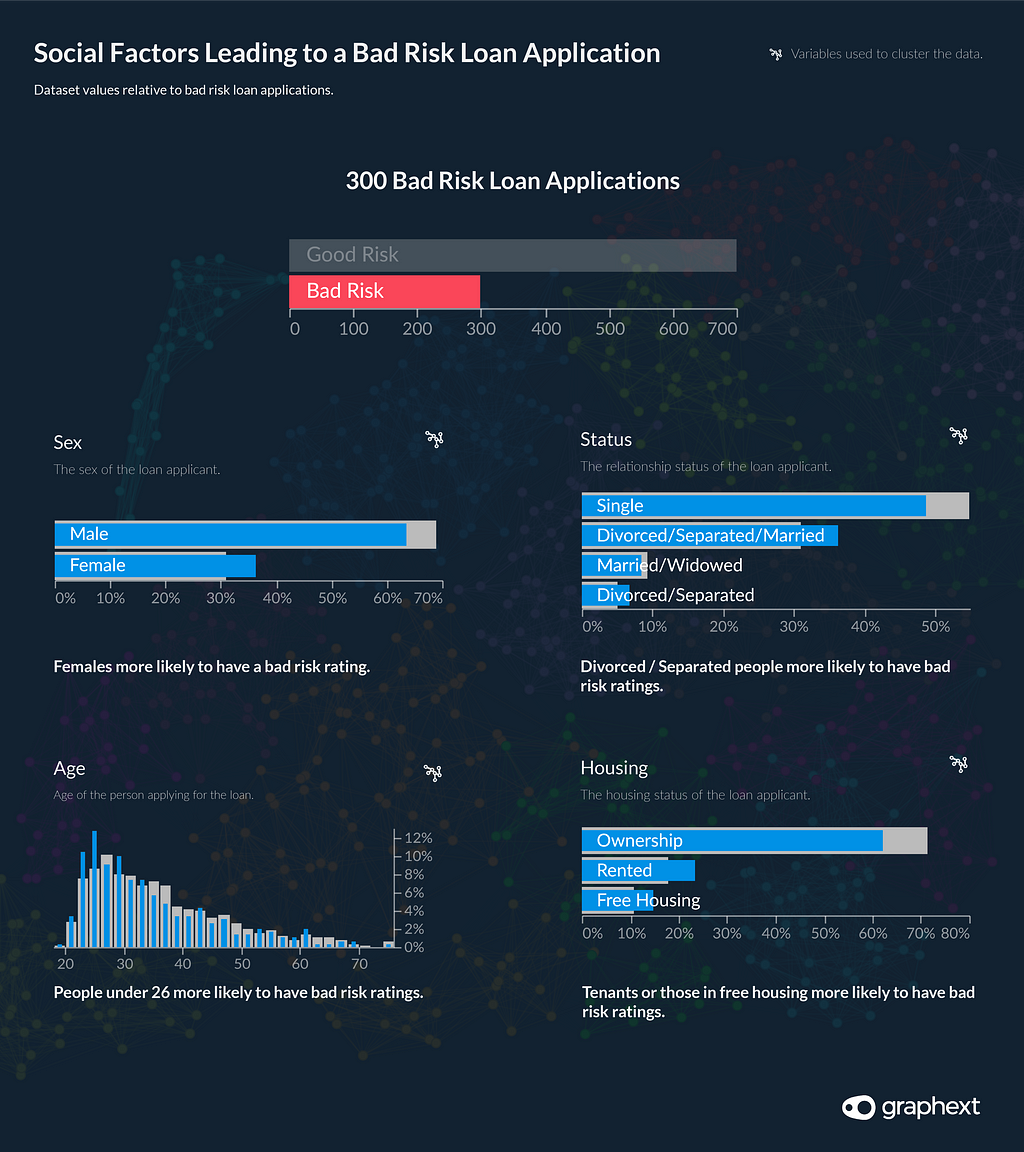
Selecting bad risk loan applications and inspecting their features suggested that women were more likely to receive bad risk ratings. The same is true for younger people, especially loan applicants under the age of 26.
It was also interesting to note that homeownership helped to increase the positivity of an applicant’s risk profile. Tenants or those in free housing were more likely to receive a bad risk rating.
With women and younger people coming out worse, I sincerely hope brokers and banks have changed their attitude changed since 1970. It would make for an interesting comparative study to find out just how much of this bias still applies.
Financial Factors
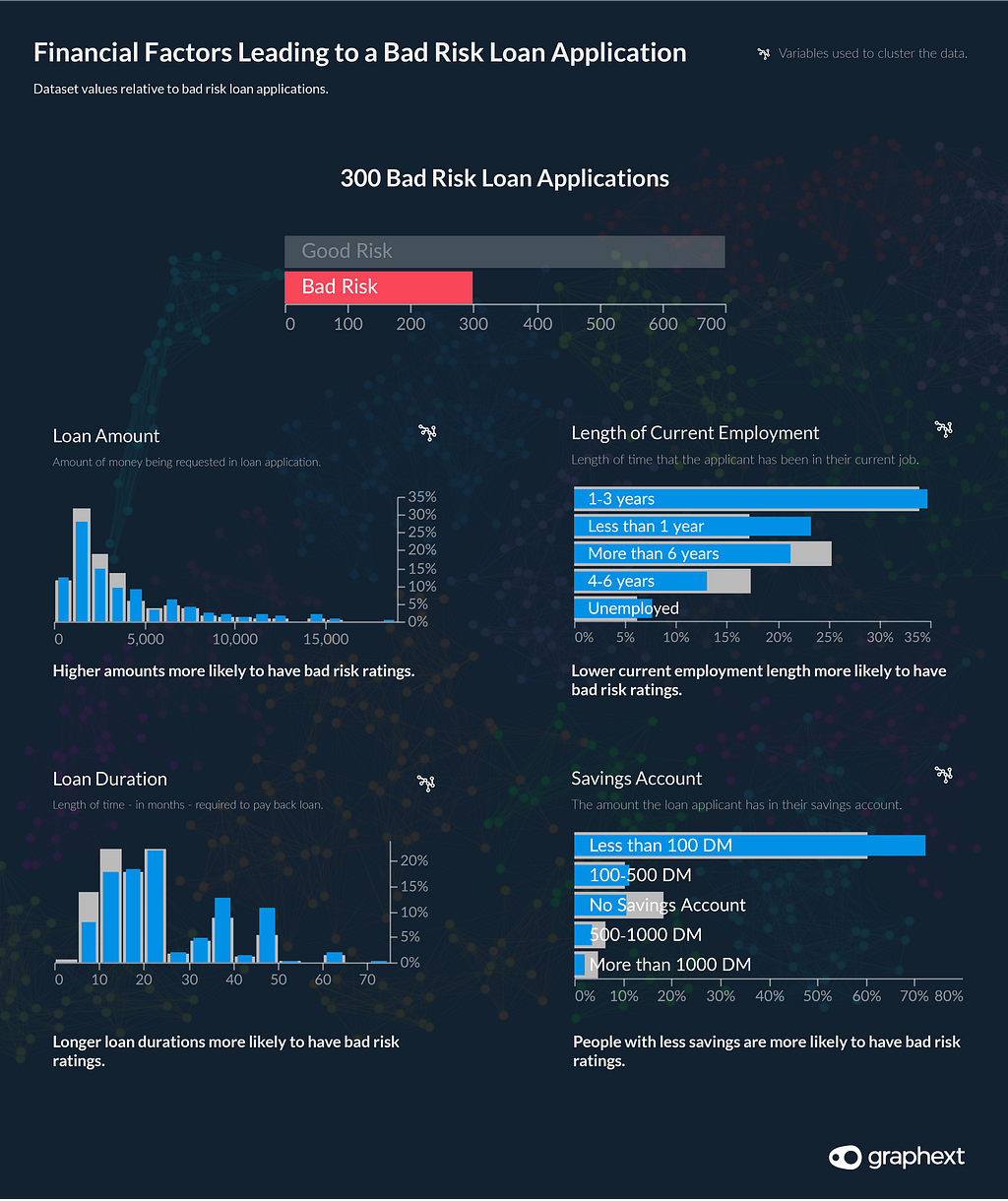
I am less persuaded that the influence of financial factors will have changed over the past half a century. Longer loans for higher sums of money are profiled as bad risk — and this makes sense! Not only this, but applicants with more savings and longer periods of current employment are more likely to be awarded good risk profiles.
So, with all this in mind, the ideal candidate to receive a bank loan in 1970s Germany would be a single man who already owns their own property and who is over 32 years old. He would have been in his current job for a sustained period and would have a reasonable amount of savings. Furthermore, he would be looking for a low sum of money over a short payback period.
At Master of Code, we talk a lot about Conversation Design, how to plan a conversation flow diagram and the importance of the flow and feel of a chatbot. Customer support, user or patient management, and answering customer questions are all great use cases that a conversational AI chatbot is perfect for. Another great chatbot application is one that can help frustrated customers solve issues and give back some time to agents: troubleshooting use cases.
In a troubleshooting flow of a conversational solution, a bot’s main goal is to automate simple fixes to free up agents’ time for more complicated issues. The customer’s goal is to get their issue fixed without waiting for help.
While it’s nice for a chatbot to be empathetic and conversational, it becomes more important to get each point or troubleshooting flow step across in the least amount of words (and the lightest cognitive load possible).
Here’s how you can make your troubleshooting chatbot conversation flows more impactful
Edit, edit, edit
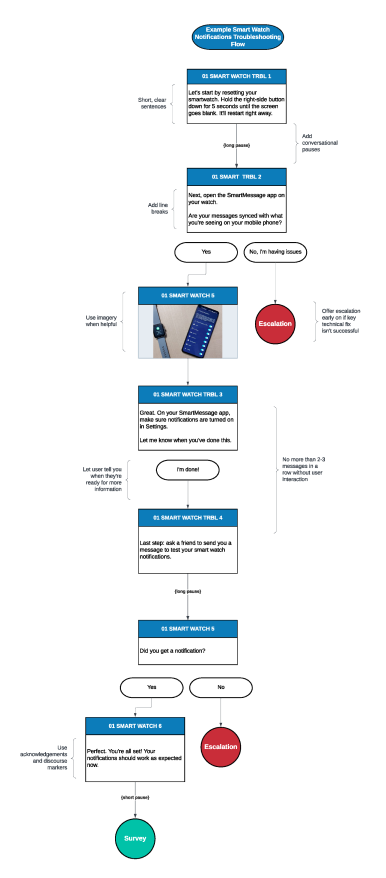
For your chatbot, you can borrow from the world of UX, copy editing, and heuristics to drive troubleshooting conversation flow strategy and find clarity in your messaging. Taper messages down as much as possible by:
Removing unnecessary words that clutter the chatbot messages.
Removing redundant language that dilutes the meaning.
Using imagery for guidance.
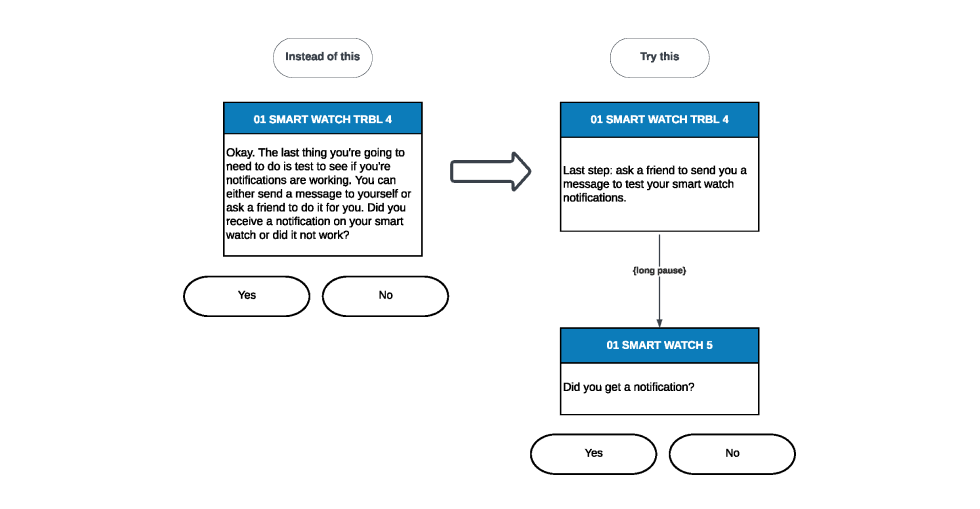
Editing down your bot’s messages within troubleshooting conversation flows
By simplifying messages, you’re already one step closer to helping customers achieve their goal by alleviating some of the cognitive load for them.
Another way to make chatbot troubleshooting content more digestible is to break longer messages into two messages. Keep in mind that it takes two to converse and a bot should never hog the conversation or overwhelm the customer with too much information at once.
Review your conversational flow diagram and be cognizant of how many messages your bot is consecutively sending. To ensure you’re not sending more than three messages in a row, invite the customer to let you know where they’re at in the process by interacting with you. You can use quick replies or give options that:
lead to other relevant information in the conversation flow or in another flow.
let customers connect to a live agent if they’ve run into an issue that the bot can’t help with.
use Natural Language Processing (NLP) to let customers stop troubleshooting whenever they want to.
give the customer the option to let the bot know when they’re done and ready to move on.
Keep in mind that not every point in a troubleshooting chatbot conversation flows should be an escalation point. In other words, there’s no need to add the option to connect with a live agent after one or two standard troubleshooting steps to call center automation. Doing so could lower your containment rate and increase wait times. Offering escalation at a key step in the beginning and at the end of the conversation flow is plenty.
Consider other paths of conversational flow
Another important piece of troubleshooting with a chatbot is to remember that customers may finish the troubleshooting conversation flow and move on to another flow in the bot. For example, a customer may need to activate a product or service before they set it up. This means that they could start in an activation troubleshooting conversation flow and end up in a set up flow.
To understand your customer’s journey, review bot conversations and analytics to see where customers are going and identify patterns into subsequent flows. This will help you anticipate where your customer needs to go next and how to map customer journey. Keep flows smooth and consistent by paying attention to how much content the customer will see when they transition flows.
The takeaway of troubleshooting chatbot conversation flows
Technical jargon and language in a chatbot is inherently more difficult to understand than checking out or asking an FAQ. On top of that, customers are often frustrated when one of your products or services isn’t working for them. To make their lives easier, always keep your troubleshooting messaging short, to-the-point, and cooperative.
Well-designed troubleshooting conversation flows require a good amount of upfront work and continued data-based optimization by Conversation Design specialists. Following the tips above will help you build a useful, frictionless and efficient experience that’s a win-win for you and for your customers.
Ready to build efficient troubleshooting conversation flows as part of your impactful conversational AI solution? Let’s chat! Get in touch with us!
Can you answer one simple question? What does it take to stay alert on road? Coffee, tea, music, conversations, and window down for some people. But, is it the safest solution?
Then what’s the solution? With the recent advancement in AI technology, there is one technology solution is at your rescue and that is the Driver Monitoring System.
Let’s go through this blog and learn about Driver Monitoring System from scratch and how it is a life savior jacket for drivers.
The driver monitoring system is an advanced safety feature that utilizes a camera mounting on the dashboard to monitor the driver’s alertness and drowsiness. In case the driver is getting sleepy and distracted driver monitoring system generates an alert and recommends taking a break.
This advanced safety feature is gaining huge attraction from car manufacturers, and as per a report the global driver assistance system growth is expected to reach $32 billion by 2025. And why not, who doesn’t want more safety while driving on highways and traffic.
Driver monitoring system typically uses a driver-facing camera equipped with infrared-light-emitting diodes or laser light that can see the driver’s face even in dark. Using these diodes, the driver monitoring system can also check whether the driver is wearing sunglasses or not.
Isn’t it amazing? This advanced driver monitoring uses training datasets points to check the driver’s action and generate points. Let’s understand how the driver monitoring system works.
This safety system monitors the driver’s most recent behavior right from the head position, and eye, and further gives a signal from cars such as vehicle speed and traffic signs. According to the data accessed by the driver monitoring system, driver alertness is graded from 1 (attentive) to 4 (distracted). That’s how this information can be used to dramatically adapt driver assistance functions such as emergency car brake assist and blind-spot detection warnings.
Also, the driver monitoring system diagnoses the driver’s drowsiness level based on blink duration and frequency as well as eye-opening and closing frequency. Based on these points, the driver monitoring system calculates the drowsiness scale from 1 (alert) to 4 (sleepy). If the driver is sleepy it generates an alert immediately.
The driver monitoring system is a boon in disguise to maintain driver safety and lower the count of accidents that occurs due to drowsiness and non-focus during driving. Some of the driver monitoring system benefits include:
Increase driver safety by generating alerts for drowsiness and alertness detection
Enhance comfort by offering automated parking and easy traffic sign recognition feature
Give a boost to autonomous driving L2+ and scalable solution for small and niche application
Help in avoiding collision and fatal accidents
The first and most important step in building a driver monitoring system is a massive amount of training data. This training data helps the deep neural algorithm to perform multiple automotive AI process such as face identification, voice and image recognition, and object identification, by training this interference dataset give outcomes.
To identify objects, the driver monitoring system has to be trained rigorously on thousands of images that made it easier for them to identify the objects and the content in the image. And to make an autonomous driving monitoring system requires a large amount of labeled and unlabeled trained datasets that can navigate through complex driving scenarios at a faster rate.
Adapting to the next frontier technology is a must-have in the digital era when safety is the biggest concern. From maintaining driver’s focus to generating alerts to drivers in the case of emergency, requires the safest solution that can be easily accessible. And drive monitoring system is a solution that allows drives to maintain their focus on road and the rest will be handled by the system itself.
Its high time to adopt the design and innovation in drive monitoring system technology and offer drivers a more safe, secure, and comfortable ride without any fear of accident and casualties.
Read Later Add to Favourites Add to Collection Report
Have you ever wondered about the amount of data that an organization holds in the form of papers and multiple formats in its system all across the organization? The answer is innumerable. Data is the key to business growth and its keeps accelerating with time. For example, you have a pdf life and you can’t make any changes until it’s in editable format. To copy the text directly requires you to convert the file into text format and then process it. Considering the time and effort involved in the whole process makes the place for technology adoption to fast-track the data processing. And the answer lies in Optical Character Recognition (OCR). Do you think OCR can add value to your business and organization, let’s dive into the basics of Optical Character Recognition (OCR) and its most relevant use cases all across industries?
What is Optical Character Recognition (OCR)?
When we talk about Optical Character Recognition (OCR), it is a field of Artificial Intelligence (AI) that is specifically related to computer vision and pattern recognition. OCR refers to the process of extracting information from multiple data formats like images, pdf, handwritten notes, and scanned documents and converting them into digital format for further processing.
Using OCR, organizations can easily encode the text from an image and allow it to be electronically formatted, searched, and compacted on a digital system or web for use.
Optical Character Recognition (OCR) Use Cases across Industries
Banking and Insurance
Think about the data banking and financial organization carry from transactions, KYC applications, contract orders, reconciliation, and loan applications to customer services. Leveraging OCR technology offers the banking industry to streamline and digitize the whole process for end-to-end document processing and easy data access to employees. For example- with advanced machine learning algorithms OCR technology offer banks to recognize their bank card with accuracy even if the image data quality is low.
Traveling
OCR technologies also make traveling an easy path for you by fast-tracking the passport checking and travel application for security and data storage purposes. Also, OCR helps in reducing manual errors in data verification and processing the data faster than humans. From booking the checking process to travel expense management, OCR technology can be leveraged for reimagining the travel industry and customer experience as well.
Government
Many government and legal industries still rely on the paper trail method to process information. From license registration to voting ID cards, OCR technology can be used to streamline the workflow. Instead of manual verification, OCR technology can easily check the registered users’ information just by scanning the card and accessing information in a smooth process way.
Healthcare
The healthcare industry can get the most out of OCR technology. Using OCR features healthcare organizations can get a medical history, past illness records, and prescriptions just with one click. Also, medical providers can encode this information and access it in the future anytime using the OCR feature.
Food Industry
Using machine learning algorithms with OCR features can help the food industry in creating a digitized menu, and a database of multiple recipes with calorie information and their apt intake amount. That’s how OCR feature not only give enhance the customer experience but also give the food industry an idea for creating more innovative process.
Logistics
The logistics industry spends most of the time on routine input and manual data process of logistics documents, training modules for engineers, design, and development of new machines. Leveraging the OCR feature can streamline the process by checking the in [put data autonomously and removing the chance of error while loading.
Retail
OCR feature can up-level the retail operations by offering retail industries to scan and extract the relevant information from bills of payment, packing lists, invoices, purchase order’s, and many other processes. In addition, OCR can create structured format data for easy data access and offer end-to-end data processing.
Time to act now
In the digital era, the most critical factor for any business and organization is the customer satisfaction and data accessibility. And Optical Character Recognition feature has all on its plate to serve you. From extracting data faster to making the user’s lives easier, OCR has a lot in store for you. All it requires is adaptation. Build a streamlined business process with OCE before it’s too late.
Author Bio
Vatsal Ghiya is a serial entrepreneur with more than 20 years of experience in healthcare AI software and services. He is the CEO and co-founder of Linkedin: https://www.linkedin.com/in/vatsal-ghiya-4191855/, which enables the on-demand scaling of our platform, processes, and people for companies with the most demanding machine learning and artificial intelligence initiatives.
What is synthetic Data in machine learning, and why do you need it? — Do It Easy With ScienceProg
As the name suggests, synthetic data is the data that is artificially generated rather than being created by actual events. In marketing, social media, healthcare, finance, and security, synthetic data helps build more innovative solutions.
Data is the key to resolution and quality service, whether you are processing an invoice or extracting information from a centralized legacy system.
Many organizations complain that collecting and using data raises privacy concerns and leave their business to data breaching issues. Also, some data is tough to collect and incurs a high cost to the organization. For example, collecting data related to real-time events like banking transactions and road events for autonomous vehicles take a heavy load on organization costing.
Then, what’s the solution to collect and use data without breaches, fines, or punishment. The answer is in Synthetic Data. Do you want to know what synthetic data is, why you need it, and how you can make the best use of synthetic data? Let’s get rolled into this blog and learn all about Synthetic data.
What is Synthetic Data?
Synthetic data is annotated information that computer algorithms generate as alternative data. If we put it in a simple form, Synthetic data is created digitally rather than collected or measured manually in the real world.
The significant advancement in the rise of synthetic data is a more data-centric approach to Artificial Intelligence technologies like Machine Learning. As per Gartner’s prediction, “By 2030, most of the data used in AI will be artificially generated by rules statistical methods, simulation or other techniques.”
Synthetic Data vs. Real Data
When it comes to using real data, it’s tricky, as real data contain the information that researchers don’t want to disclose as it might lead to data breaches and privacy violations.
But, with synthetic data, privacy is not a concern. Synthetic data ensures-
Labeled data in a uniform way
Privacy and confidentiality
Error-free data
Data collation from multiple resources
Existing Data scalability
Data quality and balance
Why is Synthetic data important?
Most developers need data to create neural networks for machine learning as diverse training datasets create more powerful AI models. But extraction and labeling data contain a few thousand to ten million elements that are time-consuming and expensive. But synthetic data reduce the burden of collecting and labeling millions of data and the cost related to it. Synthetic data ensures that you have the label data with all the diversity to represent in the real world.
Benefits of Synthetic Data
Synthetic data comes with a range of benefits for almost every industry type, from finance to healthcare. The best way it helps an organization is to reduce the need to capture images and data from the real world and make it possible to generate and construct a dataset much more quickly than a dataset that depends on real-time events. Synthetic data has a variety of use cases and can be applied to any machine learning task or process. Some of the typical applications of synthetic data are-
Using synthetic data helps vehicle manufacturers create training data for cars at a real-time pace to avoid accidents and casualties. Also, the banking and finance industry can benefit from synthetic data by creating a fraud detection model for detecting fraudulent transactions and maintaining data security.
In addition, healthcare organizations can leverage synthetic datasets to train AI models for better medical imaging and patient care while protecting patient privacy.
Challenges of Synthetic Data
However, synthetic data comes with a range of benefits but specific challenges that make a tough call for organizations. These challenges include:
As synthetic data is not the replica of actual data, it might not cover the original data’s outliners.
Synthetic data might reflect biases in data as the quality of synthetic data is dependent on the quality of input data and data generation model.
Synthetic data adoption might be slower due to no witness of benefits before.
It takes huge time and effort to generate synthetic data.
Synthetic Data- Key to unlocking new Possibilities
Compared to real-time data synthetic dataset generation model is much faster, accurate, and time savvy. From allowing data science engineers to train machine learning models to create an autonomous AI, synthetic data has a lot on its plate to drive in this data-centric era.
It’s not only a replacement for real-world data but is much bigger than that. Synthetic data offer data scientists to create innovative solutions that are almost impossible with real data alone. It’s time to pedal for a better world with synthetic data before it’s too late; act Now!
Author Bio
Vatsal Ghiya is a serial entrepreneur with more than 20 years of experience in healthcare AI software and services. He is the CEO and co-founder of Shaip, which enables the on-demand scaling of our platform, processes, and people for companies with the most demanding machine learning and artificial intelligence initiatives.
The ability infused into the machines- making them capable of interacting in the most humane ways possible- has a different kind of high to it. Yet, the question remains, how does conversational AI work in real-time and what kind of technology is powering its very existence.
Let’s find out:
Simply put, Conversational AI is a segment or sub-domain of Artificial Intelligence — aimed at enabling humans to interact more seamlessly with computing entities.
Remember those quirky website chatboxes that return specific answers to even some of the trickiest questions! Well, those are exactly the Conversational AI products we are talking about. Yet, the question remains: how come these chatbots become so perceptive. Surely, it isn’t just about feeding raw training data, like human voice and text, into the relevant models. There has to be more.
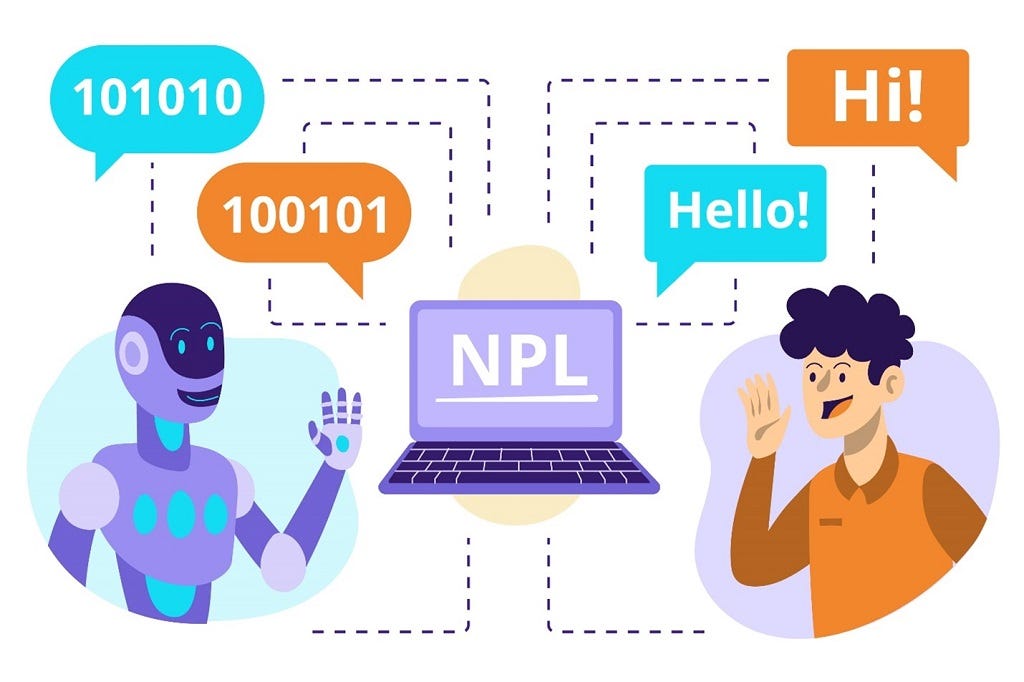
Often touted as a computer science vertical, NLP or natural language processing focuses on helping computers understand voice and text better- allowing them to better interact with the world or rather us, the humans.
The power of NLP allows humans to communicate with intelligent systems using specific languages, like English. Also, NLP helps a computer get better at machine learning, which is a pathway for computing entities to develop ‘artificial’ intelligence.
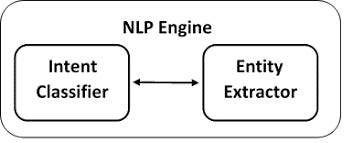
NLP-based intelligence is fed using NLP engines, which is the core prepping component- responsible for interpreting speech and text- and eventually feeding the structured inputs right into the system. But there is a lot more to an NLP engine.
What can Natural Language Engines do?
As mentioned, NLP engines are important. Why, you ask? Keep reading on:
Vocab enhancement: Every conversational approach must keep the training stream open for new words. NLP engines can help with that- assisting with word, phrase, synonym, and descriptor additions.
Context determination: Every conversation is made of multiple stages. At one stage, the customer might just throw a random question, whereas, at any other stage, it might be a specific query to close the deal. A natural language processing engine helps the computer determine the context associated with every stage.
Entity identification: Imagine a customer typing the following command: ‘How can I procure the mentioned offer that is to start on 25th July 2022’? As you can see, the statement comprises a date, numbers, and even a description. Powerful NLP engines help machines identify these disparate entities to perfection.
Utterance detection: A question like ‘When can I expect the email?’ can be asked as ‘Where is my email?’ NLP engines help intelligent machines get accustomed to every variation of specific questions for added relevance by factoring in the nature of utterance- both verbal and textual.
Intent: ‘I would like my coupon code now’ looks a tad different than ‘Where the heck is my coupon code?’ While the first is a standard statement showing desire, the next might be borne out of frustration. Top-of-the-line machines are great at differentiating based on intent, thanks to the efficient natural language processing engines.
Yet, analyzing the intent requires us to dig deeper.
How does NLP help to analyze the Intent?
Before we delve deeper, it is important to understand that conversational intent can be Casual (including every emotion) or Business. And that is exactly when ‘NLP-powered’ Intent Analysis is looked at as an important tool used by NLP engines.
In simple words, intent analysis helps machines assess the exact or near-exact intention of any user input- often by extracting the relevant entities. And that is how a chatbot actually learns to pick up a suggestion, news, or even a complaint.
As far as the approach is concerned, NLP tools (precisely the engines) help parse multiple intents- feeding them into the machine as high-quality training data. A structured dataset, therefore, helps with intent analysis. On top of that, the structured dataset is further fragmented to include some tricky words.
Output-wise, the NLP engine analyzes the sentence and tries to analyze intent based on the data fed, plurality, positioning (position of words in a sentence), and conjugation. For speech, other factors are also taken into consideration. And that’s more or less how intent analysis takes place in the background.
According to detailed research conducted by Market & Markets, the NLP market is expected to be valued at $26.4 by the year 2024. That is a CAGR of 21%.
And their role in enhancing the quality of conversational AI isn’t limited to emotion, utterance, entity, or even intent analysis. NLP is also relevant to aspect mining, topic modeling, text summarization, and more- helping chatbots software, self-driving cars, home automation setups, and digital assistants get more intelligent over time. With NLP, the possibilities are virtually endless.
Author Bio
Vatsal Ghiya is a serial entrepreneur with more than 20 years of experience in healthcare AI software and services. He is the CEO and co-founder of Shaip, which enables the on-demand scaling of our platform, processes, and people for companies with the most demanding machine learning and artificial intelligence initiatives.
In this day and age, we’re lucky that most of us have access to education. In 2020, 90 per cent of the world’s population had completed primary education, and 66 per cent had completed secondary education.
Education is an essential building block of our society because it provides knowledge, skills and an environment to help people grow — and in turn, they will help society grow.
But out of the billions of people who have completed primary education, how many get to experience quality education? And what does that even mean?
In this article, we’ll explore the definition of quality education, its importance, the dimensions of quality education, and how educators and institutions can get there.
The popularity of chatbots and mobile apps is undeniable. This is evidenced by extensive data describing how much they are used and how the market is expected to benefit.
For example, 2020 data from Statista shows that apps have reached over 3 million downloads for Android and over 2 million for iOS apps. Moreover, 2021 market share projections predict that 59% of global revenue will come from mobile phones. Meanwhile, 2016 reports show that the market for chatbots was estimated to be worth a little over USD 190 million. By 2025, it is expected to increase by nearly 24% to a value of USD 1.25 billion.
With this in mind, marrying chatbots to mobile apps is like a match made in (business) heaven. Here are a few ways chatbots can make your business app better.
Benefits
Excellent Customer Service
Chatbots, especially those powered by artificial intelligence, are efficient tools capable of responding 24/7 to customer queries, thereby reducing client wait time and increasing the likelihood of sales.
Customized Experience
Based on intent and app behavior, a chatbot can make highly personalized product recommendations and make choices that usually suit the settings and needs of the user, thus creating a personalized journey for each client.
Strengthens Marketing Efforts
With the use of chatbots in mobile apps, businesses may gather a wealth of demographic and engagement data that can be utilized to improve each customer’s experience and support wider business marketing strategies.
Better Onboarding
A significant percentage of consumers never use an app again after the first time, according to numerous research. Why? A lack of clarity on what the app contains and how to use it. An intelligent chatbot can be particularly helpful in these situations by interacting with the user from the onset. Users can be guided by a chatbot through all app features, significantly reducing the chance of misunderstanding.
Use Cases
Many industries have already recognized the benefits of using chatbots in their mobile apps. Some of which include:
Finance
Companies like Bank of America and PayPal have integrated chatbots in their applications to engage with customers via text and sound about questions, investment opportunities, payment tracking, and other financial matters.
Healthcare
Chatbots provide critical and possibly lifesaving advice in a fraction of the time one would probably have to wait to see a doctor. These types of apps are not meant to replace doctors but to support an already overwhelmed system. Medical bots can provide interim health guidance. A virtual radiologist bot was developed by radiologist experts at the University of California (UCLA) that can assist patients and those looking for care by providing insightful answers to their concerns. The AI-based bot can give the doctor clinical patient data and can give the patient a thorough treatment plan. Bot Libre’s parent company Paphus Solutions has developed several medical, first aid, and health and fitness chatbot apps for their clients across North America, Europe, and Asia using the Bot Libre platform.
Shopping
Stores like eBay and Whole Foods have created apps that have intelligent chatbots that help customers browse products, and in the case of eBay, act as personal shopping assistants offering suggestions based on uploaded pictures. Chatbots in the retail industry has become increasingly popular. A study showed that 70% of millennials and Gen Z were willing to use chatbots to make purchases of consumer products from applications.
Learning
As learning is no longer defined by the four walls of a classroom, virtual educational tools have increased in popularity. Bot Libre’s English Tutor app includes an intelligent chatbot that teaches English through regular conversation, offering a wide range of topics for the user to choose from. The app offers 24.7 learning availability, provides new and exciting learning techniques, creates a marketplace for English teachers, and is Self-paced. Another example comes from Duolingo. Through their app, users can practice their chosen language with a bot that develops in intelligence as more people use them.
With open source platforms like Bot Libre, people can build their own chatbots with little to no programming and attach to their mobile apps using the open source Bot Libre mobile SDK and web API.
A few years ago, only 9% of airports were utilizing chatbots to communicate with customers. Adoption since then has continued to increase, with a projected spend of $3.69 billion USD projected by 2027 for the airports and aviation industries in AI-related services. With this rise of Conversational AI chatbots, airports are no longer forced to choose between high-quality customer service or low costs — they can have both. In this article, we’ll take a closer look at the top 5 examples of Conversational AI chatbots for airports in 2022, and the key use cases that each solution covers.
Airport Chatbot Example #1: Melbourne Airport
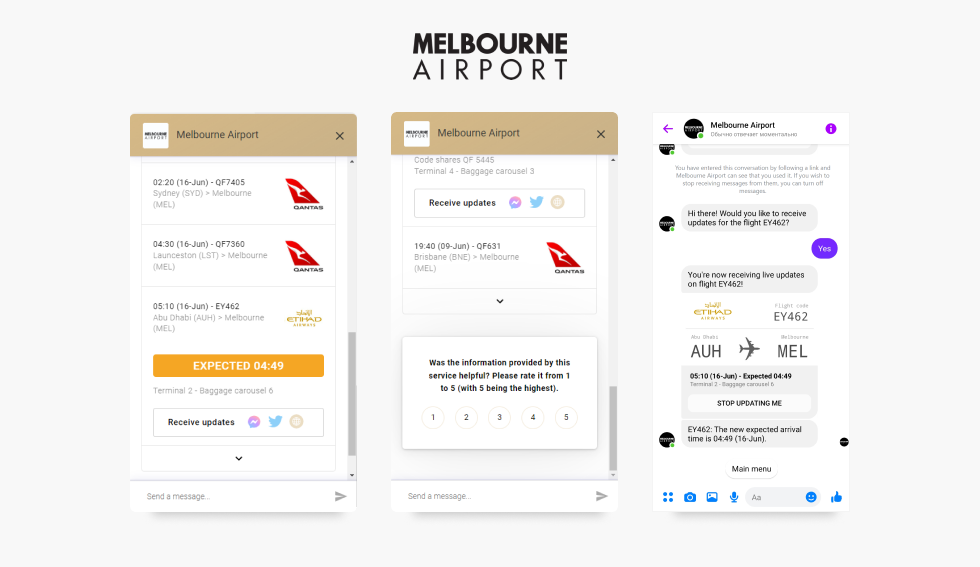
Melbourne Airport is the second-largest airport in Australia, with four terminals serving more than 2.2 million passengers in April 2022 alone. Melbourne Airport is famous for its innovative approach to customer services such as hybrid desks and the installation of self-service check-in kiosks, digital signage, and chatbot implementation for their call center automation. Melbourne Airport provides a really good airport AI chatbot example as it covers most customers’ use cases and provides digital assistance to users on both their website and Facebook Messenger.
Use Cases covered by AI chatbot from Melbourne Airport
Real-time flight updates can be tracked by the airport chatbot: with information about the flight number, destination, and airline, current flight status can be checked, and with an API chatbot integration all updates can be sent to the client’s messenger service.
FAQ page automation with airport latest updates and parking information: which reduces support ticket maintenance. All common questions are collected under the FAQ section within the chatbot, so no need to request them from a live agent.
Food & beverage and shops search within each of the four airport terminals: the AI-powered chatbot provides a full range of information that contains a venue overview, working hours, and link to the official website.
Airport Chatbot Example #2: Aéroports de Lyon
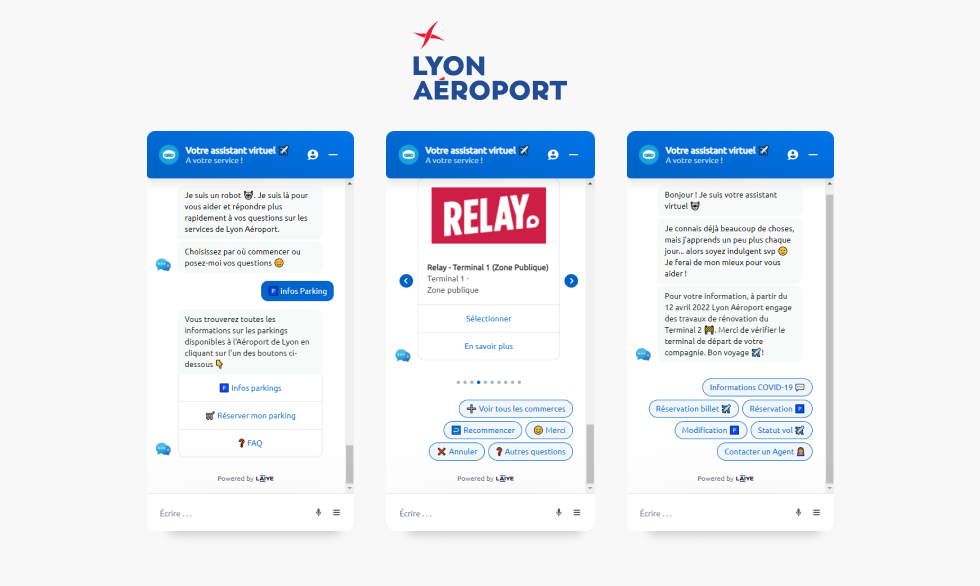
Aéroports de Lyon, which is part of the VINCI group (a leading private airport operator), is an international airport based in Lyon, France that has served more than 11 million passengers in 2018 alone. As one of the main regional airports in Lyon, they provide a range of services for passengers such as parking, shopping, restaurants, and hotels, and much of their customer base asked questions about these topics to their AI-powered chatbot.
Flight information automation: With the help of the Lyon airport AI chatbot, passengers can check their flight status, check-in, and ask flight related questions.
Shop and Restaurant finder: Users can ask the chatbot to look up cafes, restaurants, and boutiques based on which terminal they’re in at the airport. The bot also offers a recommendation engine for sures to find a place to shop or eat suited to their needs.
Parking information: Lyon airport provides approximately 16,000 parking spaces. By automating access to parking information, users can check the FAQs about the service as well as other activities, including booking parking in advance. After its launch, AI-powered chatbot increased the parking conversion rate by 40%.
Baggage problem solving: Users can learn about what to do with their bags during connections and how to file a report for lost or stolen bags.
Navigation option via airport chatbot: In case a passenger wants to spend some free time in the airport, the AI-powered chatbot can navigate the user through shops, cafes, and restaurants, which includes the ability to book a reservation.
FAQ page automation: The Lyon airport chatbot provides continually updated information about the current COVID situation per country to its users. Since the requirements differ from country to country, and are continually updated when you consider global travel, the ability to provide the latest travel requirements (such as testing criteria and documentation) on specific locations is necessary.
Geneva Airport is located in Switzerland and in 2021 served 5.92 million passengers. To assist passengers in finding related information and bridge the gap between customers, airlines, facilities, and the airport itself, the Geneva Airport launched their AI chatbot on the Facebook Messenger platform.
With the help of their chatbot, the Geneva Airport automated FAQ page allows users to identify country entrance restrictions due to COVID-19, providing everything a passenger needs to know for how to prepare for the journey, including check-in services, baggage requirements, and the travel documents needed. Their approach on flight information and updates were also included as part of the chatbot, providing proactive notifications for any necessary change to passengers.
Airport Chatbot Example #4: Brussels Airport Assistant “BRUce”
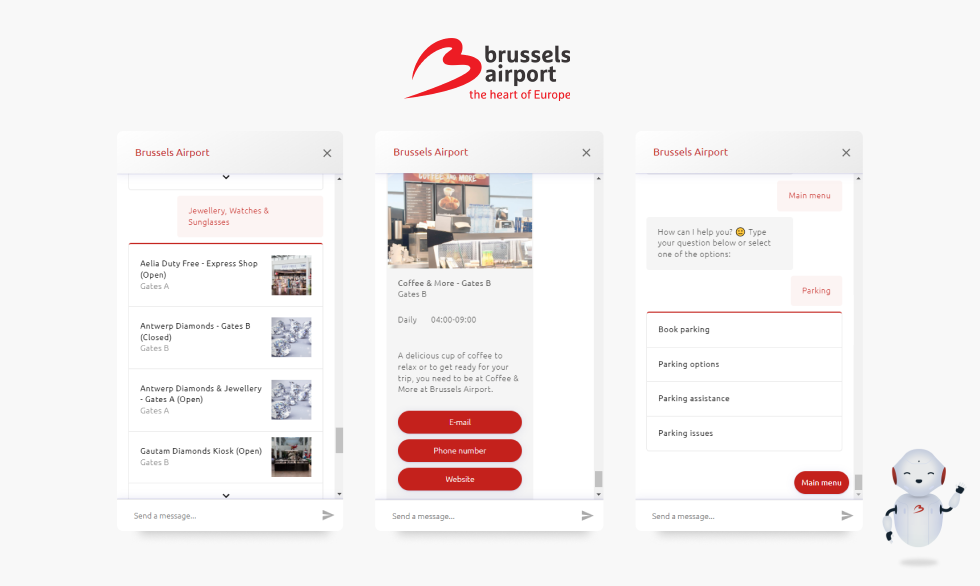
In 2018, Brussels Airport launched its chatbot on Facebook Messenger for testing and collecting feedback about the bot. Now, after a series of tests, improvements, and launches, BRUce — the Brussels Airport Virtual Assistant — is available via WhatsApp, Facebook Messenger, and the airport website. It helps customers check flight information and answer common airport FAQs.
Additionally, shops, parking and train information, COVID-19 restrictions and tests, and all other airport FAQs are automated within the airport chatbot. More recently, services such as ordering a lounge pass and booking parking are also now available through the BRUce AI chatbot.
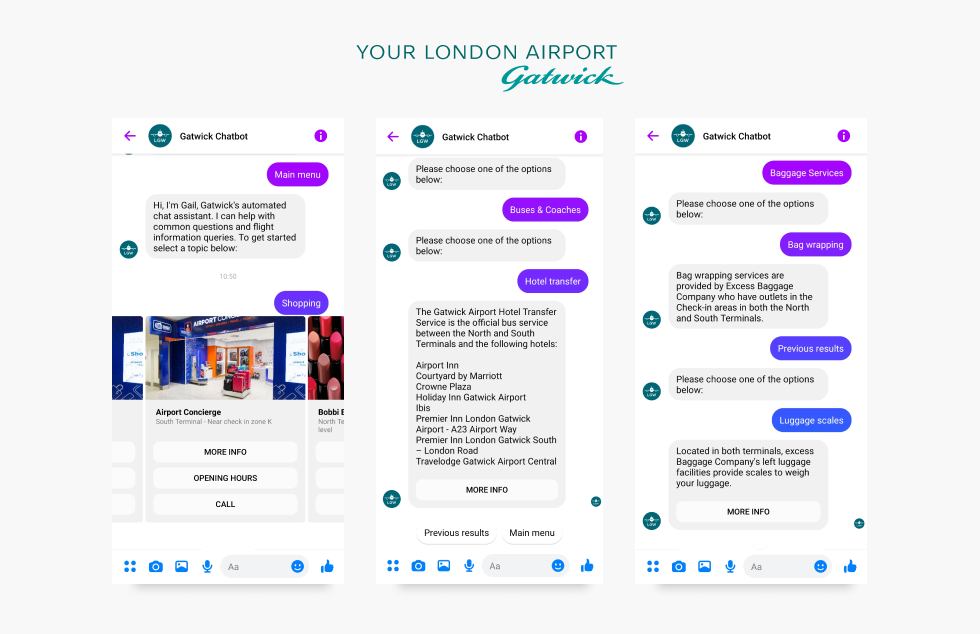
Airport Chatbot Example #5: Gatwick’s Airport Assistant “Gail”
Gail, Gatwick’s automated chat assistant, was launched in 2019 based on Facebook Messenger. Gatwick Airport, a major international airport in England, wanted to improve customer experience and the quality of conversations with clients. Over just a year, Gail managed to understand and answer about 80% of users’ questions.
Gatwick’s Airport chatbot takes the role of a guide and helps customers save time by helping them to find all important information before entering the airport itself. Find a flight, check Coronavirus latest info, book a COVID-19 test, and plan your free time in the airport by visiting shops and cafes. This AI-powered chatbot provides easy to access travel information 24/7.
We introduced only 5 examples of how airports can implement chatbots and improve customer service by using Conversational AI solutions. Airport chatbots cover the most popular use cases and can be developed for the airport’s website as well as other channels for user engagement, such as Facebook Messenger, WhatsApp, and Google Business Messages.
Businesses increased in sales with chatbot implementation by 67%. Ready to build your own Conversational AI solution? Let’s chat!