Artificial Intelligence is proving to be a huge disruptor. The rising popularity of ChatBots is one of the greatest examples of how technology is changing the way we do business. Various online shopping websites and services have successfully integrated ChatBots into their marketing strategy to improve customer service. While Chatbots do enhance the customer experience, they can also be used to add efficiency to your internal firm operations.
Here are some ways in which ChatBots can upgrade the partner, attorney and associate experience by acting as a personal assistant and virtual concierge for Client and Matter related information.
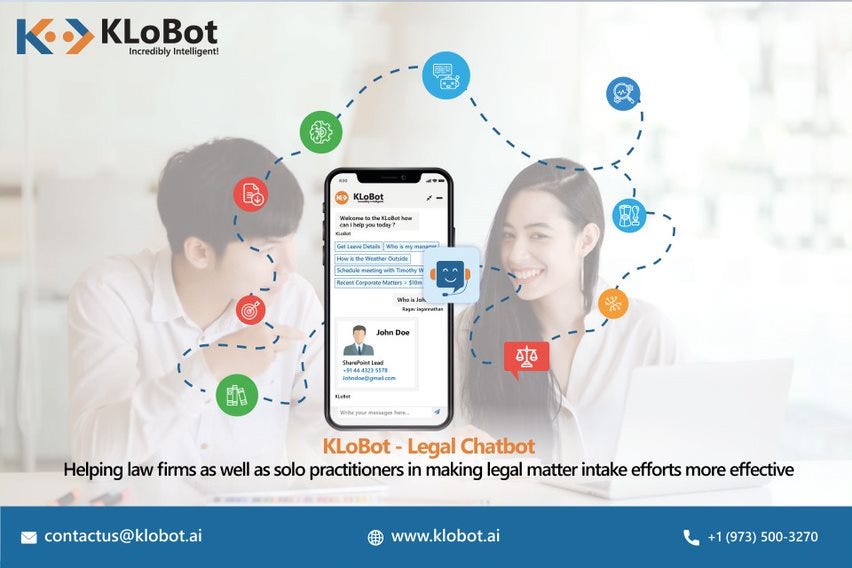
KLoBot can help your firm extract deeper data intelligence via a simplified web chat interface that can be surfaced right within your SharePoint Intranet portal or any web channel such as public facing website or extranet sites.
The virtual guided assistant will save you the hassle of manually locating the Client and Matter related information. All you need to do is set up a ChatBot in your intranet and program them with access to all your files. Then, you just must ask what is required and all the relevant information will be ready for you.
Attorney’s and law firm employees can also leverage the text and voice capabilities of KLoBot to schedule meetings, set reminders, ask intelligent questions and get immediate answers.
KLoBot will find and connect you to peers based on various criteria like practice, office, school etc.
It can also be set up as a tool on your website for all your existing customers to get immediate knowledge and updates about their case through various touch points — Website, text, email, phone or mobile application
And, there is a lot more to it. Take a step forward to get future ready with KLoBot.
KLoBot is a DIY AI chatbot that provides a unique drag+drop Bot Builder experience that can help your business communicate with their audience real-time in the most cost-effective manner. It can be integrated and customized across various platforms within a few hours. The benefits are innumerable.
KLoBot, Inc, develops artificial intelligence powered conversational user interfaces that can simplify internal and external enterprise communications, automate routine tasks, streamline business processes and provide organizational intelligence-on-demand to its users by using voice and text.
KLoBot’s mission is to ensure that narrow artificial intelligence can assist humans in getting access to organizational intelligence on-demand and deliver economically valuable work output that benefits all of humanity. KLoBot will build safe and beneficial chatbots, and artificial intelligence powered innovations that allow users to communicate with systems and smart appliances using voice and text, very similar to how they talk to colleagues.
Build conversational Legal AI Chatbot and Intelligent Virtual Assistants for your Firm with Machine Learning Capabilities and experience a human-like conversations.
While people are used to paying attention to the tone and meaning of the words that have been heard, developed AI-based algorithms are being taught to detect connections between words themselves and to see the irony and intentional lies.
Now intelligence officers/ agencies are ready to prove the ability of artificial intelligence to detect the human art of sarcasm. The tool, funded in part by the U.S. military, lets them analyze the social media content (including comments, posts, forum talks) while ignoring posts that shouldn’t be taken seriously.
A couple of scientists from the University of Central Florida conclude the following: “Сertain words in specific combinations can be a predictable indicator of sarcasm in a social media post, even if there isn’t much context”.
To simplify, there are some words — “triggers”, that get more attention from the system and help it to identify sarcasm. Thus, words such as ‘just’, ‘again’, ‘totally’, or exclamation marks make it easier to recognize the suggestion of sarcasm in text. The algorithm learning base datasets include posts from social networks (Twitter, Reddit), dialogues, and headlines from The Onion and other news sources.
So, we have here one of the most difficult forms of communication. Moreover, we`re dealing with the text format, which eliminates the voice cues.
How can an algorithm handle this?
Obviously, only neural networks can handle this.
In a nutshell, AI is trained to give more weight to some words than to others, depending on what other words appear nearby. Practical significance is in helping the military to understand what’s happening in key areas where they might be operating.
The work was supported by DARPA (the Defense Advanced Research Projects Agency). They initiated and launched the program to seek a “deeper and more quantitative understanding of adversaries’ use of the global information environment”.
Scientists are now trying to take into account all the results of previous attempts to recognize human emotions. In previous releases of the podcast, we have been discussing the brightest of them.
This attempt was preceded by a more in-depth study, which improved on the previous ones. The main difference lies in the approach to the search for trigger words.
Earlier algorithms were developed to seek words suggesting specific emotions or even emojis. As a result, they skipped expressions that did not contain them. Consequently, most sarcastic comments were skipped.
Neural networks were also used before and tend to perform better. However, it was still impossible to define for sure how the neural network reached the conclusion that it reached.
Finally, research has gone a little further and AI has come to understand us a little better. What “challenge” will be next in this direction? Is it possible to teach algorithms how to analyze slang and spoken words soon? Can it also predetermine the mentality of the commentator depending on his remarks?
And, on a more personal level, do you think the AI can detect your sarcasm?
AI now can reveal your sarcasm was originally published in Chatbots Life on Medium, where people are continuing the conversation by highlighting and responding to this story.
As more and more consumers shop online, businesses must find new and innovative ways to improve the buying experience for end customers.
One way to do this is with AI chatbots.
There is an overwhelming need in the eCommerce world today to automate and streamline tasks wherever and whenever possible. As customer demand increases, you want to make sure that your eCommerce business is doing everything possible to make sure that their interaction with your brand is a memorable one.
Chatbots have been heralded as one of the best digital tools for customer service support. Retailers have found that they are also useful to increase eCommerce sales, drive customer engagement, and automate large volumes of customer enquiries.
Want to know what some of the best eCommerce chatbot features in 2021 are? Here are a few of the most ingenious ways eCommerce retailers are using chatbots as part of their digital marketing strategy to scale their business.
1. Automate High Volume Customer Service Requests
With the rise of online shopping, customer service reps are struggling to keep pace with a growing number of customer enquiries. Reps can only handle a certain number of calls per hour, and adding more contact centre staff is expensive and not scalable.
Chatbots can hold an unlimited number of conversations at once, are available 24/7, and don’t make your customers wait on hold while they speak with other customers.
They’re are also programmed to learn from past interactions, meaning they get smarter over time, increasing their capability to further automate more complex enquiries and assist customers in making online purchases.
Easing the volume of repetitive customer service requests gives your reps the time they need to solve more complicated enquiries. Chatbots take care of the volume, so your people can focus on providing value.
2. Drive Sales with Guided Selling Experiences
With a growing number of people using messaging apps, it’s not surprising that eCommerce retailers are using chatbots to increase sales and conversions with assisted buying experiences.
Chatbots act as a digital sales assistant, answering specific questions about products and services, recommending complimentary items, and even processing orders (securely of course!). Not to mention providing other key information like shipping costs and stock availability through integrations with various eCommerce platforms and order fulfilment systems.
They also interact with your customers through the messaging platforms they prefer — Facebook Messenger, SMS, WhatsApp, and more, allowing retailers to streamline the buying experience across the channels their customers engage with.
Retailers are also using chatbots to gather important customer information and data — before, during, and after the purchasing process. (The best way to upsell a customer is with the data you already have about them!).
By using this data, you can see things like their buying habits, geographic preferences, and what products they’ve previously viewed. This data can then be used to target customers with the right offers at the right time.
Chatbots can also divert high volumes of repetitive enquiries from contact centres by enabling customers to easily find or update account information. This includes details such as user names and passwords, delivery addresses, billing details, customer ID numbers, order tracking, and much more.
4. Gather Insightful Customer Feedback
Chatbots are also used to create surveys and polls in order to gather important customer feedback on products and services. The ability to ask both open-ended and multiple-choice questions in a conversational manner, makes the experience seem natural and authentic.
A chatbot will measure the sentiments of your customers’ feedback and respond instantly in real-time. This approach to customer feedback provides a more engaging and interactive experience compared to a typical form. Customers are more likely to respond and share feedback that provides real value to your business.
Once the survey or poll is completed, the bot can analyse the responses for positive or negative tones, and integrate the information into a variety of business systems, allowing you to effectively use the data and act accordingly.
5. Bring in Humans When It Counts
eCommerce retailers are seeing great success by integrating their chatbot with a live chat system to bring in human agents when it counts.
AI-powered chatbots are smart enough to detect when an enquiry requires a human touch and seamlessly hand over the conversation to a live agent standing by. At the time of the handover, any information or data gathered by the chatbot is instantly shared with the agent. This gives them valuable context to the enquiry, enabling them to assist customers without delay.
Retailers are also using the combination of chatbots and live chat to increase their online upsell capability. This extends to additional products, add-ons, upgrades, warranties, and more. As an example, New Zealand based electronics retailer, Noel Leeming, experienced 2.2X more product and service upsells after implementing their AI chatbot, Nola.
“Our Digital Employee, Nola, is seen as a great lead-gen tool. If we have four consultants on calls, and four consultants working just with Nola — the Nola consultants outsell the other consultants every day.”
– Noel Leeming
Scale Your eCommerce Business with Chatbots
It’s no secret that chatbots are transforming the eCommerce playing field to facilitate a seamless, simpler, and more enjoyable online shopping experience. Chatbots deliver personalisation at scale which is critical to drive customer satisfaction and build brand loyalty.
Are you ready to scale your eCommerce business? Get started by creating your own chatbot today.
Technology appears to be evolving at an unprecedented rate. New technology is continually being provided with the promise of increasing the profitability of our enterprises and making our hectic lives easier to manage. The chatbot enters the picture, bringing a new dimension to online customer care and search engine optimization.
This post will discuss the SEO process and how chatbots can help search engines rank your website higher.
What Is A Chatbot?
Chatbots are conversational agents that use Artificial Intelligence to optimize communications between customers and businesses. Being AI-enabled, they can understand the requests made to them and respond accordingly on their own. Apart from enhancing customer experience, chatbots are a secret weapon for search engine optimization.
The interactions between chatbots and humans are incredibly beneficial, saving your time, providing a better customer experience, and utilizing an upgraded user interface. See some chatbot examples for various B2B sales to better understand this technology’s possibilities.
The chatbot’s personality is a direct expression of the company’s brand and ideas. Attempt to mimic the energy and flow of natural one-on-one contact between a consumer and a customer service agent during the first setup phase.
A chatbot can communicate with customers in four ways. The following are the stages of the chatbot conversation:
1. The salutation
2. Explaining services
3. Providing services and information
4. Answering and asking questions
Chatting has replaced email as the dominant mode of web browsing on mobile devices. With web-based conversations, customers can receive real-time support with issues they are experiencing. In addition, Chatbots’ conversational nature enables the automation of the settlement of the most typical customer care concerns.
Increased Dwell Time
One of the most crucial things that search engines examine is the amount of time a visitor stays on a website. It is referred to as dwell time. The longer a customer stays on a website, the more relevant it is to search engines. If chatbots’ user experience and user interface are enhanced, visitors are more likely to stay on the website.
It is sometimes referred to as a website’s bounce rate.
Of course, a lot goes into measuring and lowering bounce rates, from making sure your material is appealing to captivating your readers’ attention and answering their questions.
Chatbots can be useful when it comes to retaining new visitors’ attention. If they can’t seem to find what they’re looking for, before they can hit the back button, Hey, presto! Your bot is asking them whether they require assistance.
According to studies, this application considerably reduces bounce rates and keeps new visitors engaged, increasing your trust and overall rankings in the long run.
Lead Generation
Chatbots can also be configured to collect personal information from visitors. However, we must address chatbots’ lead generation capabilities with caution. It will turn off many prospects if a chatbot’s first request is for personal information about a visitor.
In many circumstances, after an engaging dialogue and assistance, it will welcome the request for information to keep the guest updated. Using a chatbot to generate leads implies automating the expansion of a company’s prospect database.
When you use a chatbot, your consumers will get the answers they need right away. This use will prevent them from clicking away to get answers elsewhere and ensure that your firm serves people how you want them serviced.
Customers rating sites or leaving reviews might assist your company’s authenticity and location. These will help your organization climb up in the ratings and demonstrate to potential consumers that you are dependable.
Increasing your SEO ranking is pointless if every review you receive makes you appear terrible or your organization sound unclear.
Collecting Data For Sales
This benefit has no direct impact on how you appear in search engines, but it does increase the number of transactions and reviews your firm receives. Chatbots are effective at gathering information and guiding customers through the purchasing process. Sites such as Nike’s use chatbots to guide customers through a tailored order and close more sales than simply utilizing the site without it.
Chatbots can also collect data to make it simpler to contact leads who have left your site without completing a purchase. To stay top-of-mind with your customers, you must follow up on these leads within 24 hours. Customers may go on to another concept or forget why they looked for your service if you wait too long. It is critical that you collect any necessary information and put it to rapid use.
Scalable As Your Ranking Grows
To make sure your SEO plan is working, use a keyword rank tracker to check your website rankings in the SERPs. Chatbots are practically available 24×7, unlike human customer care, which requires you to recruit more people and extend your hours. As your company expands, your clients won’t have to worry about losing contact with you when they require assistance.
Customer Service Exceeds Your Expectations
Are your consumers spreading the word about your company, and if so, what are they saying? Before the technology boom and search engines, word of mouth was the best and most efficient sales approach. This type of marketing makes or breaks companies.
What you might not realize is that modern word of mouth takes the shape of reviews. Believe it or not, Google Reviews can have a long-term impact on your SEO ranking. You may make your consumers feel valued by implementing chatbots, leaving them satisfied with the service you gave. It indicates that you have a greater probability of receiving a favourable evaluation.
Conclusion
Chatbots can increase customer satisfaction as well as boost your website’s ranking. We hope this blog will help you know how chatbots can really compliment your SEO strategy and help you stand apart from your competitors.
Automation is one of the current technological trends in the business world. It reduces a company’s resource expenditure and improves productivity. The travel sector has always been one of the early adopters of the latest technologies.
In order to be successful in this competitive world, businesses have to observe how customers behave in the market and what are the factors which influence their decision-making. All businesses need to understand the consumer buying process and according to that, businesses need to craft their customer acquisition strategy.
Role of Digitalization on Consumer buying
Digitalization has impacted the consumer buying process a lot. In the early days, people used to plan their Holidays with local travel agents. With local travel agents, there are fewer choices/options. Their own reach must be limited. It was the time when Travel companies were enjoying bargaining power. But the internet and new-age technology have turned the table.
With the help of the internet and new-age technology, consumers now have more opportunities to research their needs. This reflects the consumer’s decision-making process as well. When you observe a consumer Decision-Making journey the very initial stages are Need recognition (The Awareness stage) and information search respectively. Technology made the consumers way smarter. Today’s customers have ample sources to research and become aware of their needs and options to satisfy the need. In addition, many online product comparison platforms have made life easier for the consumer.
Moreover, the emergence of giant players like trivago, Make my trip, etc are providing multiple options in terms of selecting preferred accommodation or booking air tickets, trending packages. In literal terms, consumers can plan holidays on their own.
However, Those gigantic start-ups have impacted a lot in the travel industry and those who have most suffered are the small to mid-range travel agencies or local travel agents who haven’t adopted new trends. However, even after the great resources those startups have, many travel agencies are fighting and winning the battle on so many fronts because they have envisioned the role of the latest technology in consumer decision-making and adopted it early.
Study shows local travel agencies still have great chances to succeed because the large player lacks the personal connection with the customers. Small travel agents have to grab the opportunity and focus more on increasing their presence online. Over 59% of people are still influenced by the reviews of friends and relatives when it comes to planning a trip. And when it comes to cruise travel still the majority of bookings are done with the help of a local travel company. Trust and Relationship is still relevant in the travel industry.
Before discussing the impact of a chatbot on a Travel Agency, let’s first discuss what it is and why it is such a massive opportunity.
Chatbot in simple terms is an artificial intelligence (AI) program that can simulate a conversation (or a chat) with a user in natural language through messaging applications, websites, mobile applications, or by phone.
Chatbots are gaining a tremendous response from various industries. Chatbots are helping companies to interact with their customers in a pretty good conversational manner. It also helps to carry out various tasks such as lead generation, customer support, appointment booking, etc. Chatbot enables companies to provide personalised service to their customers which ultimately helps to improve the customer experience.
Chatbots have become a common form of customer service these days and they’re now used by travel companies to help their customers during in-person bookings. AI chatbot helps owners answer FAQs professionally, which helps enhance the customer experience as they no longer need to be in a queue to get answers to basic queries. Users can get answers from anywhere.
One of the best uses of chatbots in the travel industry is lead generation.
Earlier, online lead generation was done through email marketing. In this day and age where it is well established that automation is the future, Conversation through email is not a great choice. Not only does it require more human resources, but engaging consumers with delayed email is a challenging task. A Chatbot can be a savior in this kind of situation. Many people are adopting lead generation automation where a chatbot can converse with prospects and ask some basic questions regarding the preferred travel destination, tentative date of the trip, contact information like name, phone number, etc. This will be a great help for the salespeople (for the follow-up call to the prospect). And the study shows one with prior details of prospect’s choices will definitely help salespeople to communicate effectively.
Impact of social media on customer’s decision making
Social Media has a tremendous influence on the Travel industry. People are more likely to get influenced by travel photos shared on social media by their friends or by their favorite Travel blogger/vlogger.
According to the skift research, around 53% of people have responded that it is important for them to share their travel photos on social media and around 49% of people have responded that Facebook is the platform where they are more likely to share their traveling photos. With this much potential for social media like Facebook, it becomes imperative/essential for a firm to be present on social media. Also, merely being present on social media is not enough, firms must use social media with full potential, generate leads, and convert the lead into a business. Imagine a Travel agency is running a social media campaign on Facebook (which is more effective now a day to intrigued the customer) for their trending travel packages and if a potential customer wants to enquire about packages, the first thing they would likely to do is check out the Facebook page and wouldn’t it be incredible if a there is a Facebook messenger chatbot available and answer the basic questions and collect the lead’s information? The presence of a chatbot on the Facebook page helps the customers to get the answers quickly and they also do not require to navigate through confusing-looking websites. This makes the chatbot a must-have technology for every travel agency.
Getting leads and converting them into a business in this competitive environment is getting tougher and tougher. Also, potential customers may be scattered across different platforms or chat channels. So businesses have to be present on different platforms. Businesses have to focus more on the Integrated approach which involves increasing traffic on the website, running a Facebook ad campaign, or cold calling with a Text Messaging campaign. Making the customer experience seamless across chat channels can be a challenging task. A Chatbot can be the go-to tool for the marketer/business owner for lead generation.
Let’s take an example of PK-Travels chatbot, built by Pragankalp Techlabs, which helps the business owners to make the customer experience seamless by having the ability to be integrated with different chat channels such as Website, Telegram, Google Assistant so that a customer who comes to check out the Facebook page can get the same experience (in terms of getting the information about Travel Packages, Contact details, so on and so forth) as they would get on a website chatbot or talking to customer service executives.
In essence, when you closely follow the evolution of chatbots and the journey of a chatbot, chatbots can play many roles in different aspects of the business. A chatbot can be a “true companion for every marketer”, as it helps to increase customer awareness concerning product information, and helps in “Prospecting” by automating the whole process. For a Business owner, a chatbot can be a favorite employee “Who is always on duty” which ultimately helps in reducing the cost. For a customer, a chatbot acts like a “personal assistant”, always eager to answer your query. So, Chatbot would offer a win-win situation for both business owners and customers making it a desirable solution for each business owner.
Speech recognition is concerned with understanding human communication and recognizing and translating it into texts by computers. It is also referred to as speech-to-text translation as it converts human speeches into a text-based format. This system is a combination of:
Linguistics
Computer Science
Electrical Engineering, etc.
This technology gives machines the ability to understand human voice and translate them into other forms like:
Speech to text
Supplying them as commands to compute a process
Identify a user using the saved segments, etc.
ASR (Automated speech recognition) combined with IVR (interactive voice responses) can enable users to speak responses instead of typing them or pressing a button on their phones.
How does Automatic Speech Recognition work?
Speech recognition systems are mainly divided into 2 main categories which are:
Speaker Dependent.
Speaker Independent.
The speaker-dependent systems are structured in such a way that they need to be trained, which are sometimes referred to as enrollment as well. It’s working is pretty basic, the speaker needs to read the text or a series of isolated vocabulary into the system. The system will then process these recordings and associate them with text libraries. Systems that do not rely on vocal training are called speaker-independent systems.
The basic sequence of an event on an Automatic Speech Recognition software goes as follows:
As you speak, your voice is recorded by the software via an audio feed.
It then creates a file of the words you spoke into the device.
It, later on, cleans the file by removing all the unwanted background noises and normalizes the volume.
Further, it is broken down into phonemes, which are the basic building block sounds of language and words.
The ASR software then uses statistical data to analyze and deduct the words into complete sentences.
Once the above process is completed the ASR can understand the whole conversation and respond to you in a meaningful manner.
What are the 2 main types of Automatic Speech Recognition software?
The 2 main types of ASR software are:
Directed Dialogue.
Natural Language Conversations.
Directed Dialogue:
Directed dialogue conversations are a simpler version of automatic speech recognition. It consists of a machine interface which has a series of yes/no type questions with extremely limited responses.
It can be found in automated telephone banking and other common customer service interfaces.
Natural Language Conversations:
Natural language conversations are complex and improved versions of ASR. Instead of having a limited option of words to use, NLP tries to simulate actual conversations. It allows you to have an open-ended conversation with them. You might see them in popular virtual assistants like:
Alexa
Google Assistant
Siri
Microsoft Cortana
Bixby, etc.
How does NLP (Natural Language Processing) work?
NLP is much more important than directed dialogue in terms of future developments in ASR technology. It works in a way that simulates human conversations.
Natural language processing software on an ASR technology consists of more than 60 thousand words. This gives it the possibility of having over 200 trillion possible word combinations.
This huge number of potential combinations makes it impractical for NLP automated speech recognition systems to scan its whole set of vocabulary and process each word individually. Therefore, natural language systems have been programmed to react on selected/tagged keywords that give context to longer requests.
Contextual clues help the system in quickly narrowing down the exact match of words that you are saying, to find the perfect response.
A good example to explain the would be if you use phrases like “what time is it, or what day is it?’’, the NLP system would focus on keywords like “time” & “day” to find the right response.
What is Human Tuning?
NLP works on two main mechanisms which are human tuning and active learning. Human tuning is the simpler version of the ASR model. It involves adding commonly used phrases it has heard during a conversation that was not initially in its vocabulary. The whole take is done manually and conversation logs are added to the ASR software. It is done to expand the comprehension of speech making it capable of answering new questions continuously.
What is Active Learning?
Active learning is the second and more advanced/sophisticated version of the ASR model. It is usually used with NLP versions of speech recognition technology. Active learning unlike human tuning keeps learning, and adopting new words continuously. It is programmed to continuously keep learning from its previous conversations and keep expanding its vocabulary.
This software can also pick up more than one speech habits and can communicate in a better manner. What this means is, it starts learning human behavior and provides a personalized experience for them based on their likings.