 |
submitted by /u/loopy_fun [link] [comments] |
Blog
-
this is a interesting conversation with kuki
-
I want to build a language teaching chatbot. I have no idea where to start
As the titles described. I’m a language instructor and would like to try my hand at chatbot building in the field that I know. Something really basic to teach elementary grammar and maybe pronunciation. If anybody knows of some free resources and tutorials, I’d be forever thankful.
submitted by /u/rosso_dixit
[link] [comments] -
Creating a chatbot for customer service – customers inquiries
Good day everyone,
I have an idea of a personal project but I don’t know where to start from.
My idea is to create a chat boat that can be integrated on my website or (telegram bot , wechatbot, whatsapp bot,… I didn’t decide yet)
I do arrange and deliver orders for clients, so usually customers would call and ask if their orders has departed. I have the data of the departed shipments in a spreadsheet that probably can be connected to a chat bot that would ask the client for the delivery reference number, do a search in the spreadsheet and return the search result in the chat for the customer.
Is there anyway that this can be done ? I have seen some paid services, but as a start i would like something that can be done free of charge as am not sure if customers would find it convenient or not.
Thanks in advance.
submitted by /u/Pretend_Trifle_8873
[link] [comments] -
WP-Chatbot Builder for Messenger – Plugin WordPress
¡Agregar un Chatbot a su sitio web usando el complemento WordPress Chatbot Builder es la forma más fácil de agregar un widget de Chat a su sitio web! 🤩
Website Chatbot puede ayudarlo con:
- Automatización de la atención al cliente
- Generación líder
- Recomendaciones de productos
- y reorientación de los clientes
submitted by /u/Botmywork
[link] [comments] -
How to Get Started with Chatbots — Part 3

A high-level overview of chatbot machine learning and the linguistic theory of conversation
-
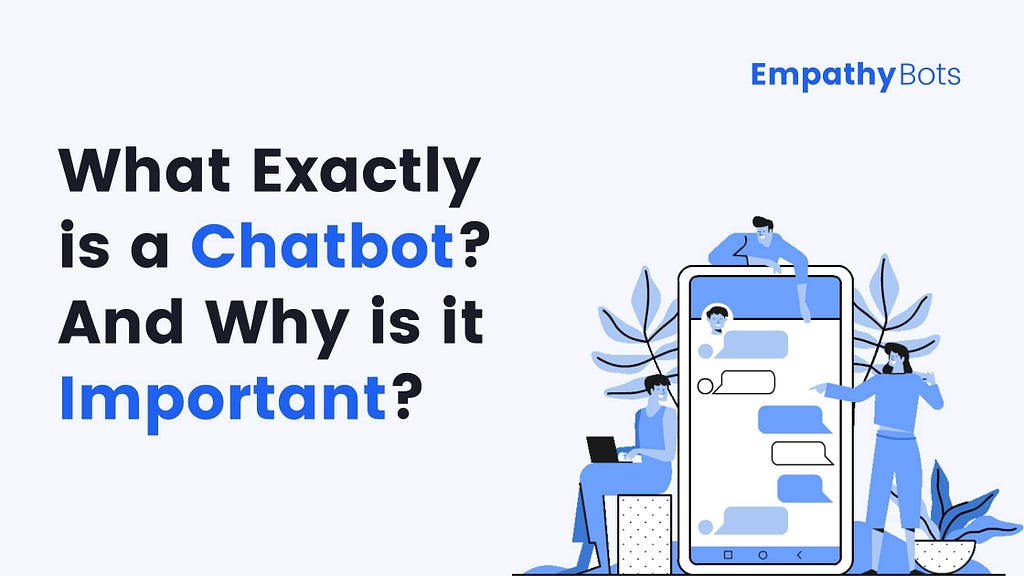
What Exactly is a Chatbot? And Why is it Important? — EmpathyBots
What Exactly is a Chatbot? And Why is it Important? — EmpathyBots
Chatbots are becoming a bigger part of our lives as consumers and in business. Why experts are predicting Chatbot market size to grow from $2.6 billion in 2021 to $9.4 billion by 2024 at a compound annual growth rate (CAGR) of 29.7%, Let’s find out!
Source: EmpathyBots What Exactly is a Chatbot?
Technically, a Chatbot (derived from “Chat Robot”) also known as “Chatterbot” is an automated conversational flow that simulates human conversation, either via voice or text-based communication.
It’s like you have an online store and you appointed Chatbot as your virtual storekeeper.
Organizations use Chatbots to engage with their customers alongside their other channels like phone, email, or social media.
What are the types of Chatbot?
There are two main types of Chatbot,
Rule-based or Task-oriented Chatbots
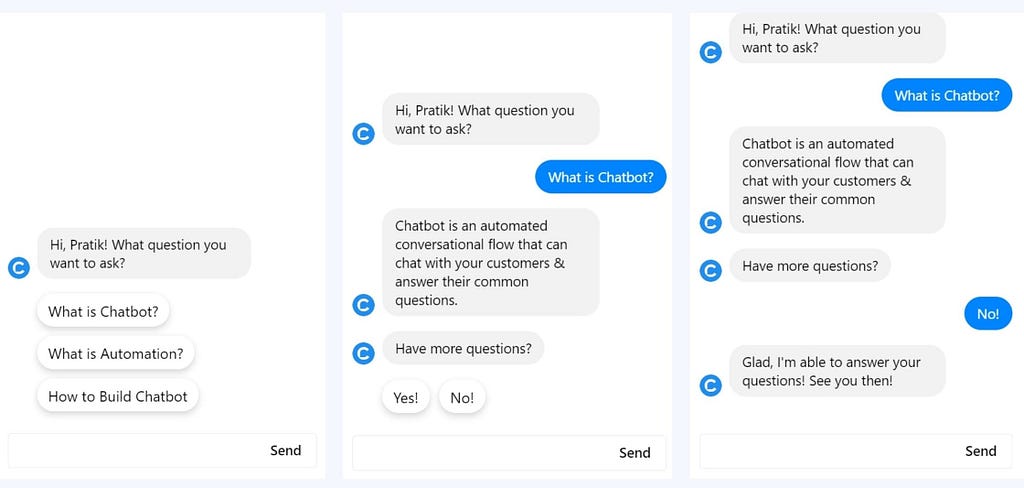
Rule-based Chatbots are built with the pre-set rules, Natural Language Processing (NLP), and very little Machine Learning (ML). These are precisely programmed using conditional loops to generate automated responses to users’ messages.
The Chatbot gives the options to a user to select and a user has to give input from the list only, otherwise, the bot cannot function properly.
Most of the time such bots used buttons to receive input from a user. But, it can ask to type a particular keyword or a number as well.
Source: EmpathyBots This is the most common type of Chatbots nowadays.
AI-Powered Chatbots
AI Chatbots are more contextually aware and use Natural Language Processing (NLP) and Machine Learning ML to understand the human language, process it, and reply appropriately.
Understanding human language is very useful when it comes to Chatbots.
These Chatbots use neural network algorithms to understand and process the natural language.
This Chatbot learns the language in patterns, as a child learns. After learning the number of words and phrases, it can make connections between questions, understand them, and give appropriate answers to the user. This is called Conversational AI.
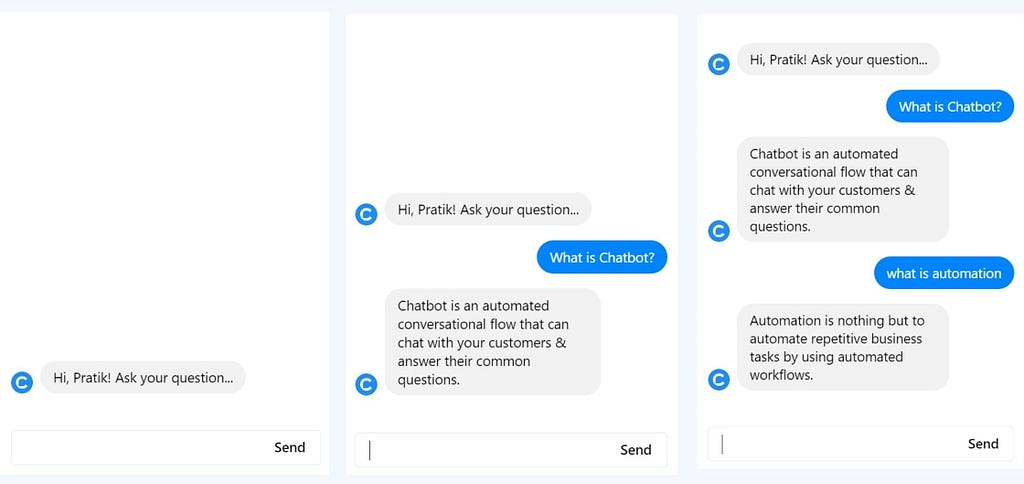
Source: EmpathyBots Why are Chatbots so Important?
According to Data
According to Salesforce’s “State of Service” report , 83% of customers expect someone to interact with them immediately after they contact a company. And also, 60% of their interaction with the company is taking place online in 2021.
76% of service professionals said that customers have increased their use of self-service resources during the pandemic. That is the reason, 81% of them are accelerating their digital initiatives.
And also, 77% of agents said that automating routine tasks allows them to focus on more complex work and increase productivity.
According to Facts
– A Chatbot has enormous potential for empathizing and personalization.
– A Chatbot is a self-service resource that can give customers information and solutions they need pretty quickly.
– People want Quality, Speed, Efficiency, and Experience higher than ever.
– It can reduce user wait time by the immediate response, instead of waiting for an email or phone response.
– It can resolve the most common and repetitive support cases and reduce the workload on live service agents (which can make them more productive).
– It can welcome users and direct them according to their needs.
- If a Chatbot is built with a proper Conversational Funnel, it can capture and nurture leads for a business and even generate sales by personalized product and service recommendations.
Trending Bot Articles:
2. Automated vs Live Chats: What will the Future of Customer Service Look Like?
4. Chatbot Vs. Intelligent Virtual Assistant — What’s the difference & Why Care?
How do Chatbots work?
The Chatbots are driven by Automated Pre-set Rules and AI functions such as Natural Language Processing (NLP), and Machine Learning (ML). It does backend data processing to deliver appropriate responses to user requests.
As I said earlier, there are two main types of Chatbot, and both of them work differently than each other.
Firstly, we’ll see how Rule-based Chatbots work.
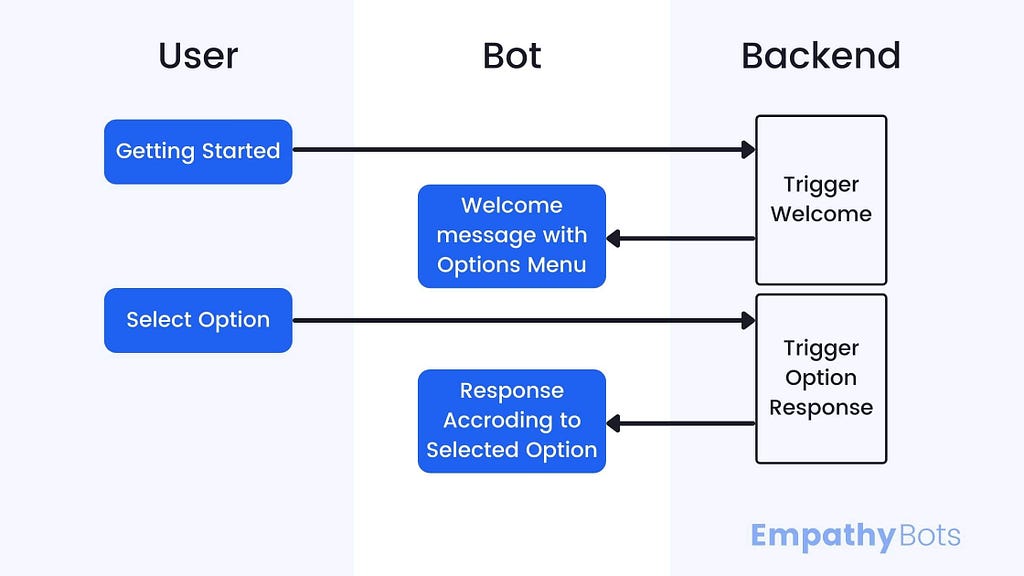
Source: EmpathyBots - First, the user starts the conversation which triggers the welcome condition.
- Then, Bot will send the welcome message and ask a user to take a certain action like clicking the button, sending the specific response, etc.
- Then, according to the selected option, it will trigger the condition.
- And, will send the response according to the selected option.
Now, we’ll see how AI-Powered Chatbots work.
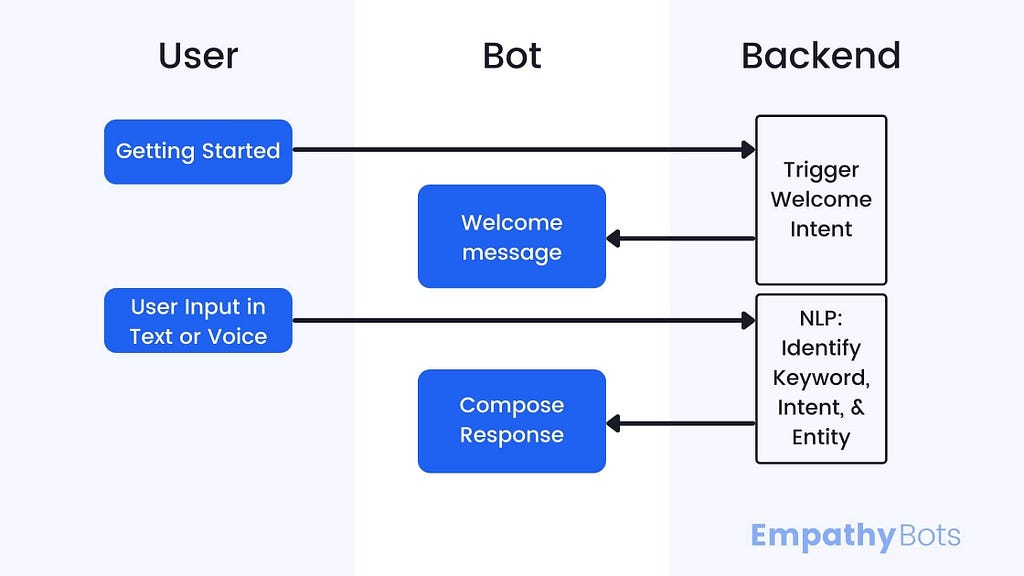
Source: EmpathyBots - First, the user starts the conversation which triggers the welcome intent.
- Then, Bot will send the welcome message and ask what to do.
- Now, here users can give any kind of response which has to be handled by the Bot.
- If Bot is built for handling the response, then it will trigger that intent and send the appropriate response.
What are the Use Cases of Chatbots?
Industries are discovering the potential of Chatbots in various functions to Automate and Streamline Activities, Improve Enterprise & Employee Productivity, and Boost Customer Engagement with the Brand.
These are the top use cases of Chatbots by Industry.
By Industry
Ecommerce
In Ecommerce, it can be used as a Virtual Store Keeper to assist the entire buying journey of a customer.
Primary Operations- Customer Support, Marketing, and Sales.
This Chatbot can
- Ask a customer about what they want or need.
- Recommend an appropriate product or service.
- Assist in completing a purchase.
- Give after support to the customer.
Banking
Primary Operations- Customer Support and Marketing.
This Chatbot can
- Assist in account opening.
- Send monthly transactional reports.
- Draft a stolen or lost card report.
- Inform customers about new banking schemes.
Insurance
Primary Operations- Agent Assistant and Customer Support.
This Chatbot can
- Transfer a call to a live agent.
- Fetch policy information and send it to the policyholder.
- Add dependents.
Healthcare
Primary Operations- Patient Support and Doctor Assistant.
This Chatbot can
- Book an appointment with a doctor.
- Help patients to get drug information.
- Engage with patients.
- Assist the doctor with patient reminders.
Retail
Primary Operations- Customer Support, Marketing, and Sales.
This Chatbot can
- Send product notifications.
- Give the entire shopping assistance.
Telecom
Primary Operations- Customer Support, Marketing, and Sales.
This Chatbot can
- Give entire customer support.
- Assist customers with recharging.
- Run promotional and marketing campaigns.
Travel & Hospitality
Primary Operations- Customer Support, Marketing, and Sales.
This Chatbot can
- Book a ticket.
- Guide them about tourist places and tours.
- Work as a virtual help desk for tourists.
Media & Entertainment
Primary Operations- Customer Support and Marketing.
This Chatbot can
- Enhance User engagement.
- Inform users about upcoming events and shows.
- Get subscribers.
Education
Primary Operations- Student Support and Teacher Assistant.
This Chatbot can
- Send notes and study materials to students.
- Inform about the daily timetable.
- Notify online class’s schedule.
Government
Primary Operations- People Support and Marketing.
This Chatbot can
- Inform about latest government initiatives.
- Enroll people in government schemes.
- Give information about different government policies and schemes.
These are the top use cases of Chatbots by operations.
By Operations
Customer Support
The first practical application of Chatbots is customer support. That is the reason most of the initial Chatbots have been built for customer support.
This Chatbot can
- Answer customers’ common questions.
- Help to solve common problems.
- Work as a first-layer help agent and then hand over to live agents.
HR Support
Now, HR departments of organizations also started leveraging the power of Chatbots to simplify and automate the HR processes.
This Chatbot can
- Answer questions about organizational policies.
- Manage the recruiting tasks such as resume collection, informing interview schedule, etc.
- Do leave management.
IT Support
With IT Support Chatbots, you can multiply the productivity of your employees and cut down your IT support costs. Especially in larger organizations, the help desk staff is unable to attend to all problems at once and employees fail to find timely IT-related help.
This Chatbot can
- Do asset management.
- Fulfill software and hardware requests.
- Handle non-productive tasks and alert support staff when human intervention is needed.
Marketing & Sales
With Marketing and Sales Chatbots, you can save a lot of time for your marketing and sales team and help them get more value on their time.
This Chatbot can
- Collect and provide data from CRM.
- Send Forecast Reports.
- Generate and Nurture Leads.
Finance
The rise of Chatbots in financial services indicates how quickly the business landscape is changing even in traditionally conservative areas.
This Chatbot can
- Do vendor onboarding
- Do payroll processing
- Provide financial advice and customer support.
Agent Assistant
Agent assistants can work as a first layer of support as a customer-faced Chatbot and also as a companion to human customer service agents to solve complex customer problems.
This Chatbot can
- Support during live chat or call.
- Do Automated CRM data entry.
- Give faster access to information.
What are the Examples of a Chatbot?
Nike’s StyleBot
Nike’s AI-powered chatbot allows users to find shoes based on their preferences through product recommendations. Users can create their personalized shoe designs and the option to share, save, and even buy them.
The Chatbots functionality includes browsing footwear, clothing, and NikeID (customizable Nike gear).
The Chatbot typically responds with interactive buttons, GIFs, and pictures. The user can interact with multiple-choice responses and natural queries as well.
Nike increased its average CTR by 12.5 times and conversions by 4 times during the launch of their AirMax Day shoe campaign. The Chatbot was developed by Snaps.io.
LeadPages Chatbot
LeadPages is an industry-leading drag-and-drop landing page creation tool, started using Drift Messaging and Chatbot to convert site visitors to the product comparison page.
The Chatbot functionality includes providing an immediate and targeted response which navigates visitors from browsing to content that could help them evaluate LeadPages as a potential solution.
The Chatbot starts the conversation when you land on their website using simple welcome messages like, “How can I help you?” or “I’m here to help!”
LeadPages achieved an open rate of 30% and a CTR of 21% to the product comparison page which is 10x times more than their email CTR.
MongoDB Chatbot
MongoDB is an open-source, cloud-hosted database program, started using Drift on its site to increase lead generation and qualify leads more efficiently.
The Chatbot functionality includes asking questions about pricing or sales to site visitors. If visitors engage, then Bot takes them through the question-answer funnel to determine if they are qualified leads or not.
If they are, then they are invited to book a sales call with a representative. Then, using calendar integration they can reserve a spot and automatically routed to the right salesperson using CRM integration.
Through this automatic qualification and immediate response time, MongoDB increased new leads by 70% and new opportunities by 170% in 3 months.
Conclusion and Future
As we’ve seen how Chatbots can enhance human capabilities and free humans to be more Creative, Innovative, and Productive.
In the near future, Chatbots will continue to evolve and bring in new text and voice-enabled user experiences. In an age where the speed of service matters more than ever, Chatbots help companies stay a step ahead.
Eventually, every person can have a fully functional personal assistant right in their pocket, making our world a more efficient and connected place to live and work.
Don’t forget to give us your 👏 !

What Exactly is a Chatbot? And Why is it Important? — EmpathyBots was originally published in Chatbots Life on Medium, where people are continuing the conversation by highlighting and responding to this story.
-
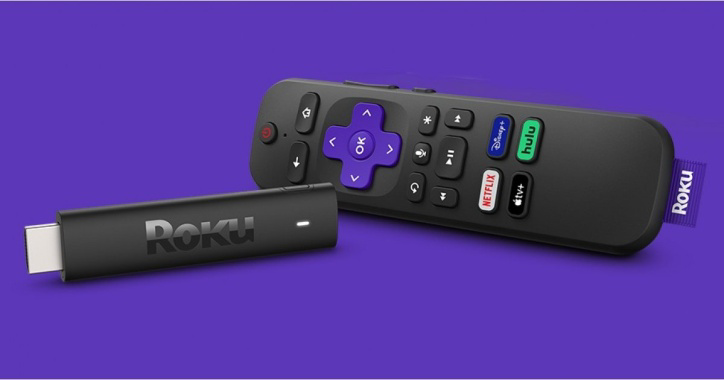
ROKU STREAMING STICK 4K DELIVERS DOLBY VISION AND SUPER-SPEED
With the replacement of excellent streaming Stick+ Roku has launched its new media Streaming stick 4k enabling Dolby version and HDR10+…
-
More faces for an online general chatbot.

More possible faces for an online general chatbot, does anyone like or hate these? Chatbot is for general help, discussions, advice and friendship.
submitted by /u/AIchatbotss
[link] [comments]

![[link]](https://i.redd.it/a040gyzqp7w71.jpg)


