
Chatbots have been around for decades, but they are just now starting to get popular with businesses. Research Dive has published a report…
Category: Chat
-
Look up and Synonyms are not working in RASA
I have used lookup table and synonyms, but the entities mentioned in the lookup are not detected by RASA, neither synonyms worked.
nlu: - intent: place_order examples: | - wanna [large](size) shoes for husky - need a [small](size) size [green](color) boots for pupps - have [blue](color) socks - would like to place an order - lookup: size examples: | - small -medium -large - synonym: small examples: | - small - s - tiny - synonym: large examples: | - large - l - big - synonym: medium examples: | - medium - m - average - normal - lookup: color examples: | - black - blue - white - red - green - orange - yellow - purple
It works correctly for “I would like to place an order for **large** **blue** shoes” , but if the input is “medium”(which is the lookup table) instead , it wont recognize
it wont work if synonyms of “large” like “big” is used.
submitted by /u/thestorytellerixvii
[link] [comments] -
A Comprehensive Survey of Existing Chatbot Architectures and Techniques(Part-1)

In this series of blogs, I will try to investigate various types of dialogue systems or more commonly knows as chatbots that exist and what are some of the design techniques and algorithms used to develop these systems. Since their inception in the 1960s dialogue systems have gained increasing attention due to their ability to streamline conversations between humans and machines. User experience and involvement have become an important factor for the growth of businesses across the globe and dialogue systems are a perfect way to engage a user to enhance their overall experience. Taking this into account this blog will cover the various chatbot architectures ranging from rule-based to generation-based. I will further investigate the social responsiveness of these dialogue systems and how we can achieve the architecture for the implementation of these chatbots in the next blog.
Introduction
Computer programs that receive natural language text or human voice as an input and can generate the best humanly responses to enable an intelligent and natural conversation between a human and a machine are known as conversational agents. These dialogue systems have wide applications ranging from e-commerce, hospitality, healthcare, automotive, question answering, and many more. Existing dialogue systems can be classified either as Task-Oriented dialogue systems, that are designed for a specific task and tends to have short conversations with the user to gain information and complete the task or as Chatbots which focuses on human engagement and social conversations [1]. A dialogue System architecture can be classified as either rule-based systems or corpus-based systems. Corpus-based systems can further be classified as information retrieval systems or generation based systems. In the sections to follow, I would provide details of these architectures.
Rule-Based System
This system is based on the simple method of decomposing the input text based on certain criteria and look for the presence of some keywords. These keywords when found are then transformed and reassembled according to the rules associated with them and certain assembly specifications. ELIZA was the first rule-based dialogue system developed to imitate Rogerian psychologist[2], which was followed by PARRY, a rule-based chatbot for studying schizophrenia[3]. More recent rule-based chatbots include DBpedia Chatbot designed to enhance user interaction with the DBpedia platform[4].
DBpedia Discussion and Developers mailing list was used as a data source, which was then cleaned and vectorized and converted into a matrix array which contains frequencies of each term in every message. These vectors were clustered into topics and threads using cosine similarity and then in the form of patterns, converted into rules which follow the structure of regular expressions.
These types of chatbots are not efficient in terms of answering questions whose patterns do not match with the rules that were used to train the chatbot. Additionally, it is a very cumbersome task to write various rules possible for different scenarios and that too for every possible scenario which becomes nearly impossible.
Trending Bot Articles:
2. Automated vs Live Chats: What will the Future of Customer Service Look Like?
4. Chatbot Vs. Intelligent Virtual Assistant — What’s the difference & Why Care?
Corpus-Based System
Due to inherent problems of hand-built rules, machine learning solutions are applied on corpus constructed from real-world data and hence the name, corpus-based chatbots. These corpora can be categorized based on the type and aspects of dialogue interactions like written or spoken corpora, human-human(contains entries of interaction between humans) or human-machine corpora(entries consists of interactions between a human and machine), natural or unnatural corpora, etc. [5]. Corpus-based natural language generation is used for spoken dialogue systems due to its inherent advantage of mimicking a human being rather than just acting on some predefined rules or templates [6]. These corpus-based chatbots can be further classified as information retrieval models or generation based models.
Information Retrieval Based Chatbots
These bots are trained on a corpus of dialogue interactions, a set of queries along with their possible responses. From the set of available responses, this system ranks all the matching responses and gives as an output the most relevant response. Query-Response Similarity and Query-Post Similarity measures were introduced for a post-comment pair dataset to measure the similarity between a query and a response where both the query and response are represented as TF-IDF vectors and fluent responses are returned [7].
One major problem with retrieval-based chatbots is the semantic gap that exists between two object descriptions due to linguistically different representations. To engage the user with the chatbot, it is of utmost importance that the responses being generated by the model are more than just answers to a given question. They need to contain some extra information to keep the conversation going and instil an environment of discussion with the user.
Topic-aware convolutional neural tensor network (TACNTN) was introduced to improve the matching algorithm which incorporates topic information by embedding the message, the response, and their related topic information into vector spaces which are processed by the neural tensors for matching[8]. By using this approach the system performed better than other baseline models such as LSTM, CNN, Cosine, etc.
The above discussion is centred on single-turn conversations in retrieval based systems which only takes into account the last input message in the conversation. We now take into account multi-turn conversations wherein responses are generated not only based on the last input message but the overall context of the conversation. The challenge in a multi-turn conversation system is identifying the right information and then using that information to find the responses that match the context while preserving the relationships between different turns.
A Sequential Matching Network was proposed in which the context vector is generated which is then compared with the response vector [9]. For every message-response pair, the model constructs word-word and sequence-sequence similarity matrix using word embeddings and gated recurrent units. In this way, useful information, by comparing the response with the previous turns, can be maintained which can add to the overall performance of the chatbot.
Generation Based Chatbots
Rather than choosing the most appropriate response for a query from the available corpus, generation-based chatbots tend to generate their answers using an encoder-decoder framework, where the query is encoded in a vector representation and given as an input to the decoder unit to generate the response. We can think of it as an alternate way of generating a response wherein machine translation from a user’s turn to a response takes place
Ritter et al. investigated the use of statistical machine translation for response generation and was the first approach to open-domain linguistic response generation[10].
They identified that message-response pairs are not semantically equivalent as in the case of machine translation of bilingual text and they were far more unaligned. Later on, encoder-decoder based models or Seq2Seq models used recurrent neural networks to read the input message and generate the corresponding response one token at a time [11]. Since one predicted output is fed as an input to predict the next output in the sequence and the entire output is not known before-hand, a less greedy approach is to use beam search wherein multiple outputs are given as an input at the previous step to predict the output of the next step. This simple and general architecture was able to produce simple responses and was able to maintain a basic level of conversation but it failed to capture long-term objective and information associated with the human conversation which is different from predicting the next step from the previous one.
To overcome the inability of this architecture to model longer prior context of the conversation hierarchical recurrent neural networks with bidirectional RNN encoder were used which allowed the model to see prior turns and to introduce additional short-term dependencies for longer messages present in the dataset[12].
A further enhancement in the model was made by including additional non-dialogue datasets that were based on the same topics and types of human conversations. Another problem with simple Seq2Seq architecture was that across multiple turns the response generated by the models tends to be incoherent and thus is only good for generating single responses.
This problem was tackled by introducing a hierarchical latent encoder-decoder model for generating dialogues and maintaining dialogue context[13]. With each dialogue message, a continuous latent variable of high dimensionality is attached based on which first the high-level semantic content of the response is represented followed by a word to word response generation.
This method helped address the problem of high variability among messages and made the conversation more natural. The Reinforcement learning-based dialogue manager was proposed to address the issues of robustness, flexibility, and reproducibility in task-completion dialogue systems and can be further applied to chatbots to allow natural interactions [14].
Going Deeper
In this post, I introduced you to the idea of dialogue systems and the various types of architectures around which to model our chatbots. In the coming posts, I would be talking more about the techniques and algorithms that are widely being used to implement this architecture and touch upon the idea of social and emotional awareness in chatbots.
References
[1] Speech and Language Processing. Daniel Jurafsky & James H. Martin.
[2] Weizenbaum, J. (1966). ELIZA — -a computer program for the study of natural language communication between man and machine. Communications of the ACM, 9(1), 36–45.
[3] Colby, K. M., Hilf, F. D., Weber, S., & Kraemer, H. C. (1972). Turing-like indistinguishability tests for the validation of a computer simulation of paranoid processes. Artificial Intelligence, 3, 199–221.
[4] Athreya, R. G., Ngonga Ngomo, A. C., & Usbeck, R. (2018, April). Enhancing Community Interactions with Data-Driven Chatbots — The DBpedia Chatbot. In Companion Proceedings of the The Web Conference 2018 (pp. 143–146). International World Wide Web Conferences Steering Committee.
[5] Serban, I. V., Lowe, R., Henderson, P., Charlin, L., & Pineau, J. (2015). A survey of available corpora for building data-driven dialogue systems. arXiv preprint arXiv:1512.05742.
[6] Oh, A. H., & Rudnicky, A. I. (2000). Stochastic language generation for spoken dialogue systems. In ANLP-NAACL 2000 Workshop: Conversational Systems.
[7] Ji, Z., Lu, Z., & Li, H. (2014). An information retrieval approach to short text conversation. arXiv preprint arXiv:1408.6988.
[8] Wu, Y., Li, Z., Wu, W., & Zhou, M. (2018). Response selection with topic clues for retrieval-based chatbots. Neurocomputing, 316, 251–261.
[9] Wu, Y., Wu, W., Xing, C., Zhou, M., & Li, Z. (2016). Sequential matching network: A new architecture for multi-turn response selection in retrieval-based chatbots. arXiv preprint arXiv:1612.01627.
[10] Ritter, A., Cherry, C., & Dolan, W. B. (2011, July). Data-driven response generation in social media. In Proceedings of the conference on empirical methods in natural language processing (pp. 583–593). Association for Computational Linguistics.
[11] Vinyals, O., & Le, Q. (2015). A neural conversational model. arXiv preprint arXiv:1506.05869.
[12] Serban, I. V., Sordoni, A., Bengio, Y., Courville, A., & Pineau, J. (2016, March). Building end-to-end dialogue systems using generative hierarchical neural network models. In Thirtieth AAAI Conference on Artificial Intelligence.
[13] Serban, I. V., Sordoni, A., Lowe, R., Charlin, L., Pineau, J., Courville, A., & Bengio, Y. (2017, February). A hierarchical latent variable encoder-decoder model for generating dialogues. In Thirty-First AAAI Conference on Artificial Intelligence.
[14] Li, J., Monroe, W., Ritter, A., Galley, M., Gao, J., & Jurafsky, D. (2016). Deep reinforcement learning for dialogue generation. arXiv preprint arXiv:1606.01541.
Don’t forget to give us your 👏 !

A Comprehensive Survey of Existing Chatbot Architectures and Techniques(Part-1) was originally published in Chatbots Life on Medium, where people are continuing the conversation by highlighting and responding to this story.
-
What do you Look for When Choosing a Chatbot Provider for Your Enterprise Business?
Compatibility, Integrations, Reviews, recommendations, or something else?
Here’s a quick review of Best Facebook Chatbots For Your Business Website by u/TechjuryO
submitted by /u/Botmywork
[link] [comments] -
how do we pass the value of an entity to a slot in RASA?
how do we pass the value of an entity to a slot?
Received user message ‘I would like to place an order for large blue shoes for my puppy’ with intent ‘{‘id’: -2557752933293854887, ‘name’: ‘place_order’, ‘confidence’: 0.9996021389961243}’ and entities ‘[{‘entity’: ‘size’, ‘start’: 35, ‘end’: 40, ‘confidence_entity’: 0.9921159148216248, ‘value’: ‘large’, ‘extractor’: ‘DIETClassifier’}, {‘entity’: ‘color’, ‘start’: 41, ‘end’: 45, ‘confidence_entity’: 0.9969255328178406, ‘value’: ‘blue’, ‘extractor’: ‘DIETClassifier’}]’
it recognized the entity and its value, but it wasn’t passed to the slot
Failed to replace placeholders in response ‘your order is {size} [color} boots. right?’. Tried to replace ‘size’ but could not find a value for it. There is no slot with this name nor did you pass the value explicitly when calling the response. Return response without filling the response
submitted by /u/thestorytellerixvii
[link] [comments] -
Ai anime chat bot like isekai
Does anyone have the ability to make a chat bot like isekai
submitted by /u/Captainrobin41
[link] [comments] -
Learn How Customers Think and Evolve with Data Dashboard

Chatbots have been the talk of the town and this technology is becoming a part of us whether we realize it or not. In e-commerce, the chatbot is the latest trend. Chatbot promises 24×7 availability, auto-learning capabilities that have intrigued e-commerce giants to hop on the chatbot bandwagon. Everyone is talking about implementing a chatbot and the ease it provides in communicating with the customers.
Here are some jaw-dropping chatbot statistics that you need to know in 2021 according to the author of Website builder,
- A chatbot can cut customer service costs by more than 30%.
- Chatbots are expected to help reduce business costs by up to $8 billion by the year 2022.
- There was a 67% increase in the adoption of chatbots by organizations between 2018 and 2020.
- 69% of the public prefers to use a chatbot instead of a company’s official App.
- 63% of people trust chatbots with their most sensitive information.
Additionally, according to an Oracle survey,
“80% of businesses said they currently use or are planning to use chatbots by 2020.”
Well, all this just proves that there is nothing greater than prioritizing customer comfort and convenience., More importantly, creating customer engagement is crucial. Chatbots help to create a brand identity, provide customer support to existing customers, retain loyal customers, and help customers communicate with the brand through an open channel.
CHATBOTS- THE FUTURE OF ECOMMERCE
In the digital age, that we live in today, convenience is a priority, and customers seek convenience. Chatbots provide just that, influencing customer relationships by providing quick solutions to their questions. A recent study found that 53% of service organizations expect to use chatbots within 18 months — a 136% growth rate that foreshadows a big role for the technology shortly.
Over 59% of millennials and 60% of Gen Xers in the United States have interacted with chatbots.
And according to a Facebook survey, more than 50% of customers say they’re more likely to shop with a business that they can connect with via chat.
Trending Bot Articles:
2. Automated vs Live Chats: What will the Future of Customer Service Look Like?
4. Chatbot Vs. Intelligent Virtual Assistant — What’s the difference & Why Care?
WHY CUSTOMER INSIGHTS IS PARAMOUNT
Customer insights give access to a powerful tool, ‘DATA’. Data is more valuable than ever and those who learn to use this data wisely will reap benefits.
According to British Data Scientist Clive Humby; “Data is the new oil”.
A resource that is extremely valuable to the business’s data not only provides crucial information but also helps in the chatbots’ learning abilities. This means that the chatbot can self-train by learning how users express their goals and needs (intents). Artificial Intelligence feeds on data and training the chatbot on this data is crucial.
The core of self-improving chatbots is an
Intent Recognition NLU, which is trained with a variety of question variations. When no intent is matched with a confidence level above 30%, the chatbot returns a fallback answer. For all others, the NLU engine returns the corresponding confidence level along with the response.
WHAT MORE CAN CUSTOMER INSIGHTS PROVIDE THROUGH THE DASHBOARD?
Now that we know customers prefer to communicate with chatbots more than humans, information that the customers chooses to leave behind is vital. Analyzing the information through an “insights dashboard” can help benefit and reframe the customer service strategy. Here are some ways the dashboard can help businesses:
- Improve customer service strategy
The more information the chatbot receives, the more efficient and empathic the chatbot gets. This is possible only with the information the customer leaves behind. This information can be used to create and improve customer service strategies.
- Context on returning customers
The chatbot can also derive numbers of returning customers and analyze their conversation history with the chatbot. When a customer returns to converse with the chatbot. the previous conversation is cataloged and that makes it itis easier to make suggestions to the customers according to their conversation patterns. For example, some customers communicate with the chatbot to check offers and promotions. The chatbot will be able to give relevant suggestions and approach them with different strategies to target a successful conversion.
- Improving communication with customers
The way the chatbot functions and communicates can be examined using metrics i.e. the duration of the conversation or the response time of the chatbot to customers’ questions. that. Longer chat duration could mean that the chatbot is having trouble understanding the customer requests and shorter chat duration could mean disrupted communication as well. Insights can help analyze these communication gaps to improve communication with customers.
- Customer retention
Insights are a key KPI metric to analyze retention rate. Dashboards can help us understand what makes customers stay, and what makes them happy, or why the clicks are not converting. Artificial Intelligence chatbots can categorize words through neurolinguistic programming that helps in understanding the customer pain points. This, in turn, helps in customer retention and also improves the customer journey.
- Analyze engagement rates
Analyzing the average number of conversations exchanged during one chat session will allow businesses to understand the engagement rates with the chatbot. This will help businesses create a more proactive chatbot by creating well-structured scenarios initiating conversations and, creating a personalized experience for customers. Insight’s Dashboard can give valuable information to improve engagement and boost conversion rates.
Analyze chat termination points
This metric will allow a business to understand where the customers terminated their conversation with the chatbot and why. Was the chatbot not understanding the customer requests? This quantitative metric can allow businesses to improve the efficiency of the chatbot by comparing the time spent on the chatbot by each user. This, in turn, will improve the quality of the chatbot’s responses and overall comprehension levels.
Summing up,
There is no doubt that insights are what feeds a chatbot and make it more efficient. Businesses that seek to derive and evolve this valuable information will truly succeed. The Insights Dashboard can be used to analyze most of the business KPI’s. Hence there is no exaggeration in saying that chatbot analytics will enable businesses to understand customer behavior, the key drivers that influence their decision-making process and what it takes to retain them, and more.
Don’t forget to give us your 👏 !
Learn How Customers Think and Evolve with Data Dashboard was originally published in Chatbots Life on Medium, where people are continuing the conversation by highlighting and responding to this story.
-
Natural Language Processing (NLP) in Speech Recognition for Kids
Welcome to “Lessons from our Voice Engine,” a series of blog posts by members of our Engineering and Speech Tech teams that explain, at a high level, how our voice engine works.
This first lesson comes from Nick Parslow, a Computational Linguist and member of our Speech Tech team at SoapBox Labs.
What is NLP?
Natural Language Processing (NLP) is about the interface between human language and machine language. This can mean taking a written sentence — just like this one — and extracting the key information from it, such as the semantic ideas, or the intent in the case of a command like left, right, open, close, for example. Going in the opposite direction, NLP can mean taking data and generating a human readable text from it.
In speech recognition systems like the SoapBox voice engine, NLP is used to build what are called language models — statistical models of language that can predict the next word based on the context. Language models are essential to help disambiguate similar sounding phrases. A great example of this is “white shoes” and “why choose.”
Trending Bot Articles:
2. Automated vs Live Chats: What will the Future of Customer Service Look Like?
4. Chatbot Vs. Intelligent Virtual Assistant — What’s the difference & Why Care?
Building a language model requires “normalization” of text — taking, for example, all instances of “ice-cream” and “icecream” and converting them to the same form. Without that normalization, the computer thinks of them as completely unrelated words.
Another use of NLP in speech recognition — in particular for English — is to work out the pronunciation of a word. This may be difficult for a machine to work out automatically (comparing “though” and “tough,” for example), so it may involve a mix of manual and automatic estimation.
What role does NLP play at SoapBox?
NLP plays a critical role at SoapBox because it links the spoken version of language with the written form, thereby allowing our voice engine to better understand and assess what a child is saying — their intent, their pronunciation, and much more — beyond just the words themselves.
Don’t forget to give us your 👏 !
Natural Language Processing (NLP) in Speech Recognition for Kids was originally published in Chatbots Life on Medium, where people are continuing the conversation by highlighting and responding to this story.
-
How to make voice payments at Exxon and Mobil Gas Stations with “Alexa pay for gas”
A collaboration between ExxonMobil, Fiserv, Amazon Pay, and Alexa has made possible the launch of voice payments technology. Who would have imagined the possibility of paying for gas just by using a simple voice command like “Alexa, pay for gas”. Let alone having it available at thousands of Exxon and Mobil gas stations all around the US.
However, it is a feature available for more than 10 months for every Amazon Alexa user, along with all the conveniences it includes.
How does “Alexa, pay for gas” work?
Every Amazon Alexa user can use this feature with the Alexa app in their smartphone, vehicles with Alexa built-in, or the Echo Auto devices to complete the payment for fuel with just their voice.
It is available in nearly 11,500 Exxon and Mobil gas stations across the US and everyone can use it assisted from the Amazon Pay services.
Trending Bot Articles:
2. Automated vs Live Chats: What will the Future of Customer Service Look Like?
4. Chatbot Vs. Intelligent Virtual Assistant — What’s the difference & Why Care?
Once you go near a gas station, you will only need to ask Alexa with your voice “Alexa, pay for gas”. Alexa will then confirm the pump number, station location and prepare for fueling. Now you can select the fuel type and start fueling.
After completing your transaction securely through Amazon Pay services and powered by Fiserv’s payment platform, your car will be filled up and back on the road in no time. There’s no need to pay inside the station or insert your credit card at the pump.
Convenience vs Security: is it worth it?
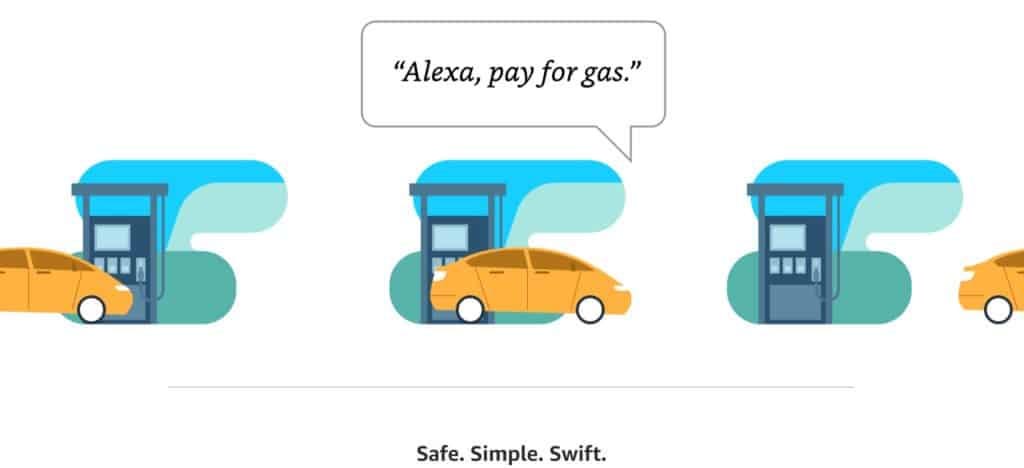
“Say, pay, be on your way!” is a phrase that has defined the future of filling up your vehicle at the gas station. What Amazon has done with its virtual assistant recently is truly innovative. You can see how this will be popular for drivers — getting them to fill up their tank without having to stand in line at the pump. Instead, they can make the process frictionless with a single voice request asking Alexa to pay for gas.
What about security and protecting your account from unwanted payments?
You can limit access to your account information by requiring a 4-digit code before you can make a purchase. If your personal information is already protected with a Voice Code, “Alexa, pay for gas” will work as expected. You can also use the same Voice Code for voice shopping.
In order to be able to use the Voice Code, you must first have a Voice Code, if not already. You can enable the feature in your Amazon Alexa account. From the Alexa App, go to “Account Settings” and then to “Voice Purchasing.”. Here you can create a new four-digit Voice Code.
Considering these details, we can conclude that “Alexa, pay for gas” is a convenient and simple way to refuel your car, yet very safe and secure since it goes through Amazon Pay services and Fiserv’s platform.
Don’t forget to give us your 👏 !
How to make voice payments at Exxon and Mobil Gas Stations with “Alexa pay for gas” was originally published in Chatbots Life on Medium, where people are continuing the conversation by highlighting and responding to this story.

