Author: Franz Malten Buemann

  • AI-powered chatbots to scale customer service support.

    When customers reach out to the company for service, they expect instant responses to their problems. However, a customer care provider can only cater to a certain number of cases at a time.

    How do you scale support? Have you thought about the customers?

    There are so many service horror sagas that customers have experienced like long wait lines where the agent is unavailable, one where the agent is unable to deliver answers to customer’s questions, agents ghosting on a customer on call, and inconsistent answers provided by service agents.

    If only there could be one place where the customers can go to, where there is an instant answer to their queries, quicker issue resolution and minimum agent transfers?

    Botspice- AI-Powered Customer support chatbots

    Customer care bot by Botspice, an AI-powered chat interface that answers customer FAQs and dynamically resolves customer concerns via smart interactive conversations. Breakthroughs in technology have completely changed the way businesses communicate with their customers. Organizations are under tremendous pressure to drive customer interactions effectively and respond to their query in minimal time. Gartner reports that virtual assistant usage in the workplace will climb to 25 percent by the end of 2021. To meet business goals and generate more revenues, companies must implement a system that engages customers more effectively.

    According to the definition from Chatbots Magazine,

    “A chatbot is a service, powered by rules and sometimes artificial intelligence, that you interact with via a chat interface.”

    Chatbots are also often compared with apps, as Gartner highlights it in its definition.

    Why AI-powered bots? Do businesses need it?

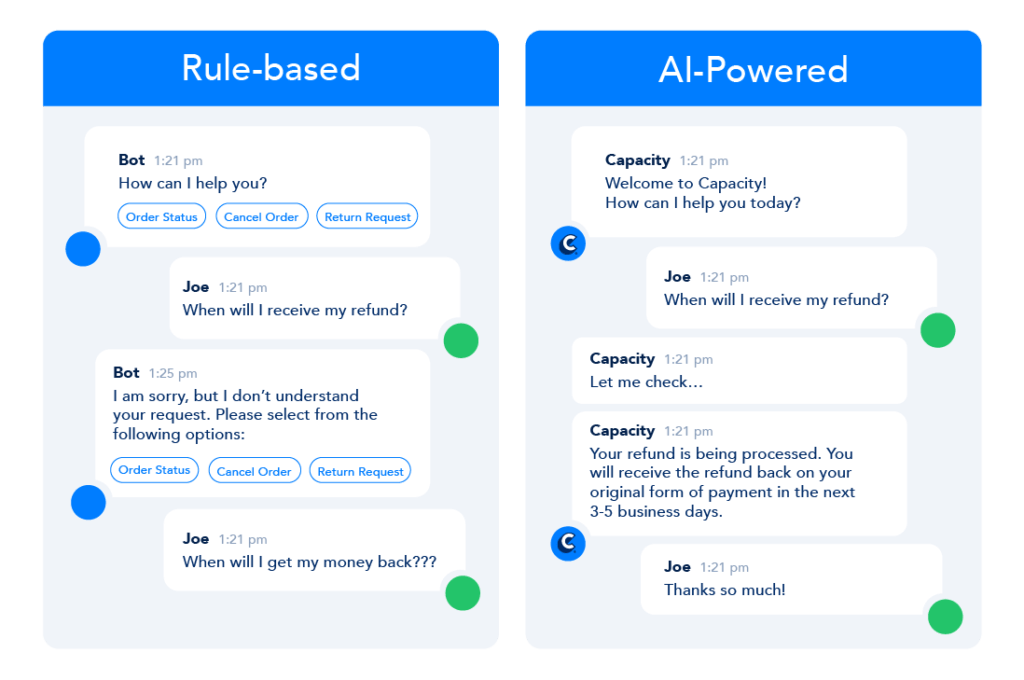
    Merely engaging customers through chatbots powered by rules is not enough, engaging them through smart interactive conversations, using machine learning & NLP and continually getting better at answering those questions in the future is an essential attribute of a chatbot. Like all successful automation efforts, customer service chatbots can reduce costs, but the improvements they make in customer experience are far more impactful. Bots are available 24 hours a day, 7 days a week, and often, customers’ questions are answered more quickly than human agents.

    Do businesses need Workbots?

    Well, the main goal of a customer service chatbot is to help businesses optimize resources and reduce agent turnover. How can a business achieve this goal? By providing exceptional customer service across a customer’s journey and also add value in the post-sales journey. Workbot is your best bet when it comes to creating engaging and interactive conversations. Workbot increases user engagement by using interactive workflows and making the conversation more human-centric.

    Trending Bot Articles:

    1. How Conversational AI can Automate Customer Service

    2. Automated vs Live Chats: What will the Future of Customer Service Look Like?

    3. Chatbots As Medical Assistants In COVID-19 Pandemic

    4. Chatbot Vs. Intelligent Virtual Assistant — What’s the difference & Why Care?

    What are the benefits and outcomes of implementing the Workbot for customer service?

    Technology shift expects businesses to take ownership of the customer engagement process. Optimizing the customer experience and implementing real-time and consistent interactions is the way forward. Workbot does just that by creating a positive and memorable experience at various customer journey touchpoints.

    By automating customer service using AI-powered bots, companies can

    • Minimize agent turnover and increase customer service productivity.

    A successful customer service chatbot will minimize the number of agents needed at a given period and provide consistent service with increased productivity. Often customers hesitate to call the customer service agents simply because they have to repeat themselves over and over again. By using friendly and approachable AI-powered chatbots, businesses can ensure that customers can have their queries understood and addressed via a simple text request.

    57% of customers would instead contact companies via digital media than use voice-based customer support, as per Ameyo’s research.

    Forrester says, nearly 1/3 of customers send a mobile/SMS message to the company requesting assistance.

    • Gather customer data through conversation funnels.

    Perhaps the biggest reason why so many companies collect consumer data is that it helps them to get a much better understanding of the way their consumers behave online, define their overall demographics, and identify how they can improve the overall customer experience. You may have heard the phrase “Content is King” first coined by Bill Gates following his essay of the same name in 1996.

    Susan Bidel from Forrester says, ‘In the Age of the Customer, Data Is King’

    It is therefore crucial to be able to access information about customer’s choices, demographics through conversational funnels. Precise user data and metrics allow organizations to optimize marketing plans. Knowing what does and doesn’t work allows organizations to be far more agile, responsive and targeted in their marketing and customer outreach efforts. AI chatbots can analyse millions of customer data touchpoints in real-time and help organizations access customer information at any point in time.

    • Analyze trends in customer inquiries and behaviors via a visual analytics dashboard.

    Organizations can analyse the statistical data and record market behaviour over time to generate valuable insights for strategizing and forecasting future business plans. Through analytics, dashboard organizations will be able to drill down and measure how effective the marketing strategies were in converting a potential lead to sales. Analytics dashboard can also predict what isn’t working in a customer journey. For example, if a customer drops off mid-way from a chatbot conversation, the organization can determine what exactly is not creating engagement which, in turn, can create new growth opportunities.

    • Customize interaction and strengthen brand loyalty.

    AI-powered chatbots communicate via a two-way conversational channel. It allows users to ask what they want without limiting themselves to a pre-determined set of questions. Workbots are available 24/7 and can help keep a business stay connected to its customers and provide consistently high support quality even when the support agent might not be available. Implementing Workbots can help build the customer’s trust, create loyalty and increase CLV customer lifetime value.

    • Drive revenue by automating transactions and providing up-sell opportunities.

    Workbots can be programmed to track your customer’s behaviours and choices based on their purchase decisions and the questions they ask. This can help organizations to generate up-sell opportunities and entice customers, thus driving revenue increase.

    • Reduce operational cost

    E-commerce statistics show that businesses spend around $1.3 trillion on customer requests every year.

    With Workbots customer service costs can be reduced to a significant amount. It can be exceptionally expensive to keep up and scale support with ever increasing customer service demands. This is especially so when one thinks of the manpower involved. Recruiting, training and retraining agents can be expensive especially as the organization grows. Artificial Intelligence-powered chatbots will be a smart solution for development and integration. Once deployed, it can help a business scale up service and sales interactions across multiple channels and enrich customer journey touchpoints.

    All these are just statistical benefits but the one benefit that organizations look for is increasing revenue-per-case while reducing cost-per-case That is what differentiates a mediocre chatbot from an AI-powered Workbot.

    Botspice delivers a vertical Artificial Intelligence that owns the entire workflow to solve targeted customer needs. It develops a complete product from end-to-end, starting with understanding the business case to optimizing product performance.

    Every brand needs an expert interactive agent!

    How does this work? How can I implement Workbots?

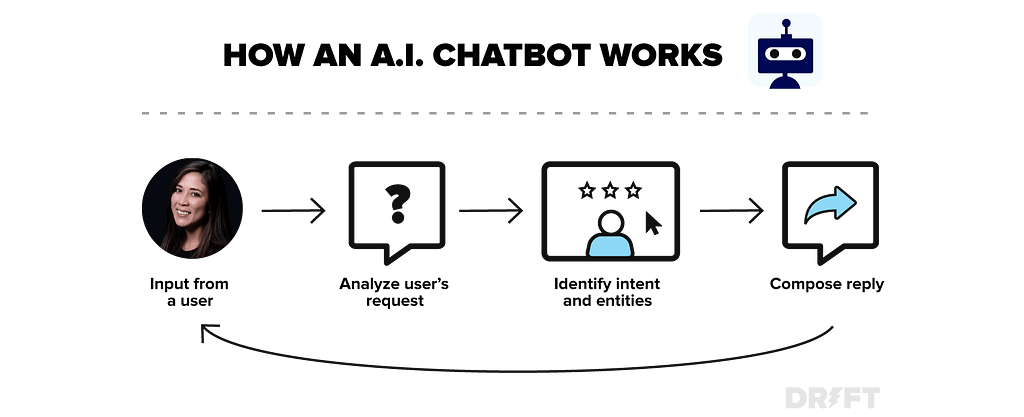
    How does a Workbot work? Workbot uses Natural Language Processing to analyse the user’s request to understand the intent and extract relevant information. It then responds to the user with an appropriate answer which could be either:

    1. A pre-defined text message.
    2. Relevant information from a knowledge base.

    Botspice simplifies the design, development and deployment of bots across multiple channels like messaging apps, digital assistants, collaboration tools and enterprise applications. It allows organizations to customize Workbots with rich media and a dynamic conversational flow. AI-based knowledge “Brains” enable Workbots to respond to queries 24/7 with consistency. Once ready, your AI chatbot is ready to be published.

    Workbots improve over time. The number of intents they can recognize will expand as your company identifies which questions are of high volume handled by the chatbot.

    In conclusion

    A successful virtual assistant will reduce cost and scale support especially if you’ve set it up with the right intention and deployed them to the right channels to optimize success. AI-powered chatbots are crucial to a well-designed customer service strategy. Workbots can help either strengthen or substitute the need for two-way human intervention thus cutting total operational costs and improving customer satisfaction. When implemented correctly, Workbots can enhance the user experience, improve engagement and provide customers with actionable solutions. How will you implement chatbots into your customer service strategy from now on?

    Don’t forget to give us your 👏 !


    AI-powered chatbots to scale customer service support. was originally published in Chatbots Life on Medium, where people are continuing the conversation by highlighting and responding to this story.

  • What is missing in chatbots today?

    I’m creating a bot for a restaurant right now, and trying to avoid the biggest mistakes bot-builders do. What are your biggest pet peeves or dislikes in chatbots?

    submitted by /u/Mfor_Mary
    [link] [comments]

  • Step by step guide to build healthcare chatbot without any coding.

    Chatbots, a smart asynchronous means of communication, powered by AI has seen a high acceptance and penetration during the last few months. A number of industries started to believe they can be a great help for their business and can support when they are focussed on fixing a number of other issues.

    A number of such chatbots are now deployed for the healthcare industry where medical professionals use them to support the cause of social distancing and help users with relevant answers.

    Chatbots in healthcare are extremely critical for the advancement of efficient and accurate patient care. They are also expected to support the world’s need of creating affordable and sustainable health care for every individual on the planet.

    Why are chatbots in healthcare growing so fast?

    Continuous availability and ongoing support

    Covid has been an eye-opener for the world why creating an ecosystem for public health is paramount. During hours of crisis, even paramedics and other allied servicemen become crucial to handle crises.

    This also makes the world vulnerable to patients who are looking for urgent medical attention and guidance. Unfortunately, doctors have limited time, and having a set of requirements makes it impossible for them to cater to everyone.

    Chatbots can play a wonderful role in supporting these patients and guide them with authentic and reliable information.

    Scheduling Appointments and Other FAQs

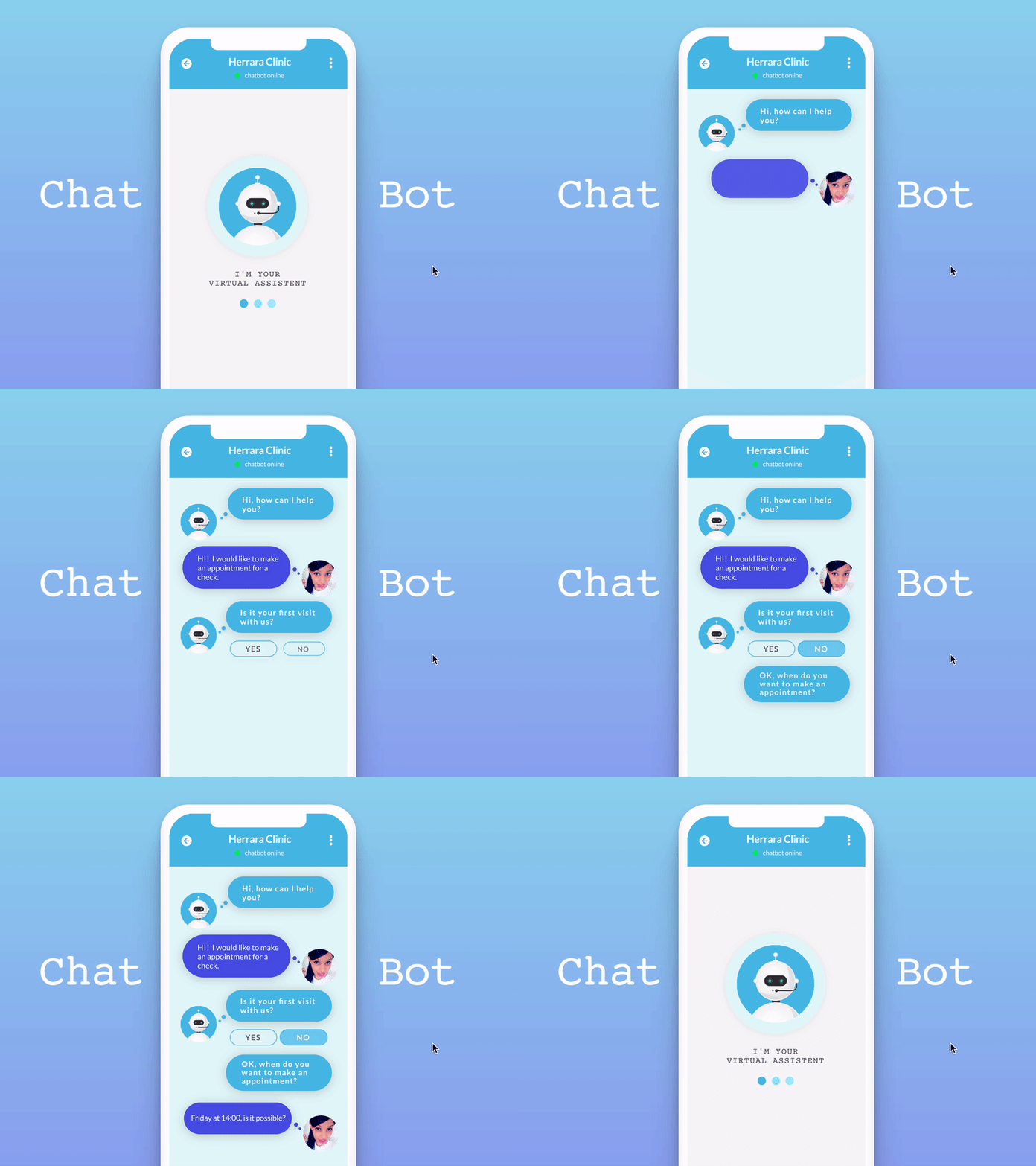
    A number of patients complain of very busy helpdesks. This often results in dissatisfaction among the visitors and their loved ones. Since a number of patients connect with health care institutions primarily to take appointments or find answers to generic issues, this can be extremely well handled by chatbots. Today’s chatbots can help in booking appointments and also respond to regular questions using the existing knowledge base.
    They can also take up relevant information after booking the appointment which can help doctors understand the patient well and track all of their visits, follow-ups.

    Building Trust Among Patients

    Every medical institution needs to look progressive and the one who is looking to keep up with advancements in the world of technology. Chatbots have become a great way to build this trust as it caters with authentic information to users and at the right time.

    For example, if someone is looking to meet a doctor then the chatbot by knowing its symptoms can easily recommend if she needs urgent attention or some basic medicines before she comes up for the checkup.

    The reasons listed above have been the biggest drivers yesterday, today, and tomorrow for the growth of chatbots in the healthcare domain. However, one must also look at the reasons and risks involved which can stop this growth.

    Trending Bot Articles:

    1. How Conversational AI can Automate Customer Service

    2. Automated vs Live Chats: What will the Future of Customer Service Look Like?

    3. Chatbots As Medical Assistants In COVID-19 Pandemic

    4. Chatbot Vs. Intelligent Virtual Assistant — What’s the difference & Why Care?

    Challenges We Must Not Forget

    Low Usage Among Senior Citizens

    Some of the most vulnerable classes for healthcare don’t find it easy to use and confusing. One of the bigger challenges in front of healthcare providers is to get onboard this section of society. They have to look beyond just chat and can look to integrate the option of text as well. This can allow users to get answers and create a feeling similar to being treated by a doctor.

    IT Vulnerability and Hacking Probabilities

    One of the biggest challenges in front of chatbot creators is minimizing the vulnerability risks involved in creating sensitive and regulated information. A number of information shared to chatbots need to be highly secured and can’t be leaked. A number of precautions need to be taken to minimize cyber attacks and also any kind of information leaks

    Well Tested Both From Performance and Information

    Information that is shared with these chatbots is a matter of life and death sometimes. It is extremely vital that this information is well researched and also tested extensively to avoid any kind of mishaps. The information should be coming from a well researched and reliable source to avoid any last kind of issues

    While we have understood the importance, need and risks involved while building a chatbot, it is extremely important for us to understand the process behind it as well. This will help us understand the technicalities far better and also explain the same to our visitors time and again.

    Chatbots across all the industries work in a similar manner so understanding one can help you understand the rest too. Here the working mechanism has been considered for all three kinds of chatbots i.e. Rule-based, intellectually independent, and machine-based. You can read more about them from our last blog on “How chatbot works”.

    From the above diagram you are able to understand how the data is processed and using the NLP layer the user’s inputs are validated and processed for the relevant answer.

    Bonus: How to Build Coronavirus Chatbot

    However, the following are the key highlights of the process

    1. Some of the chatbots divide certain words into smaller tokens so that they can easily understand the process and also define its applications.

    2. Chatbox is used for named entity fields like user name, gender, age, etc to understand better details about the user and then recommend the relevant answer

    3. One of the key highlights of using NLP is understanding the phrases of our users and deciphering the exact meaning of the same. With dependency parsing, chatbots are able to identify different parts of speech such as nouns, verbs etc and understand the meaning of complex sentences as well.

    Also, using sentiment analysis they can understand the real meaning of the words which are often called “homonyms”.

    While we have understood the need and process of implementing chatbots it is crucial for us to understand the process of building it as well

    How to build your own healthcare chatbot

    A number of tools today can help you create your first chatbot in minutes. Let us understand the process of the same.

    However, to use these tools you are no longer required to understand the world of coding but are primarily driven by drag and drop processes

    Here I am using the NLP based codeless bot builder Kompose. You sign up here for 30 days free trial and follow further steps to build your healthcare chatbot.

    1. Login to your Kommunicate dashboard and click on Bot integration
    2. In the bot ‘Bot Integration‘ section >> Select Kompose >> Setup Bot
    3. You can create the following right away.

    Welcome Message

    A simple message on how your bot will behave once you are user initiates a conversation with your bot.

    Answers

    While you are discovering how to welcome your user it is also critical to see what are the probable answers for the bots to share. This is vital as understanding the user is crucial.

    Small Talk

    What are the various FAQs which the bots need to know?

    You can feed all them here and users can get quick answers to that.

    Fallback

    This is important as leaving everything on the bot is not recommended. Creating a backup plan where a human can forward when the bot is not able to understand is crucial.

    You can also check out the step by step process on How to make a chatbot

    Once you are able to follow the above-listed steps you are almost halfway through the process of creating a basic chatbot for your business. It is vital that you are testing it extensively across multiple languages and devices to ensure that the experience is a good one for your user.

    Some Useful Templates For Healthcare Chatbots

    Now that you have a good understanding on how to create a chatbot your healthcare institute, here are some of the best practices for you to get started.

    Booking a doctors appointment

    Cato: Welcome to <Name of the entity>. We are a super specialty clinic with more than <number of doctors> under one roof. How can I help you today?
    User: I need to book an appointment
    Cato: Ok! Please let me know what kind of treatment you are looking for?
    User: I need to consult a cardiologist
    Cato: Ok. What is the best date and time for you to drop by?
    User: 5th October anytime
    Cato: Here are the available options
    5th Oct, 10: 00 AM
    7th Oct, 11:00 AM
    9th Oct, 3.30 PM

    Healthcare Services

    Cato: Hi, Welcome to <Name of healthcare institute>, a super specialty clinic.
    How can we help you today?
    User: I am looking for a medical recommendation
    Cato: Ok, I understand. To get started: Please do share your Name, Age, sex
    User: I am Katen. I am 35 years old and a male.
    Cato: Thanks a lot for sharing. Do let us know what are the challenges you are facing
    User: I am having a mild fever for the last few days and also a pain in the throat
    Cato: Ok, I see. Let me help you. I have a few more questions to ask: Is that ok?
    User: Yes

    So what are the use-cases of Chatbots in the healthcare industry?

    Lead Generation:

    Never miss out any of the visitors who are looking to know more about your services or trying to book a service

    Specific Chatbots:

    This pandemic has already taught us how every healthcare professional is critical for the world. With disease-specific chatbots, one can use the same for reaching out to multiple users at once with authentic information.

    Customer Support:

    Answer all the relevant questions or queries of the visitors in a flash. Have an extensive knowledge base for them to answer it quickly. You can train your bots too with time.

    Feedbacks and Survey:

    Take regular feedback about their experience and discover what all you can improve with time.

    The use cases mentioned above are of generic nature and they can be expanded as per user behavior. Let us also look at some of the chatbots and its utility as per the current market requirements

    1. Florence: A chatbot that reminds users to take pills, track body weight, track mood, and also menstrual periods. It aims to behave like a nurse for an individual.
    2. Safedrugbot: A chatbot which aims to offer assistance to medical professionals with an extensive knowledge base about drug dosage and more.
    3. CancerChatbot: As the name suggests it is a chatbot used to guide patients and their loved ones on everything related to cancer. Whenever a user shares a query, the chatbot finds the best possible answer from a reliable database and shares.
    4. Sensely: A smart chatbot that is used to track symptoms from both text and speech. It’s the ability to understand the symptoms and recommend a diagnosis that has been a great attraction point for users and doctors.
    5. Woebot: A mental health chatbot which aims to understand the need and symptoms of users around mental health. The chatbot studies the mood, personality and recommends the best way forward.

    Wrapping up

    One thing we should remember after reading the evolution, growth and use cases about chatbot in healthcare domain. It is just the beginning of a revolution and it has just started.

    The very purpose of introducing chatbots is to make life easy for users. In today’s world of extremely busy and hectic life traveling often becomes tedious. Also, finding an authentic and reliable resource is also becoming a challenge with so much noise around

    These virtual assistants can be a great way to address these growing challenges as they can keep users engaged, help them when needed and also guide them to the best possible solution. The world can easily rely on them for creating an ecosystem of affordable and authentic healthcare.

    In the future conversational AI will become the best way to help patients navigate through major challenges. The time ahead is surely exciting for chatbots in healthcare domain.

    This article was originally published here.

    Don’t forget to give us your 👏 !


    Step by step guide to build healthcare chatbot without any coding. was originally published in Chatbots Life on Medium, where people are continuing the conversation by highlighting and responding to this story.

  • App Highlights: Dialogflow

    Dialogflow is a Natural Language Processing (NLP) platform by Google that provides users with the service to build, and design conversational interfaces; that can be integrated into applications, websites, and chatbots with ease. Dialogflow can analyze multiple inputs of media like audio, text, and video. It also has the capability of replying in these multiple formats.

    Benefits of using Dialogflow

    • Developer friendly: With a built-in, inline code editor; Dialogflow simplifies the coding process for developers. Agents can connect to their applications and code with ease through the cloud and on-premise facilities.
    • Powered by Google’s machine learning: App developers are given the platform with which they can train their agents to gain a better understanding of conversing with people. The app extracts relevant information and provides it to AI for better understanding.
    • Pre-built templates: Dialogflow comes with more than 30 pre-built templates that act as a foundation for developers.
    • Can express itself through natural conversation: Chatbots created with the aid of Dialogflow can have the ability to speak to people using natural language. This means it can understand abbreviations, and converse with people in an informal tone ensuring that it doesn’t sound too robotic.

    Trending Bot Articles:

    1. How Conversational AI can Automate Customer Service

    2. Automated vs Live Chats: What will the Future of Customer Service Look Like?

    3. Chatbots As Medical Assistants In COVID-19 Pandemic

    4. Chatbot Vs. Intelligent Virtual Assistant — What’s the difference & Why Care?

    Apps that connect with Dialogflow

    • Facebook: Build a conversational bot on messenger.
    • Wix: Build a conversational bot on your website.
    • WhatsApp: Build a shopping bot or FAQ bot on WhatsApp.
    • Intercom: Enhance live chat service on your platform.

    These are just a few applications you can pair Dialogflow with, explore our Dialogflow page to know more about automating Dialogflow and get in touch with us in case you don’t find an app you’d like to pair Dialogflow with!

    Don’t forget to give us your 👏 !


    App Highlights: Dialogflow was originally published in Chatbots Life on Medium, where people are continuing the conversation by highlighting and responding to this story.

  • A Guide To Chatbot Testing Framework & Techniques 2021

    vectorjuice

    Nowadays, almost every site uses Chatbots, whether it’s a social network, a website, or an e-commerce platform. Chatbots help expand your business and manage your CRM (Customer Retention Management) interaction like a professional.

    The futuristic benefits and timely investment into chatbots have leveraged many companies to realize their full potential. A chatbot proves to be an excellent addition to enhance your marketing plans and benefit your organization if applied correctly.

    However, successfully deploying a chatbot doesn’t warrant goal achievement. You need thorough testing before applying it to your marketing strategy. If you’re a beginner to this topic, you might wonder about the techniques available for testing a chatbot?

    This guide will help in solving your concerns regarding tips and techniques related to chatbot testing. Let’s take a closer look below:

    Regulation of testing frameworks

    Generally, almost every testing procedure is devoid of standardization. It becomes challenging to measure the amount of communication covered by test cases, particularly before launching a bot. The objective of the testing procedure should be to include the most anticipated use cases.

    The testing framework developed broadly follows three categories listed below.

    • Expected scenarios
    • Possible scenarios
    • Almost impossible scenarios.

    These testing use cases can be charted to sigma distances. When testing for the third category (nearly impossible use cases) is completed (known as 3-sigma distance), the chatbot’s performance can be said to be evaluated at a 99% confidence interval. Any testing beyond this level would incur high costs because there are endless possibilities in which humans use language.

    Domain of testing:

    Chatbot testing offers seven kinds of domain for testing:-

    • Conversational flow
    • Natural language processing model
    • Intelligence onboarding
    • Personality
    • Understanding
    • Answering
    • Security
    • Speed
    • Navigation
    • Error management
    • Intelligence
    • Response time

    Agile and regular Testing

    Chatbots are good instances of software technology developed using the Agile approach. It offers the best possible viable products that can be obtained after every loop. It captures new phrases with the help of error handling functions.

    To prevent bugs from creeping into the bot, testing needs to be done at each iteration. The initial phase includes manual testing, which ensures the execution of the business workflow. The end phases include automatic testing that reduces wastage of time and helps programmers to launch better versions to market.

    Trending Bot Articles:

    1. How Conversational AI can Automate Customer Service

    2. Automated vs Live Chats: What will the Future of Customer Service Look Like?

    3. Chatbots As Medical Assistants In COVID-19 Pandemic

    4. Chatbot Vs. Intelligent Virtual Assistant — What’s the difference & Why Care?

    Developer Testing

    This kind of testing is simple and direct, which the developers are familiar with. It includes executing a validation and verification test and defining the chatbot’s answers and user questions beforehand. These tests will check whether the bot gives precise answers to an imaginary question or cannot do so.

    Chatbot Testing Frameworks

    Developers and testers have to follow analytical thinking to overcome elements of uncertainty in their test objects to understand how a chatbot will operate. The following list shows some of the techniques testers can utilize when dealing with a chatbot:

    • Advanced automation framework: it is essential to test for the point-to-point flow of conversation, understanding natural language, and scope for self-improvement.
    • Domain-specific testing: evaluating selected products and services mainly for the business- and consumer end benefits limits the range of testing. Therefore domain testing helps test all possible use cases.
    • Real-time monitoring and KPI (Key Performance Indicators): KPI for measuring chatbot performance are different and include parameters like rate of goal accomplishment, AI and machine learning rate, self-service rate, and fallback rate.
    • Advanced security mechanism: The security mechanism must incorporate user authentication, end-to-end encryption, two-factor authentication, compliance validations, authentication timeout, channel authentication, intent authorization, and self-destructing messages.

    Testing the latest technologies and practically implementing them can be exciting and challenging at the same time. Especially viewing the approaches and tools that have worked in your favor failing in chatbot testing can cause frustration among the best developers. Therefore, considering these up-to-date strategies will assist the developers in testing a chatbot in a better way.

    Botanalytics

    Botanalytics is a dynamic AI-enabled conversational analytics tool that assists you in capturing engagement across your user lifecycle. With the cutting-edge AI-based solution, you can enhance the capability to interact through sentiment analysis and A/B testing, etc.

    Chatbottest

    Chatbottest is a free guide with 120 questions that help you assess your chatbots’ user experience. It evaluates the bot based on the seven domains of testing mentioned above.

    Dimon

    Dimon is a tool for testing tests your chatbot’s flow of conversation and user experience. It even has added functionality of integrating with social media platforms such as Facebook, Slack, Messenger, Telegram, and WeChat.

    Techniques for Testing Chatbots

    There are different techniques available to test chatbots which depends upon the type of tool being used. A straightforward way is to try the entire training data in your model and correctly predict your model. Moreover, the testing techniques are broadly divided into two main types:

    Industry Standard Cross-Validation Techniques

    Models based on MI (Machine Learning) are tested using a statistical approach called cross-validation. In this testing, the model’s capability to predict new data dissimilar from the one used for training is evaluated. This kind of testing in interactive AI systems implies testing the bot using queries from the scope examples used for training it.

    Standard practices include Leave-one-out cross-validation (LOOCV) and K-fold. The K-fold method divides the data into k groups, in which one part is used for testing the model and the remaining part (k-1) for training. It is iterated k times with every split taking turns at being used for testing.

    The LOOCV approach is an extensive method in which the model is tested over possible combinations that the original sample could be divided into testing and training sets. It is bears less computational cost and is appropriate for training small data sets. Experts recommend using cross-validation techniques before switching to blind testing.

    Blind Tests — Testing Data Sets with Statements

    Blind testing includes testing data with utterances or questions that users might enquire about along with the equivalent exact answer. These queries are executed through the model via a batch test. During this process, every query is marked as to whether the prediction made by the model was correct or not.

    Irrespective of the methods used, it is critical to detect the action steps relying on the result. Data visualization techniques help better understand how similarly or dissimilarly the model understands the data by displaying them as close or far away.

    A confusion matrix is also quite beneficial in representing objectives predicted by the model so that the NLP trainer can detect patterns and retrain the objectives as per requirements.

    Every project doesn’t need to evaluate through both kinds of tests. The selection relies on the developer’s knowledge and potential to conduct the tests.

    Create a Good Test Set In Case of Non-Availability of Current Data

    Both the testing of the interactive AI and its successful implementation mainly depend upon the selected data set. Before preparing a blind test set for AI, keep the following rules in mind.

    • Scenario-based — reflect on as many scenarios possible that users could encounter while communicating with a conversational AI. It will help in grouping intent-based questions that map to unique answers.
    • Well explained descriptions — having a detailed description of a problem is always considered better since the bot needs to offer a solution to the user. You need to incorporate the following things -user type, the difficulty faced, and how the user will express the query.
    • Align interpretations- it is better to arrange the questions asked to the bot by the users in a systematic order.
    • Well-defined answers — ensure that the queries used in the training set carry their corresponding solutions well-phrased and carry value.
    • Questions based on ground reality — always opt for the best data source regarding testing that includes genuine questions asked by real users.

    Few Common Errors to avoid

    Often, the training test data set does not meet expectations when training the bot is concerned. It occurs due to common errors like –

    • Irrelevant test questions for solving the scenario — improper preparation could lead to participants of the test ending up enquiring peculiar and arbitrary questions to test conversational AI or for fun.
    • Similar expressions carry different intents — which could create conflict and confusion.
    • The explanations of scenarios being very general
    • The questions are lengthy and lacking clarity — often, while preparing the data set for training, questions could become verbose and include unrequired content.

    Coverage Ratio — Critical Analytics Parameter

    Continuous monitoring of the analytics tool is essential in a software deployment project. It becomes even more critical when iterative reviewing and testing of the chatbots’ performance is concerned.

    Tune your analytics to track the Coverage Ratio. It will help you know what questions users ask and how many of those questions are featured in the AI-based assistant trained for answering correctly.

    • For coverage greater and equal to at least 70 to 80%, the questions selected by you for training the chatbot are good and closely represent how actual users might ask.
    • For coverage values lower than the above limit- implies that few queries made by you come under the training set for the chatbot but are not precisely what the actual user is asking.
    • For such a scenario, the best option is to delete a few of these inappropriate queries and include many relevant questions that the users need assistance with.
    • Having fewer examples per intent and similar expressions grouped into different purposes is the most common cause behind wrong predictions.
    • It is essential to gather good examples to train the bot according to the predefined test sets. As per the rule, you should target 10–20 examples per intent.

    Integrating Email and SMS With Chatbots

    Email

    With advanced technical frameworks available these days, your chatbots can be aligned with email marketing easily. These two technologies function together well, as can be seen through the following use-cases, highlighting three situations where chatbots can sync with email marketing.

    • Chatbot for Email subscription list
    • Conversational chatbots for email marketing
    • Chatbots for online purchases

    These are some of the most straightforward use cases that can be directed to sign up for a mailing list. When the lead gets successfully converted, the bot can ask for some basic details along with the subscriber’s email address.

    So basically, the entire workflow comprises of the following-

    • Email — data and essential documents that customers require for making a decision
    • Chatbot — Answers to queries and delivers information instantly when leads are about to be converted
    • Chatbots are even used for managing online purchases.

    SMS Chatbot-Marketing Through Text

    Just like email marketing chatbots, SMS chatbots are also being utilized for marketing and promoting brands. SMS marketing services offer a consistent channel for marketing since you re-engage with the user repeatedly.

    It uses permission-based text messaging to spread marketing messages, such as new product launches, analyses, or feedback.

    Conclusion

    It eventually comes down to testing -which forms the foundation for including desired features of the conversational AI. However, these features can be enhanced with constant effort and deploying of apt technologies.

    Chatbot testing forms the most critical characteristic of the whole chatbot lifecycle. The techniques mentioned above and tools will guide you in extensively checking your bot before launching it on any platform.

    It would be better to ensure that your bot is interactive enough, execute a domain-specific test, and carefully examine the results. It should tell you how good your bots are at handling unexpected queries.

    You can either go for manual checking through the developer’s help or use the described tools to evaluate them. Last but not least, to make the chatbot more interactive, always encourage small talk, look for matching intent, and define a fallback along with excellent navigation.

    Don’t forget to give us your 👏 !


    A Guide To Chatbot Testing Framework & Techniques 2021 was originally published in Chatbots Life on Medium, where people are continuing the conversation by highlighting and responding to this story.

  • Five Common Misconceptions About AI-Powered Chatbots

    AI chatbots continue to expand, and many misconceptions have made headway as well. Read to find out the biggest misconceptions about AI-Powered chatbots.

    https://preview.redd.it/qlq6ch3aze571.png?width=6692&format=png&auto=webp&s=201eacd4062244e8d3f4c8c8c5a7b566a8c72184

    submitted by /u/MashFromDigitalWorld
    [link] [comments]

  • Insurance Chatbot | The success story of 3 largest companies

    Life can come at you in unpredictable ways, and having yourself safely insured is always a smart investment plan. The core of any insurance plan is to provide you with protection. Making small investments in insurance can provide you with financial security in advance. Now, with technological advancements and messaging platforms growing popular, the insurance sector has seen a significant surge in the way it has been running all along. Insurance is a data-driven sector and in the last many years, data corruption has been a persistent problem in this sector. Hence, AI-driven chatbots are a boon!

    Making use of chatbots in the insurance sector, companies have been able to uplift their services, communication, efficiency, and customer support. So in this blog, let’s dig a little deep into how chatbots for insurance are proving to be advantageous.

    Trend- Insurance chatbots for agents?

    Insurance Chatbots are growing into the hottest trends in technology for the last 2 years. Chatbot algorithms that enable intelligent conversations with humans are now being used to assist both customers and agents in many areas of the insurance sector. These insurance chatbots enable new functionalities by assisting hundreds of queries all at the same time, and as more companies come up with newer technologies to make bots more intelligent, they’re bound to offer more applications in the insurance industry in the coming years!

    Though insurers have been using voice assistants at call centers for a while now, the development of new technologies has been enabling far more complex interactions. chatbots for insurance are being used extensively within the industry to support agents, and customer applications such as onboarding new clients, processing claims and renewals. Even though chatbots offer many benefits, insurers must make sure they’re being supported with the right intelligent tool.‍

    Challenges That Insurance Chatbots Can Solve

    Today, the insurance industry faces countless challenges. With the world becoming more digital each day, consumer expectations change at a rapid pace. Consumers look for policies from online websites and compare prices themselves before contacting an agent. As information has been made easily available to the consumers, the insurance companies are using chatbots to overcome these commonly faced challenges to build better relationships with their policyholders.

    1. Consumers don’t easily trust insurance companies

    According to a recent survey, people trust insurance companies way less than they trust any other sector. People are very hesitant to invest their money in insurance. They’re always looking out for any hidden clauses in the policy fearing ending up with something they don’t want to buy, while the insurance companies are often labeled with a bad reputation if they’re open about their policy!

    Customers don’t trust insurance companies easily‍

    To overcome this, insurance companies are building website chatbots that can make quick and reliable engagements while building trust among its users. Insurance Chatbots communicate with the consumers, provide them with details and quick solutions in simple language which builds a good rapport between the consumers and the brand.‍

    2. Consumers don’t always understand insurance policies properly

    People lack proper knowledge bases about insurance policies and their advantages, which makes it even more difficult for insurance companies to sell their products. This can be easily solved with online insurance chatbots. Insurance companies usually have a web of complex technical terms that are hard to understand from a layman’s perspective. Chatbots can easily communicate these terms to the customers in an interactive manner using simple language, aiding customers in having a clearer picture of the policy and many things as such.‍

    3. Insurance claims and renewals are complicated processes

    Insurance claims and renewals have always been a complicated process and time-consuming when done manually. That’s why insurance companies are building chatbots that allow customers to make claims or renewals directly through the chatbot and there is no need for a live agent to do so. This automation in claims and renewals has made the whole process really quick and easy, both for the agents as well as the policyholders.‍

    4. Consumers have different communication preferences

    Consumer-company interactions happen in three ways- online communication via texts, talking over the phone, or in-person meetings. As more and more people turn towards messaging as their chosen communication medium, insurance companies have to cater to this preference quickly. And what better online conversational tool than a chatbot? Insurance chatbots become the ideal customer support agents the buyers are looking for. They’re always available, you can just drop in a text and have a solution/reply immediately!

    The future of insurance in a digital world

    In this digital age, opportunities and threats are often different sides of the same coin. Customers are less loyal and more demanding; competitors are entering the industry with radical ideas unburdened by legacy systems or mindsets. Disruption is inevitable; insurers must decide whether they will be among the disruptors or one of their casualties.

    Now, digital insurance companies are creating unique customer experiences through new combinations of information, business resources and digital technologies. As AI becomes more deeply integrated in the industry, carriers must position themselves to respond to the changing business landscape. Insurance executives must understand the factors that will contribute to this change and how AI will reshape claims, distribution, and underwriting and pricing.

    Chatbots are bound to play a more significant role in the future to come. But let’s explore how they change the customer experience while assisting your agents and looking after the smooth running of your organization.

    The rise of the automated insurance agent

    he Insurance sector has invested an average of $124million on AI and related processes, and this value is projected to rise exponentially as more investment on diverse applications is on the immediate horizon. The automation of several processes like broking, low-level claims processing, standardized underwriting is already implemented, and more automation is expected to follow.

    Automation for insurance has also helped to mechanize the repetitive tasks that once needed a dedicated workforce.

    Simplification

    With Chatbots to help lead customers to the exact information, they are seeking, or provide solutions instantly, customers no longer need to navigate the website or any other interface, saving precious time. They can simply ask or type what they need, and multi-step actions are compressed into a single command followed by the chatbot. For example, instead of searching for information on all the different kinds of health insurance that alight with a customer’s needs and then make the effort of emailing it to oneself, the customer can ask the chatbot to find, compile and email the information on his behalf.

    Streamlined process

    One of the biggest challenges for insurers is the expectation of a faster-than-ever-before timeline for claims management and approval. Customers too dread the tedious process of filling out endless paperwork, only to have their claims rejected due to incompletion or technicalities. Chatbots can be enabled to cut down on unnecessary paperwork and steps within the claims filing and approval process. As machine learning and AI technology evolve, chatbots too will be able to assist customers faster and more accurately, approving valid claims within minutes.

    Multi-tasking

    Because customers are required to put in minimal effort — they only need to ask or type their queries — they are able to leverage chatbots to do multiple things at the same time. For example, a customer can ask a Chatbot to walk them through the differences and benefits of term-life and whole-life insurances, while, say, drafting emails for another task.

    Trending Bot Articles:

    1. How Conversational AI can Automate Customer Service

    2. Automated vs Live Chats: What will the Future of Customer Service Look Like?

    3. Chatbots As Medical Assistants In COVID-19 Pandemic

    4. Chatbot Vs. Intelligent Virtual Assistant — What’s the difference & Why Care?

    How Insurance Chatbots Help Brands

    1. Drive higher sales

    Chatbots optimize the response to user queries and reduces time to action, thereby reducing drop-offs. The click and point nature of mobile apps and the web reduce down to users asking pinpoint questions of their needs thereby increasing the efficiency of information retrieval and quicker decisions.‍

    2. Generates leads

    Chatbots are well-known for lead generation and turning up the marketing scales. They engage visitors on your website and keep them hooked with various methods like asking them relevant questions, recommending policies, and providing details. Once the visitor shows interest, the chatbot can assign an agent to them for further decision-making. They recognize hot leads and push them down the sales pipeline through proper customer engagement.‍

    3. Product selection

    Bots can also suggest policies and products based on a query-based path because it’s important to capture customer needs.‍

    4. Premium payments

    Customers can be sent alerts on renewals; policy lapses; notifications on due dates, and a lot more status information in an insurance sale or support cycle.‍

    5. Personalized customer service

    Based on AI and Machine learning, chatbots are capable of reading and memorizing user data from all their conversations and hence, personalization comes into play! Insurance Chatbots interact with the customers and collect user data like their preferences, what kind of insurance they are looking for, and so on. An insurance chatbot can work as an artificial insurance agent that recommends appropriate insurance to clients based on their requirements and lifestyle habits.‍

    6. Help in finding the right policy

    Chatbots assist clients to choose the right insurance policy. They collect large amounts of data and are able to provide all the educational support required for the consumer to understand each product. With all the collected data, chatbots are capable of tailoring products according to each consumer’s needs. After helping them decide on a product, they can further assist you in going ahead and purchasing it hassle-free.‍

    7. Manage claims and renewals

    Healthcare or employee-initiated policyholders are always eager with their claims. With the help of chatbots, they can check their coverages, how to file for a claim as well as track status. They also assist in renewal processes similarly.‍

    8. Services round-the-clock

    The insurance sector has to be available 24/7 because critical moments can strike at any hour of the day! Hence, has been a great assistance tool for not just the prospects, but also the doctors round the clock!

    Consumers can interact with chatbots at any given time, make claims, renewals, or even find details on the policy at any given time. Their easy-to-reach and 24-hour availability have made chatbots the best tool for automation in the insurance sector.‍

    According to the Global Trends Study 2017, insurance invests an average of $124 million per company in this alluring technology.
    VentureBeat report on Insurance Chatbots.

    Key features of an insurance chatbot

    Incorporating a chatbot into a company’s environment is not as easy as it seems to be. A chatbot should have several fundamental features that could allow it to function successfully.

    Many companies have deployed chatbots for insurance, but not all of them are up to standard. They have limited capabilities and can be tedious to use. In the end, customers still end up speaking to a live agent.

    The most proficient virtual assistants provide advice and go beyond the functions of an FAQ chatbot. To do so, they must know what customers want, fully comprehend the services the business provides, and be able to learn from real data to interact with customers and engage as a human would.

    Comprehensive speech recognition

    This software feature will reduce word error rates and improve machine translations. Improvements in speech and language processing technologies make chatbots more capable, expanding their potential applications across the enterprise.‍

    Perform operations

    This feature is vital in the insurance field as we expect an agent to give us the requested information and perform some actions (send quotes, open accounts, sign claims, etc.).‍

    Connectivity

    There should be a range of communication methods with customers, including web, mobile apps, messaging platforms, etc.‍

    Security

    Customers provide sensitive data to insurance companies and expect the company to follow regulations regarding privacy. Protected data is an important part that builds stable customers’ loyalty to the insurer‍

    Reliability

    A vendor should design a chatbot thoroughly so it operates flawlessly and there are no errors that can push away an insurance company customer.

    Insurance Chatbot Case Studies

    Here’s how 3 of the largest insurers in the Middle East region create fantastic experiences and drive sales through the use of chatbots!

    1. Tokio Marine Insurance Company

    Operating in the UAE market since 1976, Tokio Marine & Nichido Fire Insurance Co., Ltd., is one of Japan’s oldest and largest non-life Insurance companies. With customer trust as the foundation for all of its activities, TMNF provides the safety and security necessary to provide comfort to its customers. The UAE brand aspired to shorten its sales cycle through proactive support.

    Their chatbot, Tokio, helps customers answer their insurance requirements over Web, WhatsApp, and Messenger 24/7. The bot helps customers get quotes, track claims, and renew policies with zero human intervention.

    Currently, Tokio handles 70% of TMNF’s inbound queries. To engage global and local audiences, TMNF will extend Tokio’s capabilities by providing support in both Arabic and English.

    2. Qatar Insurance Company

    Founded in 1964, Qatar Insurance Company is the market leader in Qatar and a dominant insurer in the GCC and MENA region. As the volume of incoming queries started overwhelming their agents, they were looking for solutions that could automate query resolution 24/7 without human intervention. They were also interested in engaging customers in their preferred channels to boost lead generation and shorten the sales cycle.

    With their intelligent chatbot, Around, they were able to help customers buy policies in under a minute. The bot was deployed over the web and mobile, functioning across Qatar, Oman, UAE, and Kuwait.

    Around provides customers with highly personalized recommendations and also allows customers to renew policies and make claims without assistance from insurance agents. As a result, the number of daily users increased to over 500, and now there have been over 500,000 interactions to date.

    3. Oman Insurance Company

    Oman Insurance Company is a composite insurance company headquartered in Dubai, UAE that engages in insurance solutions for individuals and businesses in UAE, Oman, and Turkey. Since the insurance landscape was becoming digital, Oman Insurance Company wanted to dabble in solutions that could drive sales without involving agents. An idea that emerged was creating new channels of lead generation to reduce customer effort.

    They decided to opt for an AI-powered website chatbot to help empower customers to renew their policies with minimum effort. The bot also facilitated processes like buying insurance plans, making claims, etc. After seeing great success with the website chatbot, they extended the bot to WhatsApp

    To sum it up

    Chatbots in the insurance sector are able to assist people faster and make the agents’ tasks much easier. They contribute to an overall increase in the efficiency of an organization and also builds better customer relationships. The future of chatbots in insurance looks quite promising. With the growing sense of independence and self-service among consumers these days, the old methods of insurance assistance will be long gone before chatbot replaces them. Engati chatbots are getting intelligent enough to offer a varied level of experience by computing patterns of information and implying them to make interactions more meaningful, relevant, and real-time.

    It’s time to automate your business processes and drive past your competition!

    Register with Engati today and build your very own Insurance Chatbot for free!

    Don’t forget to give us your 👏 !


    Insurance Chatbot | The success story of 3 largest companies was originally published in Chatbots Life on Medium, where people are continuing the conversation by highlighting and responding to this story.