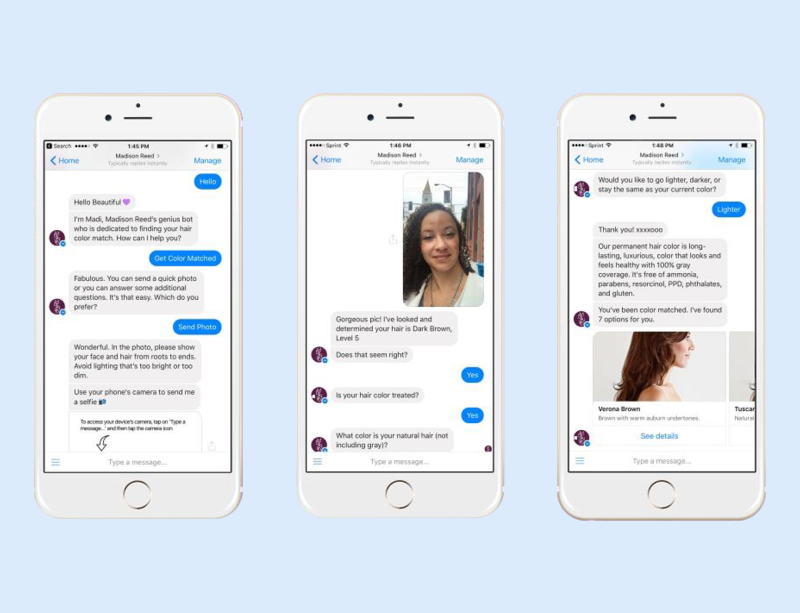
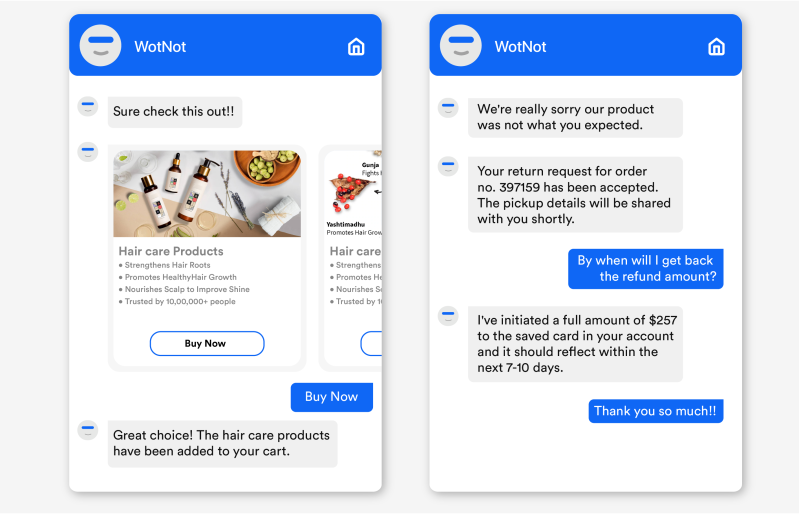
Wenn Unternehmen den Einsatz von Voice Bots und Chatbots erwägen, steht in der Regel diese Frage im Raum:
Wollen unsere Kund:innen überhaupt einen virtuellen Assistenten benutzen?
Laut dem Report “The New Rules of Customer Engagement” ist die Antwort auf die Frage ein klares Ja. 69 % der Kunden sind bereit, mit einem Chatbot zu interagieren. Allerdings möchten sie das nur bei einfachen Problemen. Offensichtlich ist die Antwort eben doch nicht ganz so simpel.
Daher wollen wir in diesem Blog Beitrag einmal genauer betrachten, wann Personen bereit sind, mit virtuellen Assistenten zu interagieren und wofür sie Chatbots nutzen möchten.
In welchen Situationen sind Personen bereit, mit virtuellen Assistenten zu sprechen?
Wenn man die Ergebnisse verschiedener Chatbot-Studien betrachtet, fällt vor allem eins auf: Die Nutzer:innen möchten schnell eine Antwort.
So gaben 69% der Befragten bei der Chatbot Survey 2017 an, dass sie lieber einen Bot anstelle eines menschlichen Agenten kontaktieren, wenn sie dadurch ihre Antwort sofort erhalten.
Bei der 2021 erhobenen Chatbot Studie antworteten 75% der Befragten auf die Frage “Was hat Ihnen an der Interaktion mit einem Chatbot besonders gut gefallen?”, dass ihnen die Geschwindigkeit, mit der sie ihre Antwort bekommen haben, am besten gefallen hat.
Des Weiteren möchte die Mehrheit der Personen ihr Problem selbstständig lösen. Bei dem Report CX Trends 2022 gaben 76% der Personen an, dass sie es vorziehen, mit einer Self-Service Solution ihr Problem selbst in Angriff zu nehmen, bevor sie den Kundensupport kontaktieren. Gerade einmal 24% der Personen gaben an, dass sie sofort den Kundenservice kontaktieren würden.
Virtuelle Assistenten sind also besonders gut geeignet für unkomplizierte Anfragen, bei den die Nutzer:innen schnell eine Antwort haben wollen oder etwas eigenständig lösen möchten.
In diesen Studien wurde die Bereitschaft von Kund:innen, mit einem Chatbot zu interagieren, untersucht. Die Ergebnisse lassen sich aber gut auf Chatbots für die interne Kommunikation übertragen. Auch hier möchten die Mitarbeiter:innen ihre Probleme schnell gelöst bekommen und brauchen dafür nicht immer den direkten Austausch mit der IT-Abteilung oder HR.
Wann ziehen Kund:innen es vor, mit menschlichen Mitarbeiter:innen zu sprechen?
Bei komplexeren Anliegen bevorzugen Personen jedoch den Kontakt mit menschlichen Mitarbeiter:innen. Das Gleiche gilt, wenn sie aufgebracht, wütend oder in einer anderen emotionalen Verfassung sind, in der Empathie und Fingerspitzengefühl erforderlich ist.
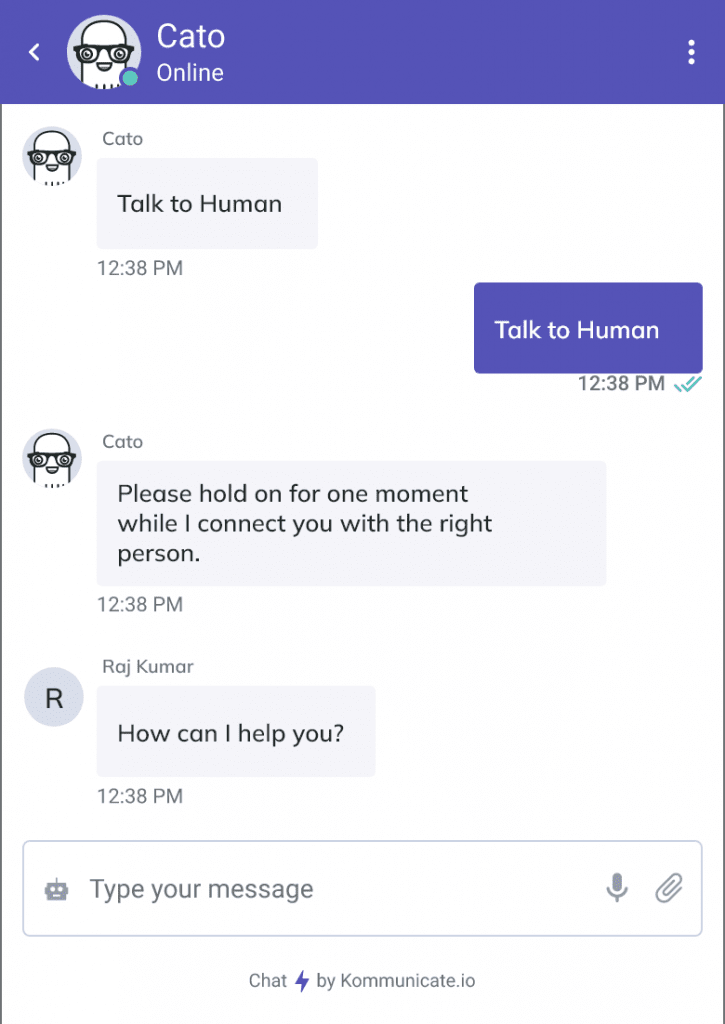
Für solche Fälle ist es unabdingbar, dass der Chatbot in der Lage ist, Nutzer:innen unkompliziert an einen menschlichen Mitarbeiter weiterzuleiten. Dies geschieht über ein Human Handover. Wenn die Wortwahl der Nutzer:innen nahelegt, dass eine Übernahme durch menschliche Mitarbeiter sinnvoll ist, wird die Konversation von dem Chatbot an einen Menschen weitergegeben. Hierfür wird die Sentiment Analyse verwendet. Bei der Sentiment-Analyse werden bestimmte Wörter als positiv oder negativ klassifiziert. Der Chatbot analysiert die von den Nutzer:innen verwendeten Worte. Wenn die von den Nutzer:innen verwendeten Wörter einen gewissen Prozentsatz an negativ kategorisierten Begriffen übersteigt, wird die Konversation an einen menschlichen Mitarbeiter weitergegeben.
Es ist aber auch möglich, dass die Nutzer:innen selber den Human Handover auslösen, in dem sie den virtuellen Assistenten darum bitten an einen Mitarbeiter weitergeleitet zu werden.
Virtuelle Assistenten können also eine große Unterstützung für Kund:innen und auch Mitarbeiter sein. Sie müssen nur für die richtigen Situationen eingesetzt werden. Dann werden sie auch gerne genutzt.
Assessments are common in almost all situations including sports, art, and health, but it’s most prevalent in educational bodies as there are countless education and student assessments throughout the year.
Just think of all your online assessments, in-class tests, pop quizzes, quarterly exams, annual exams, and major leaving examinations.
So, what’s the problem with assessments? Is there even a problem? And should we try to change it when nothing seems awry? This is why..
Companies are forever seeking opportunities to save time, increase efficiency, promote positive customer relationships and boost their revenues. To achieve this, many businesses readily invest in hiring customer service agents. A 2017 article by Forbes shows that the customer service industry is a booming market, at the time valuing $350 Billion.
So customer service is key to your business’s success, but what of companies with limited resources like a startup? Or organizations whose employees are already stretched thin?
A virtual agent provides a welcome solution.
A virtual agent is a term typically used to describe a type of chatbot for businesses.
Virtual agents offer help with websites, give information about their companies products or services, answer users’ questions, and provide support, sales, and customer service. They are an automated version of a human customer service agent made up of artificial intelligence applications that have come to seamlessly interact with human intelligence.
Bot Libre makes it EASY for you to create your chatbot or virtual agent for your business.
For free, and with no programming required, you can create your bot, and embed it on your website, mobile app, or social media. You can create bots for website help, technical support, sales, marketing, customer service, or to automate social media, thus improving your online presence.
Training Your Chatbot
Chatbots can be trained using one of several simple options.
Import FAQs, scripts, and chat logs
Review and edit responses from Admin Console’s Training & Chat Logs page
Have conversations with yourself and others
Listening in on the chatbot during a live chat
Bot Libre bots support advanced artificial intelligence that can be enabled to let bots learn and comprehend language. Bots can also be scripted and programmed using AIML, and the Self (a dialect of JavaScript).
Once you have created your chatbot, you can begin to train it using the steps above. Then you can personalize it to suit your website. You can change your bot’s picture or choose an animated avatar from the Bot Libre Avatar page in its Admin Console. You can also connect your bot to Twitter, Facebook, Skype, Telegram, Kik, WeChat, email, or SMS. You can import chat logs, words from Wiktionary, or data from WikiData. You can browse the internal structure of your bot’s memory. If you’re an advanced user, you can program or script your bot using AIML or Self. You can view your bot’s log.
Embedding Your Chatbot Onto Your Website
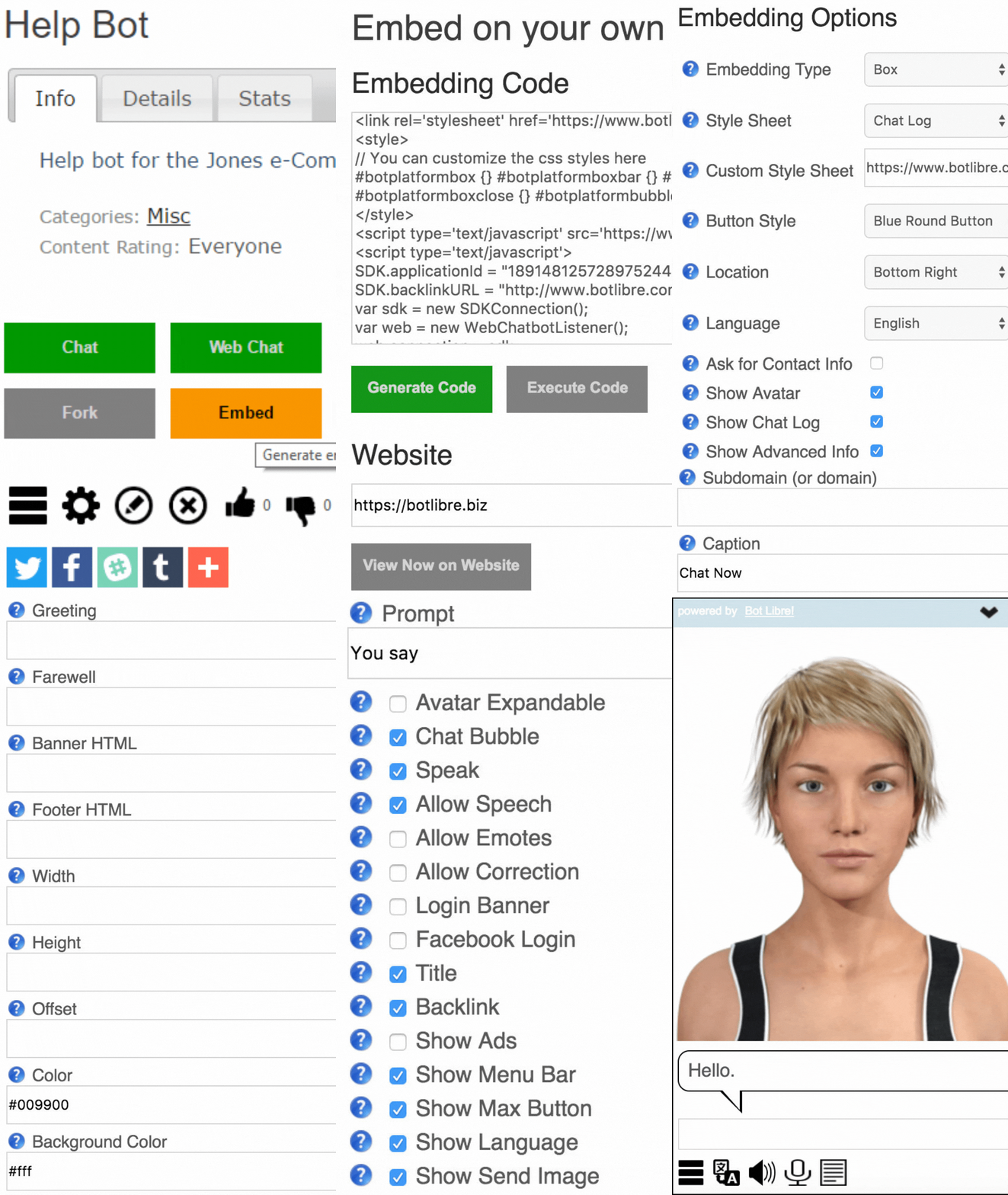
The Embed page generates the HTML/JavaScript code required to embed your bot on your website. Simply copy the code in the top text area, and paste it into the page on your website you want the bot to appear on.
The Embed page provides several different types of embedding, and many embedding options to control the look of the bot on your page. The “Box” embedding option is the most common for a virtual agent and gives you a “Chat Now” button on your page.
The embed page also lets you enter a CSS styles sheet to customize the look and feel of your bot’s popup. You can also customize the style settings in the generated code.
The embedding code uses JavaScript and the open-source Bot Libre JavaScript SDK. You can customize the JavaScript however you wish. There are also more embedding options available in the JavaScript object, such as prompting the user for their contact information.
Styles
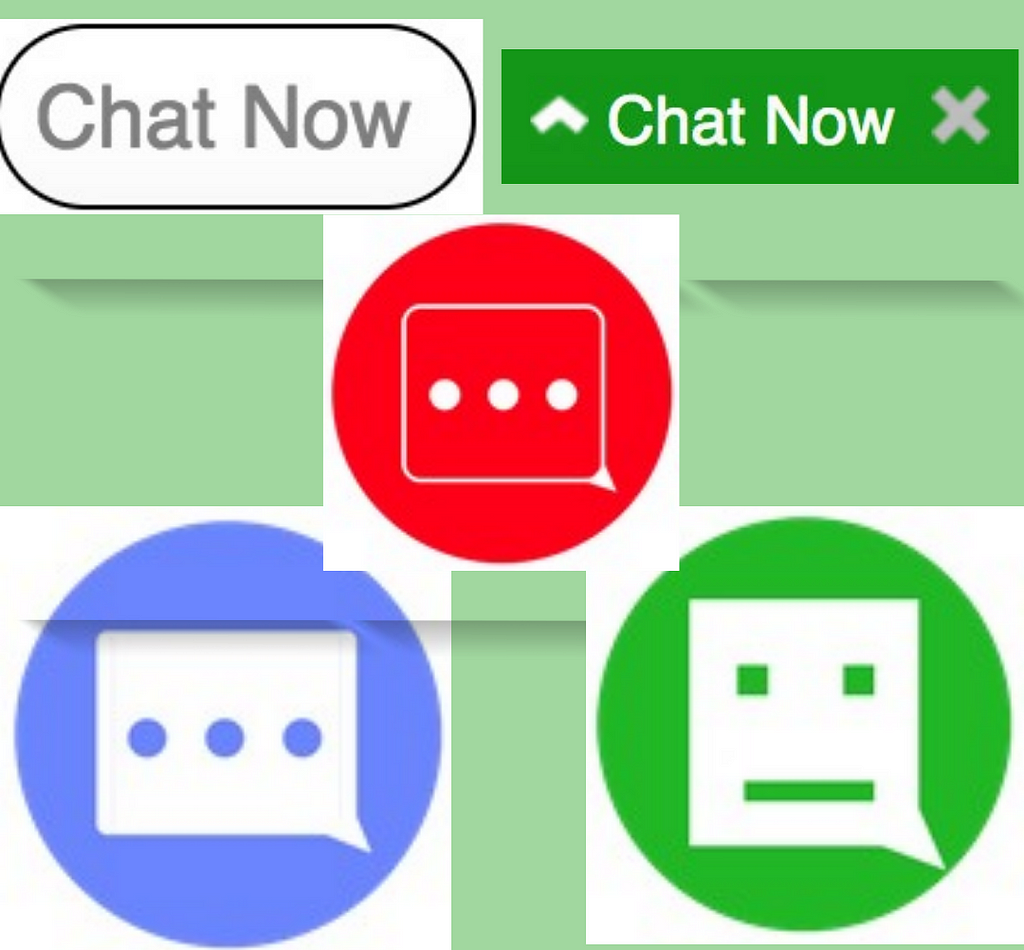
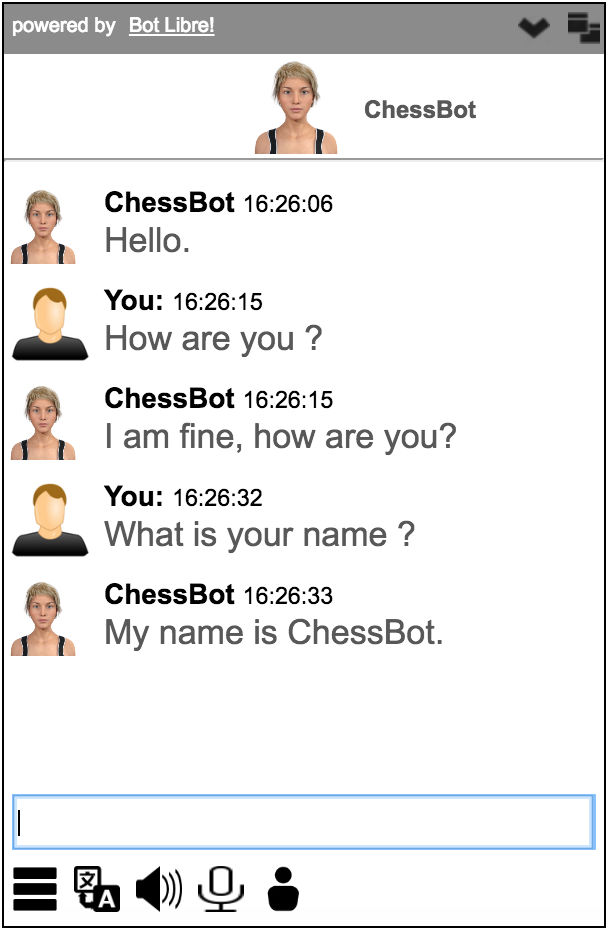
Bot Libre supports several different types of button and chat styles to enhance user experience.
Button Styles
Here are just 5 of the 11 Bot Libre button styles for the embedding page. Simply select any button style from the button style drop down menu.
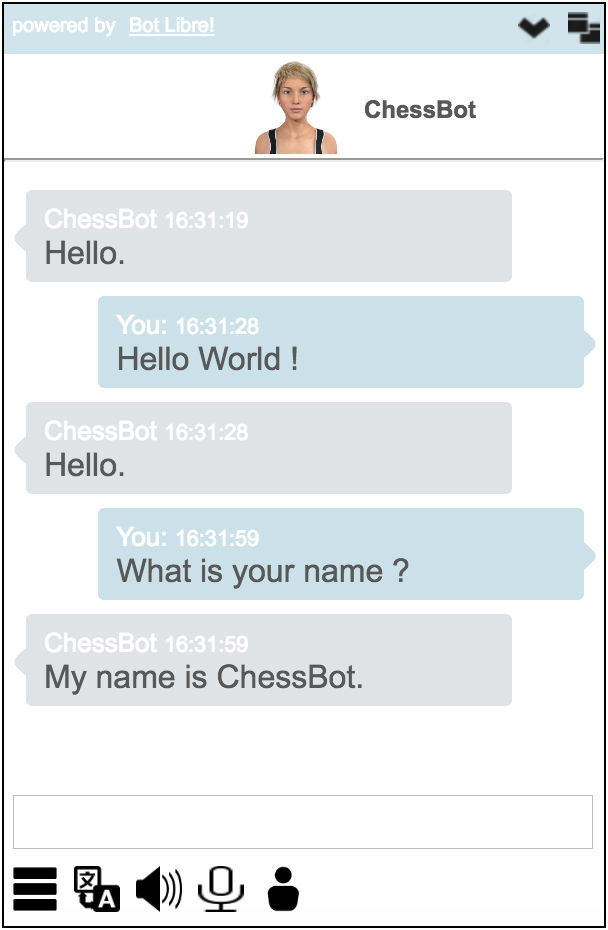
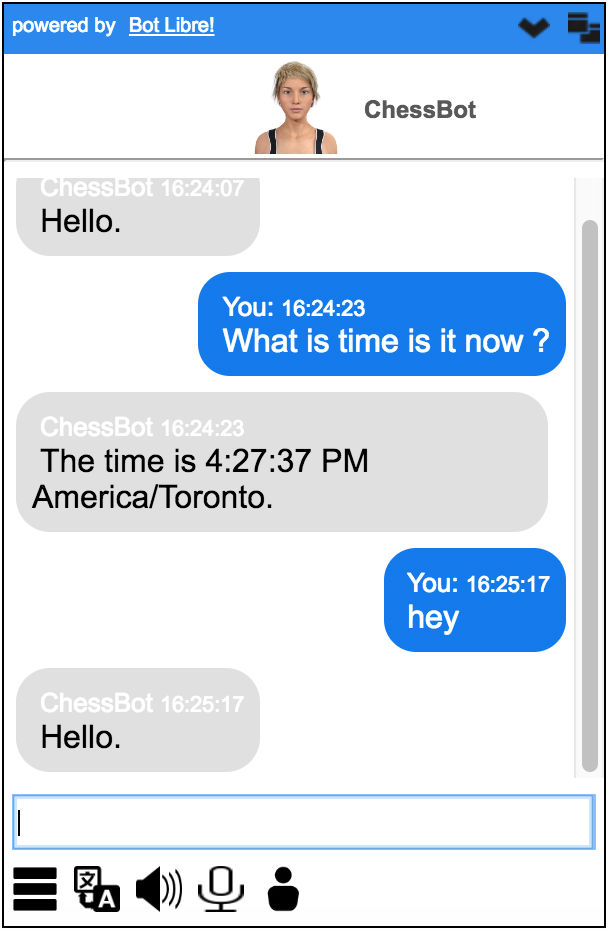
Chat Styles
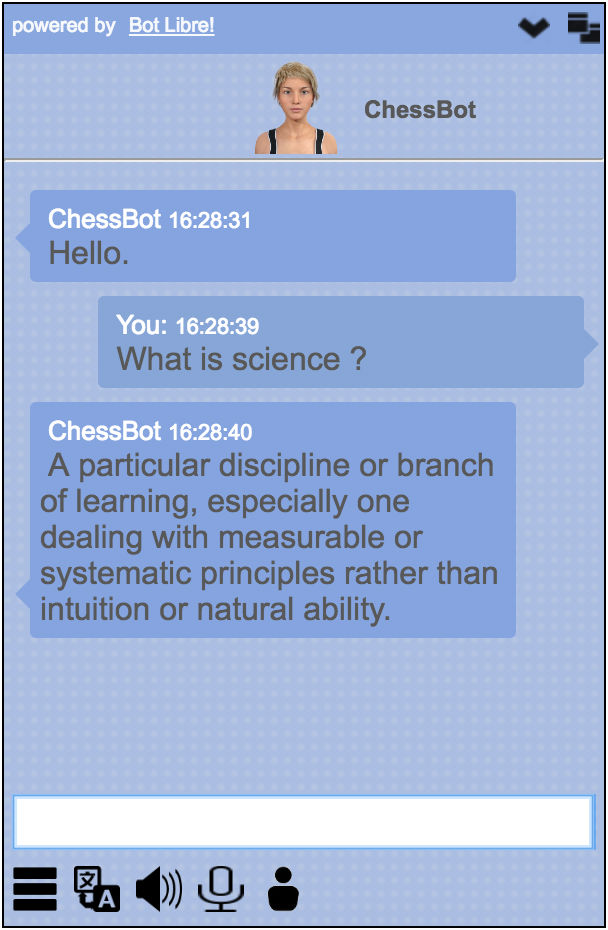
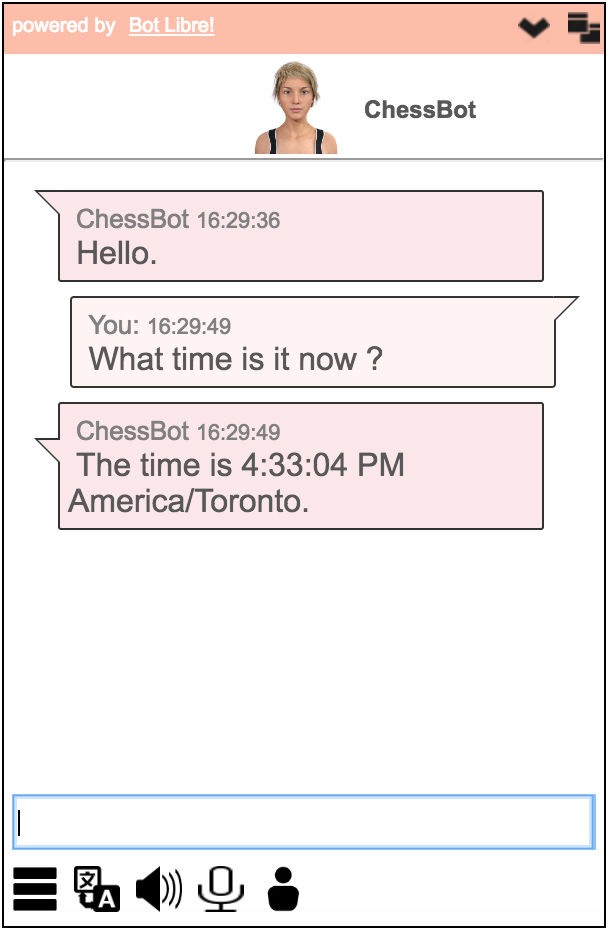
Bot Libre now supports five chat styles. Pick one of the five different chat styles for your embedding by selecting a specific stylesheet option from Style Sheet drop down menu.
Bot Libre also supports custom style sheets. Simply select “Custom Style” from the style sheet drop down menu. Enter the URL pointing to your custom style sheet in the custom style sheet input field, and press the “Generate Code” button. You can copy the code from any of the existing style sheets to make your own custom style. You will need to host your custom style sheet on your own website, or in the Bot Libre script library.
If you also want to add live chat to your website, you can do that by creating a Live Chat Channel, and getting its embed code from its embed page.
That’s it, good luck creating your bots! If you have any questions, encountered any issues or would like help setting up your bot, you can contact support@botlibre.com , or chat with the Help Bot or upgrade to our Platinum service where we can build your bot for you, contact sales@botlibre.biz .
Ally McBeal, an American drama that was popular in the 2000s, has an episode about a woman who chooses euthanasia because of her “dream” family. The story starts with a woman with an absurd demand of living her life in a dream with her “dream” family through euthanasia instead of her reality where she is alone. Usually, dreams are not continuous, but the woman can continue the same dream when she sleeps and live a totally different life. This episode is especially memorable because the story is very relatable to the element of “Metaverse” in the 21st century. New technologies are shifting our imagination closer to reality.
Ally McBeal, Source(TMDB)
Metaverse has become a buzzword in the IT industry recently. The Metaverse is a 3-dimensional virtual world where social, economic, and cultural activity takes place. Virtual reality has become more popular in the last few years, so many companies are working on making the Metaverse a reality. Facebook, Microsoft and NVIDIA are all working on a version of the Metaverse. Facebook has changed their company name to Meta, Microsoft is working on “enterprise Metaverse,” and NVIDIA is working on a project they’ve named Omnibus.
Why Is the Metaverse So Popular?
Metaverse is the next step in virtual reality (VR). While VR allows you to immerse yourself in gameplay through an avatar, the Metaverse will allow you to engage in a range of social and cultural activities.
Millennials will remember a popular online chat room, Habbo Hotel, that allowed users to create rooms, personalize their avatar, and engage in conversations and games with other users. Habbo Hotel and chat rooms of the early 2000s like Club Penguin were the predecessors of the Metaverse. They allowed a certain amount of personalization and social activities, but the Metaverse promises an immersive experience through the use of VR technology.
The Metaverse that tech giants like Meta (formerly Facebook) envision is like an online world where users can work in virtual offices, attend virtual concerts, and even walk virtual pets with their friends. The Metaverse is so popular because it represents breaking down the final barrier in globalization, location. Location will no longer be an issue in catching up with friends or attending events. You can do all of those things from the comfort of your own home.
Not just for gamers, the Metaverse provides more freedom in communication and life.
A lot of dystopian sci-fi books and movies have examined this concept of a “second-life.” Think about the Matrix movies, Ready Player One, or Snow Crash, where the term the Metaverse originated. Virtual reality gaming allows players to immerse themselves in gameplay, but the Metaverse will allow people to conduct life in a virtual environment. Many experts believe that Covid-19 was a catalyst to the sudden interest in the Metaverse. Since reality was restricted due to the pandemic, communication moved largely online.
To look at where it all began, we need to look at online gaming. Two great examples of this are Zepetto and Roblox.
Zepetto collaborating with various fashion brands DIOR to launch a makeup collection. Source: Zepetto
Zepetto
Zepetto is an AR avatar-based service created by Naver Snow. It was derived from their camera application Snow, which allows users to turn selfies into avatars. Zepetto was launched in 2018 and has grown exponentially since then, surpassing 200 million users in 2021. In 2019, Zepetto even ranked first in the app stores of 37 countries.
The functionality of Snow allows users to create 3D avatars by taking photos of their faces. Deep learning-based facial recognition software creates an avatar that they can then customize with skin, eye, and hair color. Once the avatar has been created, users play games and communicate on social media through Zepetto.
Zepetto has a circular structure that allows users to create anything they can imagine. Avatars function as if they were real people with personalities and can participate in activities like in real life. In Zepetto, users can:
Travel
Participate in dance competitions
Cook for friends
Tour a house
Users can record their activities and share them on their social media feeds within Zepetto. This has been done over 1 billion times to date.
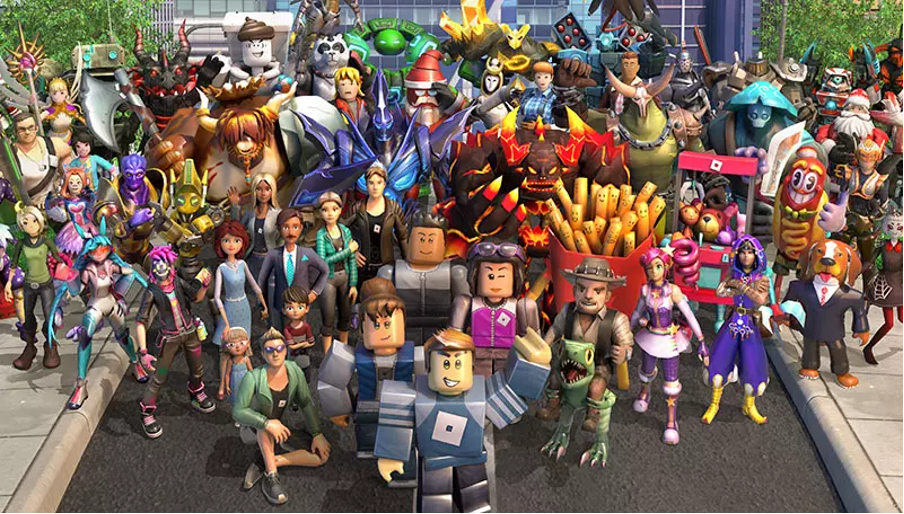
Lineup of Roblox Avatars. (Image via Roblox)
Roblox
Roblox differs from Zepetto in that it concentrates on games rather than social functions. Roblox boasts 43 million daily active users and is particularly popular with teenagers in the US. It was released in 2006 and now operates in over 180 countries, and over half of American teenagers under the age of 16 use Roblox.
The driving force behind Roblox is “openness.” Unlike other gaming platforms, users can create and distribute their own games on the Roblox platform. The Roblox environment makes it easy for people to create games using simple coding, and elementary school students in particular use this feature with gusto. There are as many as 50 million games on Roblox, and more than 10 million games are played every month.
While the most popular games are provided by game companies, the individual users also create games and earn money through contributions.
The Metaverse: Removing Daily Commutes
The Covid-19 pandemic’s remote work requirements identified another use of the Metaverse. While technology makes it easier to work from home and to communicate with colleagues, the work environment was lacking. A major benefit of working from an office is the ability to collaborate and network with colleagues. Remote work adds barriers to those activities, and many people who started new roles in the pandemic reported that they didn’t know any of their colleagues.
It seems that flexible work arrangements are popular, with many workers wanting the option of working from home in order to reduce the cost and time of a daily commute. However, the Metaverse will be able to bridge the gap and allow more connection throughout the workday.
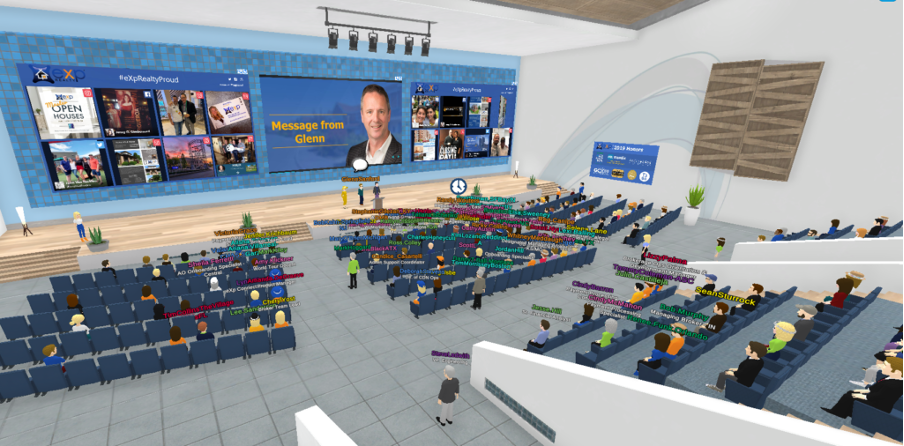
Virtual workplaces are already in use across the world. eXP Realty, a US real estate broker, has been using a virtual office since 2009. They needed to cut costs after the housing crisis but didn’t want to lose the benefit of sharing knowledge around the office. While it took a little while to adjust to moving around in a virtual space, realtors quickly took to the platform. eXP Realty has even implemented office etiquette guidelines for their virtual office like respect closed office doors. Open office doors in their virtual workspace mean colleagues can enter freely to collaborate.
Large-scale meetings are held in eXP World’s Auditorium where agents can attend from around the world via their avatars(Source: eXP Life)
How Will the Metaverse Look in the Future?
So far, it is hard to tell because the Metaverse is in very early stages. Currently, users explore virtual spaces through an avatar and can use text or voice chat to communicate with other avatars. When tech leaders speak about the Metaverse, they talk about creating realistic experiences such as virtual concerts and product launches. But so far, it is hard to see how that can be achieved in a realistic way.
The one thing we do know is that a lot of investment is going into creating the Metaverse and there is a lot of interest from people and companies in creating this virtual world. We predict that the Metaverse will bring wide scale change and that people will spend increasing amounts of time in the Metaverse, both professionally and in their personal time. The Software Policy Research Institute predicted that Metaverse platform B2C games and social networking would gain mainstream attention in 2020 and 2021, and from that point, adoption would spread to B2B and B2G areas. PricewaterhouseCoopers (PwC) predicted that the Metaverse will be worth 300 trillion in the next five years as companies are discussing Metaverse real estate and corporate opportunities.
We believe that a growth focus in the Metaverse will improve the realism of the content. This is something that tech companies are already working on as a marketing differentiator. So far, the Metaverse will combine AR, VR, and MR (Mixed Reality) technology to allow users to move around the virtual world, seeing through an HMD (head-mounted display.) There has been talk of incorporating other senses such as touch and smell that will relate to the visual content. Another prediction is that companies can create avatars for AI technology, called MetaHumans, who can interact with the virtual world and avatars as a human-controlled avatar would.
All we can say for sure is that we are excited about the possibilities the Metaverse will bring to the world both in terms of personal and business impact. We advise companies to watch out for new developments so they can be quick to jump onboard trends and adapt to the virtual world.
The Arrival of the Metaverse was originally published in Chatbots Life on Medium, where people are continuing the conversation by highlighting and responding to this story.
What is OCR? How does it work, and what are its use cases? — Tech Zimo
You might be familiar with OCR technology if you have been in the race of making automated document processing workflows. Moreover, with increasing digital advancement
Enterprises across the world are transitioning from paper-based documents to digital data processing. But, what is OCR? How does it work? And in which business process can it be utilized to leverage its benefits? Let’s dig into this article into what benefits OCR brings to the table.
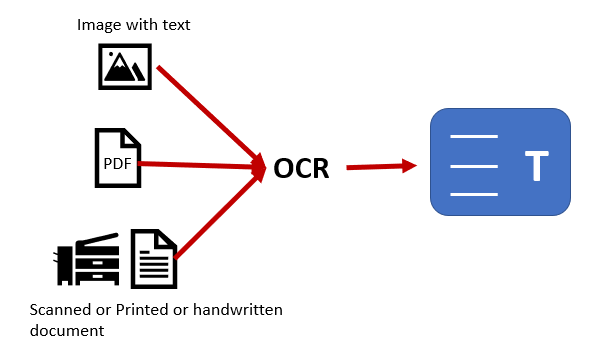
An OCR system is a combination of hardware and software. The main goal of this technology is to scan the textual data and images from the physical document and translate the character within document and then utilize it for processing data or information. Organizations can use OCR to Fastrack data access and processing, from gathering to analyzing data.
For instance, let’s say the scanner identified the invoice total as $800, but in reality, it has to be $8000. A human might make mistake if they have to handle high volume invoices. But OCR with AI can identify the mistake automatically correct it in real-time without manual intervention.
OCR system works in three processes-
Image Pre-Processing
This step involves the processing of documents into images for analyzing data and light areas and categorizing them into separate elements.
Intelligent Character Recognition
The second step involves the identification of characters and converting them into ASCII code for further manipulations.
Post-Processing-
The final step includes the error correction by using Artificial intelligence. Also, artificial intelligence can be trained on the specific lexicon of words that will be found in the document.
However, using NLP, machine learning algorithm, and computer vision method offers an advanced version of OCR that is not limited to character recognition only. Using this combination of technology correct errors using probabilistic approaches and recognize patterns in training samples.
Legal Documentation
Regardless of industries, sensitive data is everywhere. Whether it’s a financial institution or IT organization, service desk agents have to go through legal documents for claims processing and others. Considering the time involved in extracting data for processing further operations, OCR is the savior. OCR limits the paperwork and extracts data from multiple systems with an easy view and sharing options. Also, OCR helps enterprises gain to create an in-house search engine to search information directly from the database.
Banking
Banking service desk agents often struggle with the humongous task of accessing data for loan processing, KYC, credit-debit card approval, money transfer, and others. Without OCR, manually verifying high volume data take a toll on employee productivity. Using OCR can benefit banking organizations by automatically reviewing the information and matching the details. In addition, combining AI with OCR reduces error, increases analyzing capability, enhances employee productivity altogether.
Retail
From processing invoices to inventory management, the retail service team is encumbered with the task of extracting data from multiple resources in multiple formats. Considering the manual intervention involved in extracting and analyzing data makes a perfect case for OCR. OCR technology can efficiently go through the keywords presented on the document, analyze them, and verify them without manual intervention. Also, retailers use serial numbers encoded with barcodes for their product descriptions. By using OCR, retailers can fast scan the barcode to get the serial number to track stock.
Health Records
Having one’s entire medical history direct on the table is all a patient wants from the organization. Rather than maintaining past medical records, X-rays, and other reports, having a digital record system could be a great help. Using OCR, healthcare organizations can digitally store past medical reports, data, and prescriptions altogether in a unified place. Along with enhancing data accessibility, OCR also helps maintain healthcare legislation and compliance policy.
The benefits of OCR go beyond digitizing documents and scanning the information. Combined with Artificial Intelligence (AI) and other cognitive capabilities, OCR can get the best deal for your business, manage and audit the mismatch at a much faster pace than humans. Also, who doesn’t want easy and efficient data processing and access? So what are you waiting for? OCR is an opportunity to lead in the digital transformation era; embracing is all you need.
Author BioVatsal Ghiya is a serial entrepreneur with more than 20 years of experience in healthcare AI software and services. He is the CEO and co-founder of Linkedin: https://www.linkedin.com/in/vatsal-ghiya-4191855/, which enables the on-demand scaling of our platform, processes, and people for companies with the most demanding machine learning and artificial intelligence initiatives.
Here is the list of 48 chatbot terminology sorted in alphabetical order so that you could easily find out the specific one you are looking for.
Actions
Actions are nothing but the logical action your chatbot takes.
It can be sending notifications, split traffic, setting message delay, etc.
AI-Powered Chatbot
An AI-powered chatbot is a chatbot built by using artificial intelligence (AI) functions such as machine learning (ML) and natural language understanding & processing (NLU&P).
API
Well, the meaning of API is the same in chatbots as well that is the Application Programming Interface which allows two different applications to communicate and share features with each other.
Attributes/Fields
Attributes are nothing but the user information fields such as first name, last name, email, phone number, etc.
There are two different types of attributes as Custom Attributes and System Attributes.
The custom attributes are attributes created by us (a chatbot developer).
And, the system attributes are nothing but the already available or defined attributes by the chatbot development tool.
Auto-Responder
Auto-responder contains the pre-defined responses to be sent to users when they perform certain actions while interacting with your chatbot.
Bot Subscribers
Bot subscribers are the same as email subscribers.
The chatbot users automatically get opt-in as bot subscribers when they first interact or reply to your chatbot.
Broadcasting
Broadcasting is an outbound message to be sent to multiple bot subscribers at the same time.
This message is sent proactively rather than as a response to the user’s message.
Chat Widget
A chat widget is nothing but a chat window that is used to add a chatbot to a website or app. It let users communicate with your chatbot from a website or app.
It can be a no-code development tool like ManyChat or an NLP-based development framework like Dialogflow.
Classifier
A classifier is a feature to categorize users or user inputs into different groups.
This feature is also known as Split Traffic on some development platforms.
Compulsory/Mandatory Input
It’s an easy one!
It is like those mandatory fields we have to fill on the forms. Similarly, in chatbot also there could be some mandatory input that is needed to perform future processes.
Content Blocks
A content block is a feature to create responses that contain content in the form of text, images, video, audio, buttons, quick replies, and more.
Conversation Ender
A conversation ender is a process to end the conversation.
It could be a message or set of messages that is used to conclude the conversation.
Conversation Failure
Conversation failure is a possible situation that can occur in a chatbot when the chatbot fails to respond to user input.
Conversation repair is a process to handle the situation of conversation failure.
The chatbot can be programmed to handle such situations by redirecting the users.
Conversation Starter
A conversation starter is a process to start a conversation.
It could be a greeting message or a set of different messages that are used to start the conversation.
Conversational AI
Conversational AI uses the technologies like artificial intelligence (AI), machine learning (ML), and natural language understanding & processing (NLU&P) to build interactive applications like chatbots, virtual agents, and interactive games.
The conversational flow is nothing but a flowchart that represents an effortless progression of responses that happens in a chatbot based on conditions or values.
The conversational script is nothing but the dialogues which are the combination of words, sentences, images, GIFs, and many other things used to give direction to a conversation.
Conversational UI
Conversational UI is an interface created for users to communicate with other users or computer technologies like chatbots.
Decision Tree
A decision tree is the same as the conversational flow that shows how conversation happens based on the decisions made.
Default Reply
Default reply is an automatic reply triggered when the chatbot doesn’t understand and cannot reply to particular user input.
Deployment/Conversational Channel
A conversational channel is a place where a chatbot is deployed after development.
It could be a website, app, or social messaging platforms like Facebook Messenger, WhatsApp, Instagram, Telegram, etc.
Entity
An entity is similar to a variable in a chatbot that is used to store and extract users’ input/data.
Entry Points
Entry points are nothing but a place from where users launched a chatbot and start interacting with it.
It could be a simple link, chat widget, or social messaging apps like Facebook Messenger, Instagram, etc.
Fallback
Fallback is the same as the default reply that is triggered when the chatbot doesn’t recognize a user’s input.
Flows
Flows are the sequence of conversational steps in the chatbot.
Hybrid Chat
Hybrid chat means a chatbot and human work together to make conversations more effective and smoother.
This kind of chatbot is called a human/agent assistant.
Integrations
Integrations are the third-part apps that can be used in your chatbot to enhance its abilities.
Intent
The intent is a feature to define the motive behind a conversation and program a chatbot specific to that particular intent.
Keywords
Keywords are the words that are used to trigger a particular action in a chatbot.
It is mostly used in AI-powered chatbots.
Live Chat
Live chat is a feature that pauses a chatbot for some time and lets you chat with users.
You can also program your chatbot to automatically transfer users to a live chat.
Machine Learning (ML)
Machine learning is a branch of AI that identifies patterns from past conversations and train a chatbot to improve its performance.
Natural Language Processing (NLP)
Natural language processing (NLP) is a branch of AI that enables chatbots to read, understand, and process human language.
Optional Input
Optional input is the same as those optional fields in the form that can be left blank.
Quick Reply
A quick reply is a short message in a bubble-kind button that shows the possible options to users and allows them to make a decision quickly.
Re-engagement
Re-engagement is a feature to re-engage with existing users by using organic as well as paid methods.
Rule-based Chatbot
A rule-based chatbot is built with the pre-set rules, Natural Language Processing (NLP), and very little Machine Learning (ML).
It is precisely programmed using conditional loops to generate automated responses to users’ messages.
Sentiment Analysis
Sentiment analysis is a technique to measure the sentiment and tone of voice or text messages by using machine learning (ML) and natural language processing (NLP) models.
It is used to analyze the user’s attitude/mood during the conversation.
Sequences
A sequence is nothing but a series of automated messages.
Templates
Templates are nothing but pre-designed chatbots/flows that can be used to fasten your chatbot development process.
Trigger
A trigger causes a particular action in a chatbot to get executed.
Typing Delay
Typing delay is a feature that enables you to set up the time delay between two responses to mimic the natural flow of the conversation.
Voicebot
Voicebot is a kind of chatbot that simulates the voice-based interactions between the human and a machine.
The best example of it would be Siri and Google Assistant.
Webhooks
Webhooks are the automated API responses that are used to retrieve information like emails, phone numbers, etc. from the conversation and send it to the web services like CRM, Google Sheets, or any other software.
Welcome/Greeting Message
A welcome message is the first message that your chatbot sends to a user to greet them.
Wrapping Up
So, we’ve just seen the list of 48 essential chatbot terminology that you should know and be familiar with.
Now, I want a little help from your side, by telling me the chatbot terminology that I have missed in this list to make this guide the ultimate resource of chatbot terminology.
How To Get The Most Out Of Your Facebook — Add A Chatbot
Keeping up with social media and keeping your online community engaged can be a time-consuming task. Through Bot Libre you can now automate your Facebook presence with your own Facebook Messenger bot. Any Bot Libre bot can be connected to a Facebook Messenger page account. The bot will reply to your users’ questions in real-time using the responses of the script you have trained your bot with.
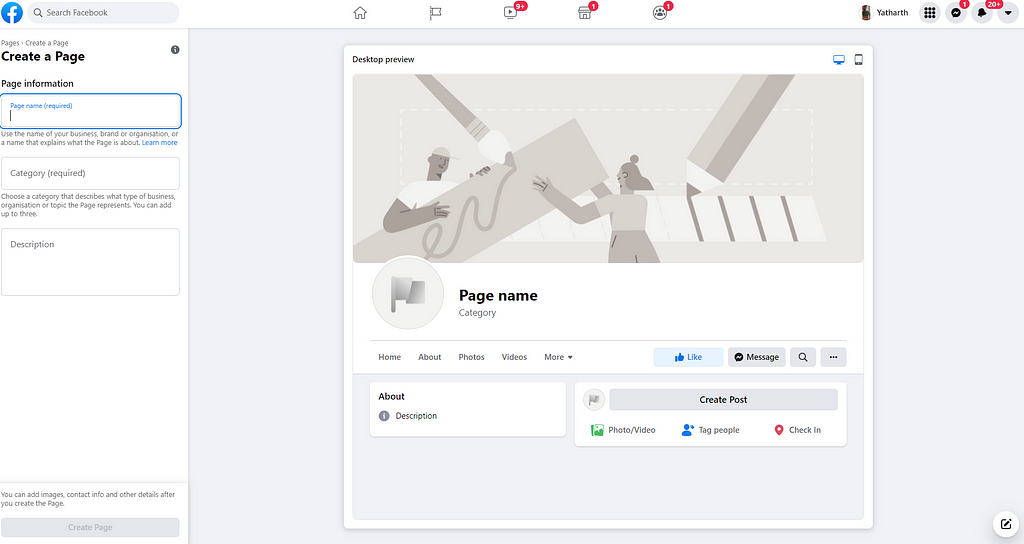
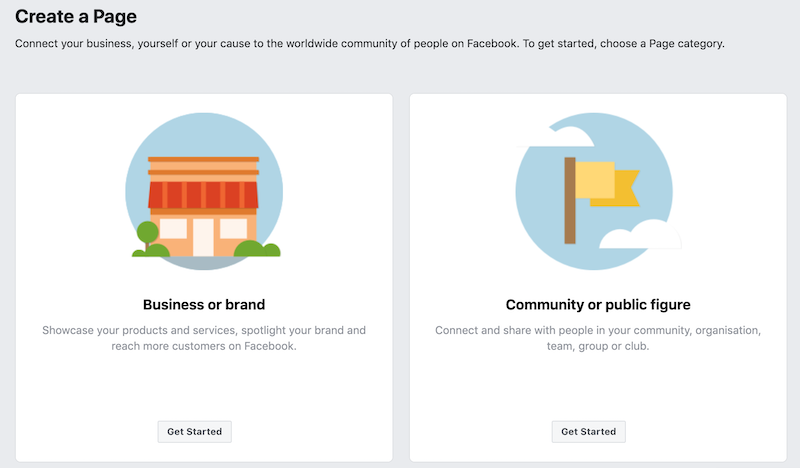
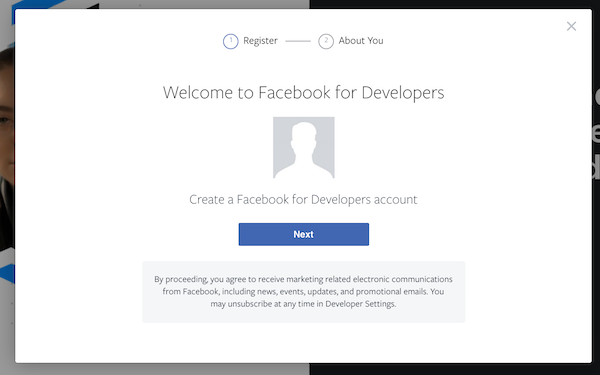
Connecting a bot to Facebook is a bit of a process, as Facebook requires a lot of permissions and validation to be set up to allow a bot on their platform. This “how-to” gives you a step-by-step process to connect your bot to Facebook Messenger.
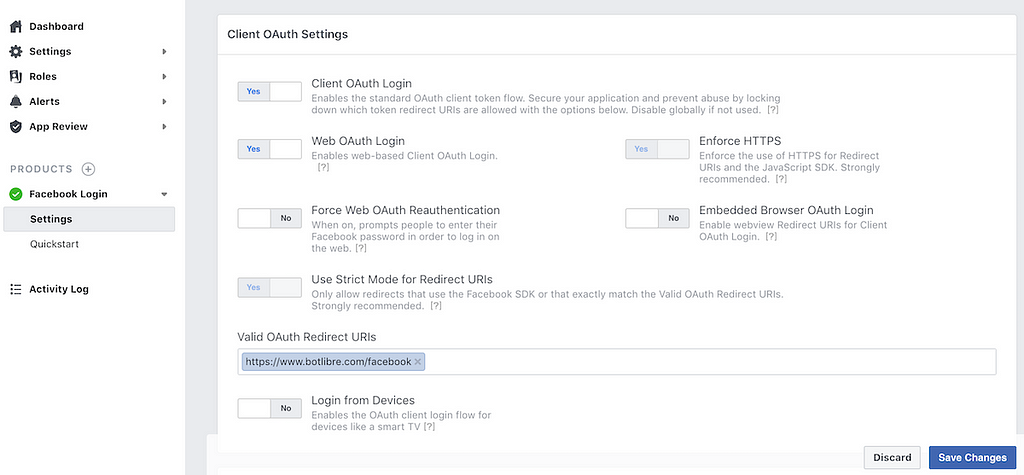
Next, click on ‘Facebook Login’ in the left toolbar, then select ‘Settings.’
Enter “https://www.botlibre.com/facebook” into the ‘Valid OAuth Redirect URIs’ field then click the ‘Save Changes’ button.
Step 3 — Create a bot
Next, you will need to create a bot to connect with your Facebook Page and App. You can follow the instructions here to create your bot: How to create your own chat bot in 10 clicks
Step 4 — Connect bot with Facebook
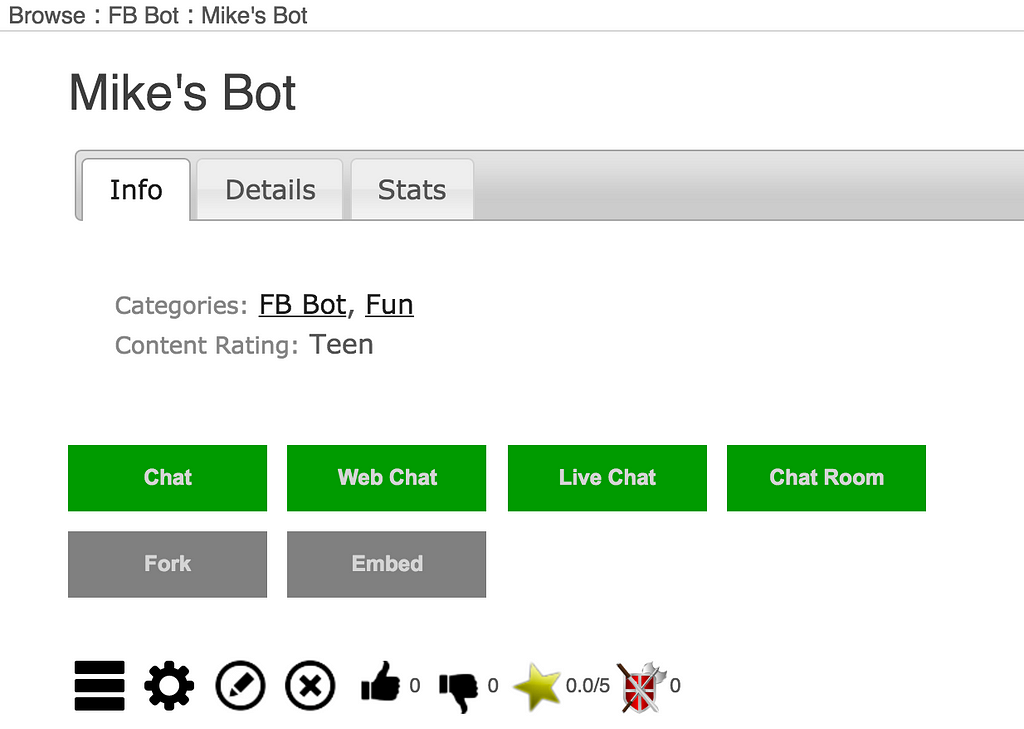
From the Bot Libre website, browse to your bot. Go to the Admin Console by clicking on the gear icon at the bottom.
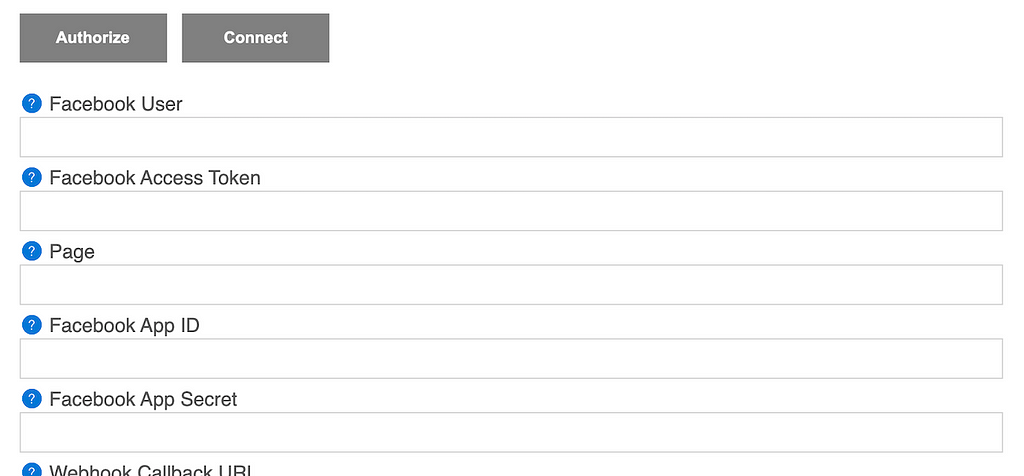
From the Admin Console, click on “Facebook” to take you to a screen to configure your Facebook settings.
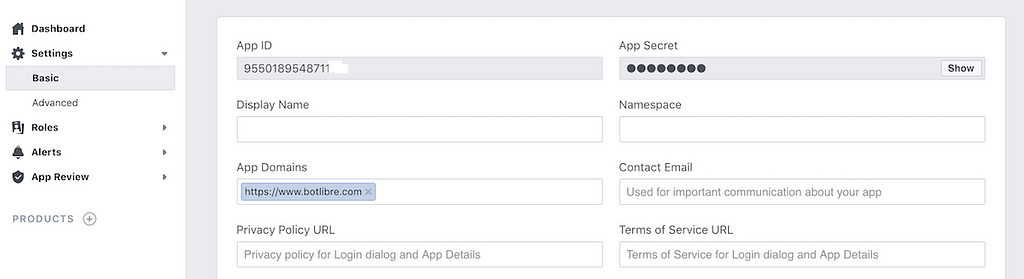
Enter the ‘App ID” and “App Secret’ from your Facebook App into the corresponding fields on this form.
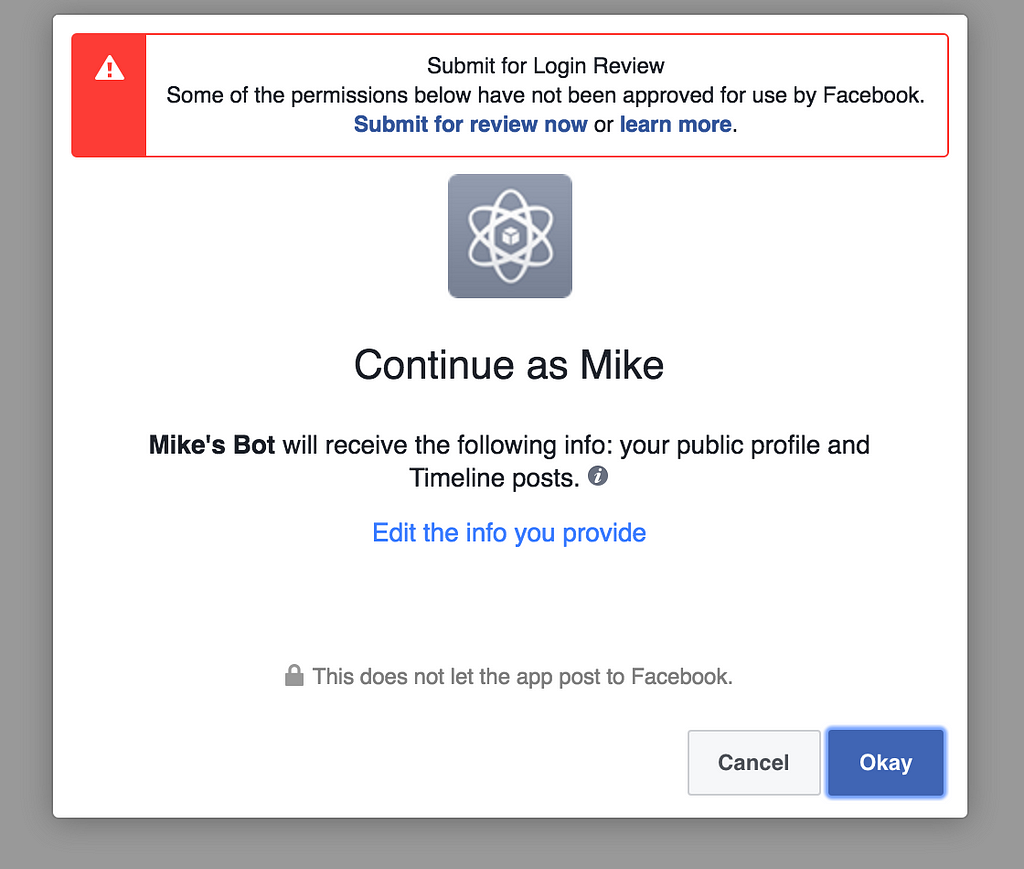
Next, click the ‘Authorize’ button to authorize your bot with Facebook. Click ‘Okay’ to accept any permissions needed by Facebook.
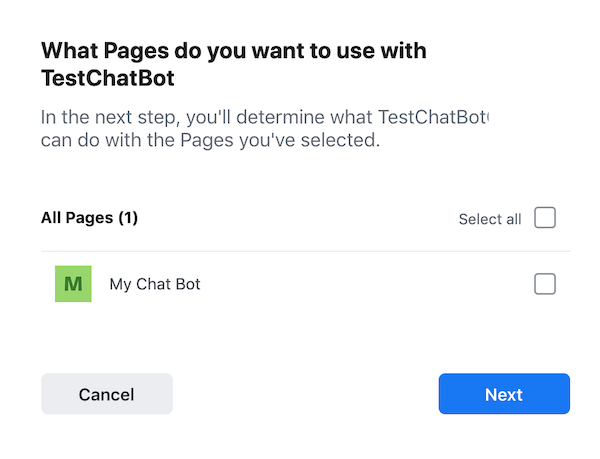
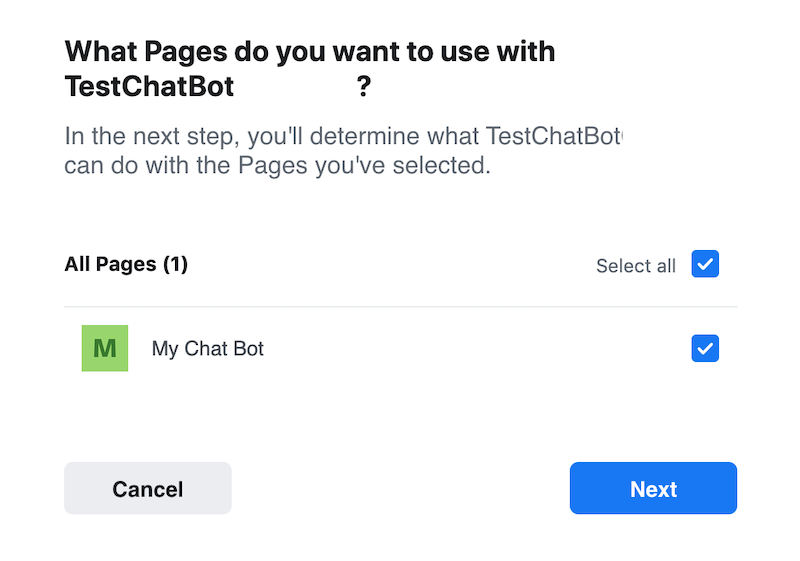
Select the checkbox for the page you created in step 1, then click the ‘Next’ button.
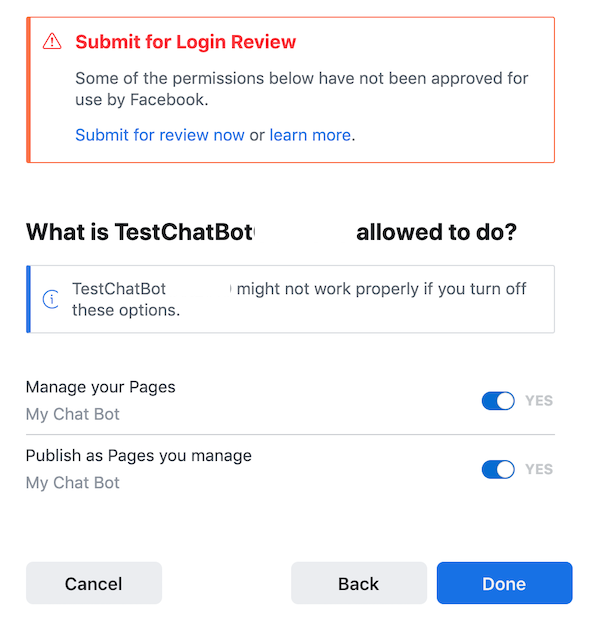
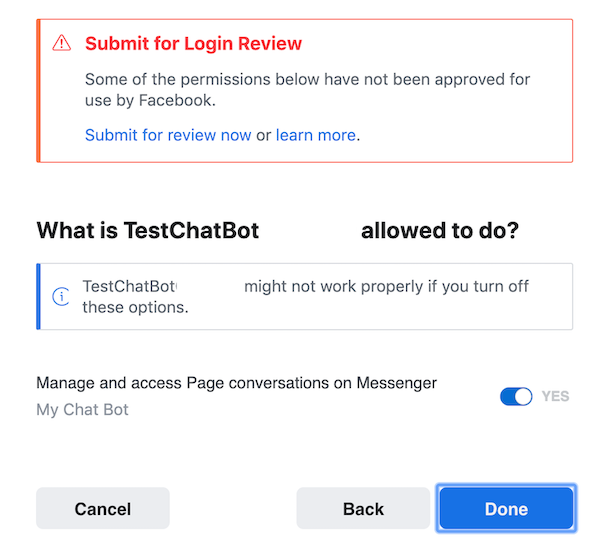
Select ‘Yes’ for the requested permissions in the following screen.
Click ‘Done’ when finished.
The “Facebook User”, “Access Token” and “Page” fields should now have been filled in automatically.
Click the “Connect” button to connect your bot to Facebook.
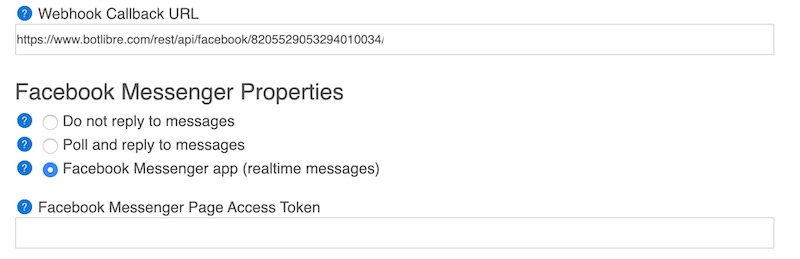
Now scroll down to “Facebook Messenger Properties” and click “Facebook Messenger app (realtime messages)” to toggle it on. Press save.
Copy the “Webhook URL” to your clipboard for use in the next step.
Step 5 — Set up Webhook URL with Facebook
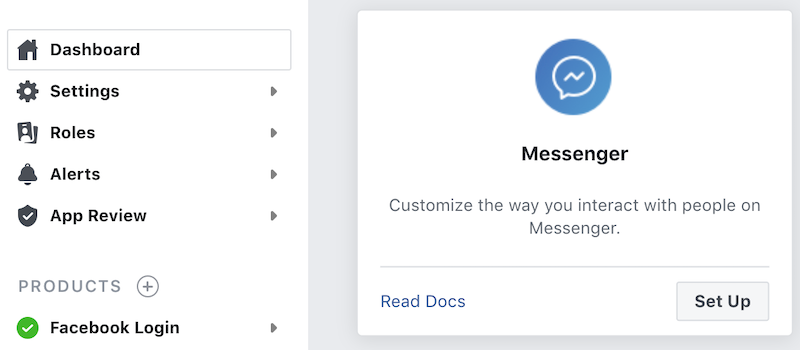
Go to your Facebook App’s dashboard webpage. Click on ‘Products +’ in the left menu.
Next, click the ‘Set Up’ button in the ‘Messenger’ panel.
Now select ‘Settings’ under ‘Messenger’ in the left menu.
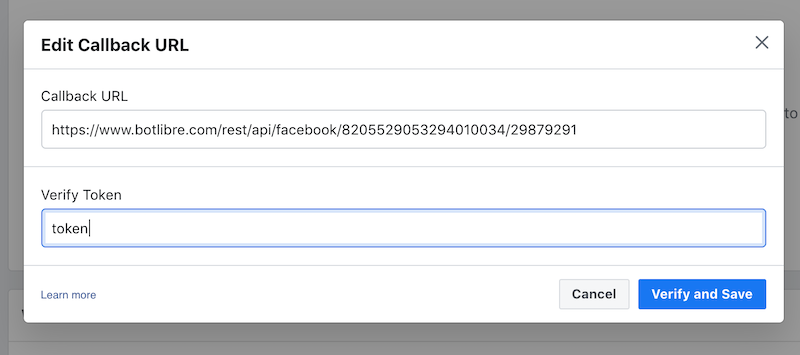
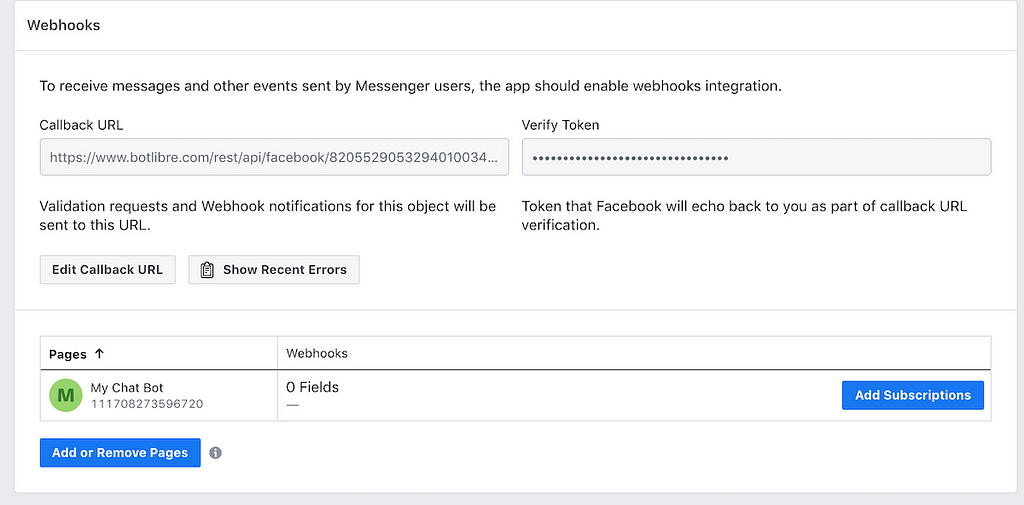
Click the ‘Add Callback URL’ button.
Enter the ‘Webhook URL’ you had copied in the previous step into the ‘Callback URL’ field. Enter “token” into the ‘Verify Token’ field.
Click the “Verify and Save” button to finish.
The following window will pop up, select the checkbox next to your page and press the ‘Next’ button.
In the following window, check the box for ‘Manage and access Page conversations on Messenger’.
Press the ‘Done’ button. On the dashboard below, click the ‘Add Subscriptions’ button next to your page.
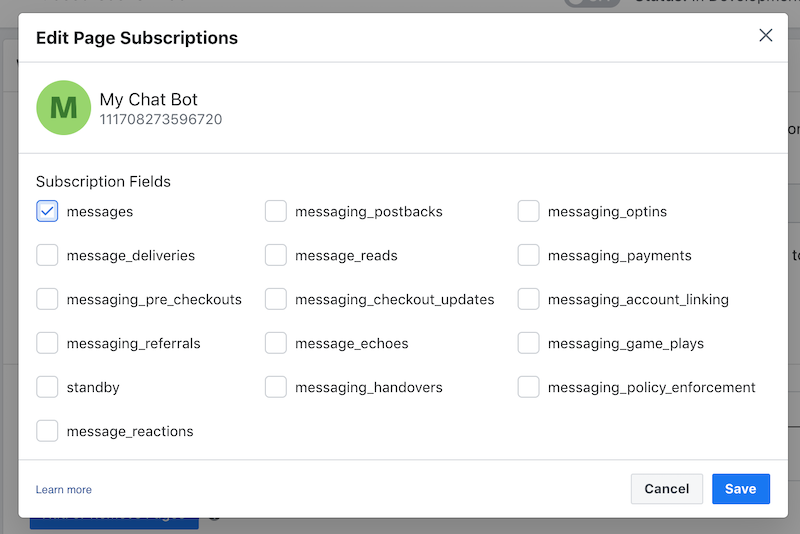
Select the ‘messages’ checkbox in the following window.
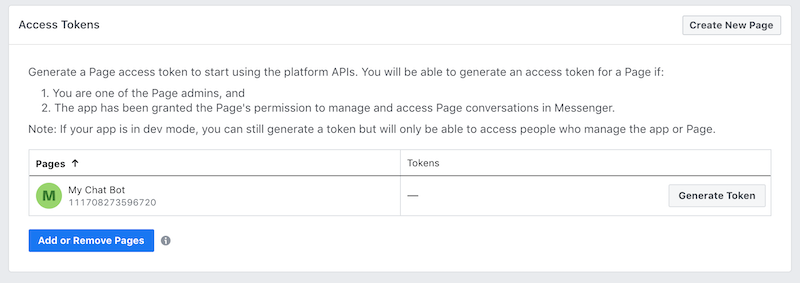
Click the ‘Save’ button. Scroll to the ‘Access Tokens’ section of the Messenger Settings page.
Click the ‘Generate Token’ button next to your bot’s Facebook page.
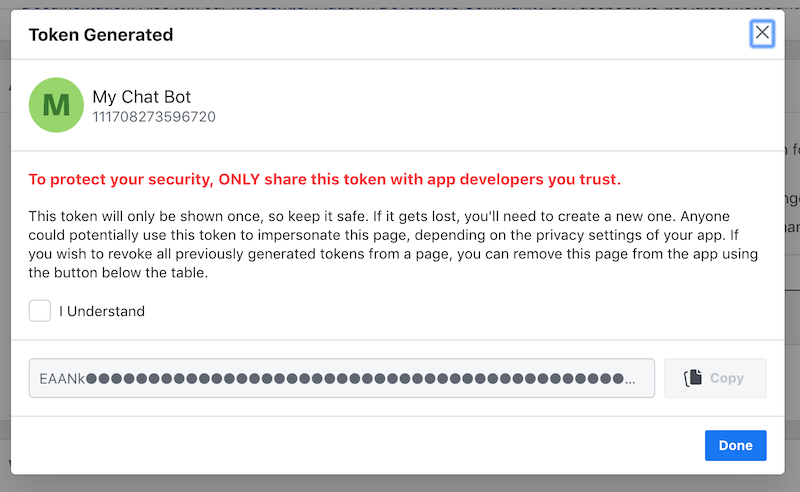
Click the ‘I Understand’ checkbox, then copy the token to your clipboard by clicking the ‘Copy’ button. Click the ‘Done’ button to close the window.
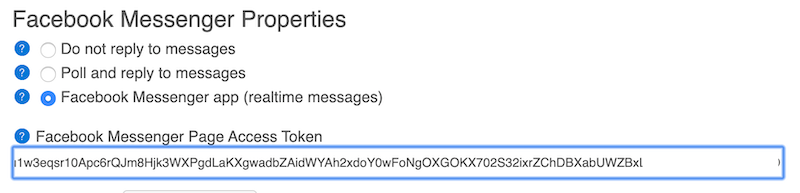
Now return to your bot’s Admin Console on the Bot Libre website. Go to the ‘Facebook’ tab and paste the ‘Page Access Token’ you had previously copied into the “Facebook Messenger Page Access Token” field.
Click the ‘Save’ button.
Step 6 — Approval by Facebook
At this point, you should be able to send messages to your bot’s Facebook Page with the Facebook user who created the page, and your bot will respond.
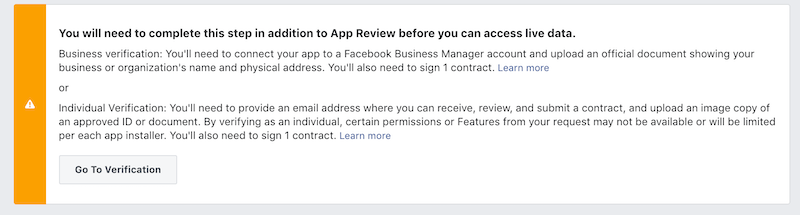
For other Facebook users to be able to send and receive messages with your bot, you will need to have your Facebook App approved by Facebook.
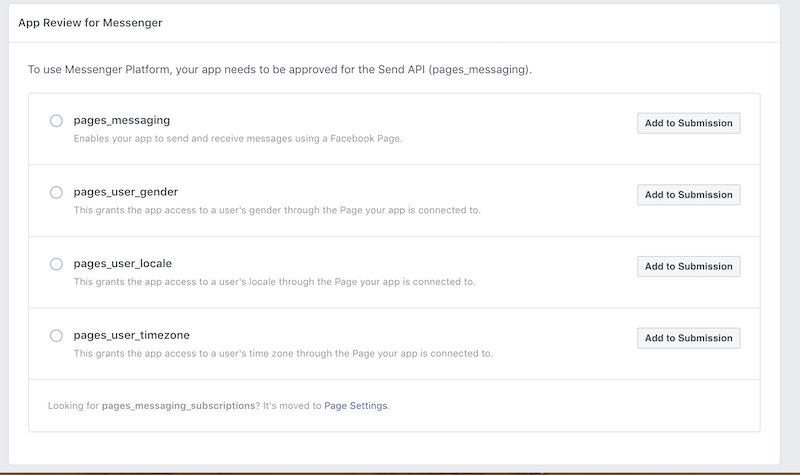
Return to the Messenger Settings page on the Facebook Developer website and scroll to the ‘App Review for Messenger’ section.
Click the ‘Add to Submission’ buttons next to the four permissions.
You may need to complete additional details in the “App Details” tab before you can complete your submission. You will need to upload an app logo and provide a URL to your privacy policy.
You will also need to complete business or individual verification. This can be found on the ‘Messenger Settings’ page.
After receiving your verification information, Facebook should approve your App after some time.
Toggle the ‘Off’ switch to ‘On’ at the top of the Facebook Developer page to make your app available to the public and have other users be able to interact with your bot.
If you got this far, congratulations, you have created a bot for Facebook Messenger for FREE. Now you can train your bot’s responses and review its conversations from its “Training & Chat Logs” page in its Admin Console.
If you’re having any issues or would like our help setting up your bot, please email us at support@botlibre.com or upgrade to our Platinum service at sales@botlibre.biz and we can build your bot for you.
Are you making the most of your collected data? The data you accumulate through your products and services can be a game-changer for your organization. Imagine if you can put that information to the proper use! Knowledge Graphs can allow you to make the most of your information to access, search, and utilize data for your enterprise search needs.
What Is a Knowledge Graph?
A Knowledge Graph is a progressive way of interconnected search, an accurate query search resolution system that combines entities like people, objects, and places. Knowledge Graphs are popular for applications into search engines¹. It is a search method that leads to the most relevant information.
More technically, Knowledge Graph interlinks data pieces related to users’ query keywords and intentions behind. Knowledge Graphs, along with Natural Language Processing (NLP), can come up with accurate answers across the database. They can be applied to extract Semantic Triples: the subject, the predicate, and the object from the information to build efficient question-answer systems².
How can knowledge graphs be used for search?
A Knowledge Graph can establish contextual relationships between search entities, display relevant results, or make search engines accurate. Notably, the core objective of Knowledge Graphs for an organization is to enable users to find contextual information with minimum effort. The whole process of implementing Knowledge Graphs can be generalized as given below:
1. Prepare a data inventory for Knowledge Graphs
A reliable data source is a critical factor in creating efficient Knowledge Graphs. A quality data inventory can allow organizations to map Knowledge graphs in a machine-readable way. One must dive deeper to find and maintain accurate data in this step.
For instance, ask further questions about data entities until the useful pieces of information surface; it can be metadata fields on a report, segmenting the deliverable, or identifying users that worked on a document. Next, the user must identify where this data lives within the system architecture and how to extract it for Knowledge Graphs efficiently. In some cases, Knowledge Graphs require multiple data sources to be linked.
2. Semantic data modeling with Ontology
Once a reliable data source is ready, the next step is to determine how data pieces can answer user queries better. Here, domain experts establish this holistic view of data and build a model to leverage it with Ontology modularity. A model can play a key role in interconnecting data with the help of classes, attributes, and relationships.
Here, domain experts and stakeholders can identify different types of information, relevant attributes, and the relationship between different data pieces. Ontology model design practices will allow you to translate relevant information into a scalable data model.
Tools can help with Semantic data modeling. For example, Neo4j enables entities to be organized with edges that help graph traversals. Additionally, RDF graphs use subjects, predicates, and objects with IRIs (internationalized web addresses) to form graphs offering semantic clarity and ease of integration.
3. User experience & Knowledge Graph accessibility
The third step is to build the end-user application where the UI is designed to leverage Knowledge Graph’s abilities to the full extent. Understanding user stories to determine their priorities and expected results is the right way to make Knowledge Graphs accessible.
Named-entity recognition can identify the particular search subject and extend search results in an accessible manner. For example, Google search shows specific page designs when searching for an organization, celebrity, or product to purchase⁴. A similar implementation can be used for enterprise search solutions.
4. Populate and ingest data into Knowledge Graph
Once the data is sourced, refined, and modeled, it will be applied as a Knowledge Graph search solution. Here, we need to integrate Knowledge Graphs to extract information through APIs or exports. Users must account for indexing needs for the data pipeline and if multiple data sources are linked through NER or Taxonomy. One can address any data standardization or data quality challenges in this step.
5. Implement and improvise
Once the search solution and Knowledge Graph are ready with the indexed data, the next step is to test it with several pilots to get feedback and validation. By now, you will be able to find the relevant information right away without hassle. Therefore, you need to reiterate Knowledge Graph with updated data sources, new user queries, more feedback implementations, and feature changes from time to time.
How Knowledge Graphs Can Benefit Your Search:
Here are the several advantages to implementing Knowledge Graphs for your business:
Using Knowledge Graphs to link data sources:
Enterprise information is shared across departments, and as such, all that information must be linked to give an entire overview and insights⁵.
Allow users to summarize relationships and hierarchical data
Sequential representation of hierarchical data is useful to make insightful conclusions. Knowledge Graphs can offer an intuitive framework to connect data pieces and visualize the flow of information⁵.
NLP and Knowledge Graphs for better problem solving
Search engines like Google leverage NLP to understand search queries and then leverage Knowledge Graphs to efficiently share the most relevant answers².
Use Cases of Knowledge Graphs:
Knowledge graphs in Google Search
Google uses Knowledge Graphs to improve the search engine results through information gathered from sources such as the World Factbook, Wikipedia, and Wikidata. As per Google, their Knowledge Graph carried over 500 billion facts on almost 5 billion entities by 2020⁶. These “Knowledge Panels” are presented on the right side of search results⁷.
Typically, these Knowledge Panels offer a quick search overview for search queries. They can typically include a brief on the subject, relevant pictures of the query, Key facts, important reference links, and notable figures.
NASA’s space exploration insights
A massive organization like NASA stores its vast data among different silos. NASA leverages Knowledge Graph to connect millions of nodes to connect information quickly. NASA was able to benefit through Knowledge Graph to identify an issue about the Apollo and Orion eras and to resolve it, saving one million dollars³.
These are just a couple of the popular examples among many! Isn’t it exciting that your business can benefit from Knowledge Graphs quite similarly?
Closing Statement!
Knowledge Graphs are now being widely acclaimed for search solutions. It can allow your users to consume your platform’s information naturally. You can also harness the power of Knowledge Graphs as you evolve your enterprise search abilities.
Connect with us now, and let’s discuss how we can help you through this journey!
Precisely why the E-commerce chatbot script matters- is to make the chatbots more conversational, personalized, and empathetic. A good chatbot script could save your customer agents valuable time, reduce operational costs and give you scalable results.
Don’t take just our word for it, have a look at some stunning stats-
82% of consumers say that getting instant responses is essential when contacting brands.
A chatbot script is an outline determining the conversational flow between a user and a chatbot based on user intent, tone, context, and keywords. A well-formulated script ensures that the bot is personalized and can answer the questions promptly and correctly.
To help you get started building an E-commerce chatbot, here are 8 essential tips for writing an effective chatbot script
1. Scripts for Greeting New Visitors
The visitors that visit your page either already know your product or are keen on knowing it.
Why is a chatbot greeting script important, though?
The first thing visitors will see when they land on your page is your chatbot’s welcome message. Hence it is important that you draft the message with the utmost consideration for keywords and tones so as to convey your brand’s personality.
A greeting script should be short and concise such that it welcomes the user and makes them feel valued. It should be conversational and must include links to your blogs or products to carry forward the conversation without human intervention. Better bot experiences with more engaged audiences can generate response rates as high as 80–90%.
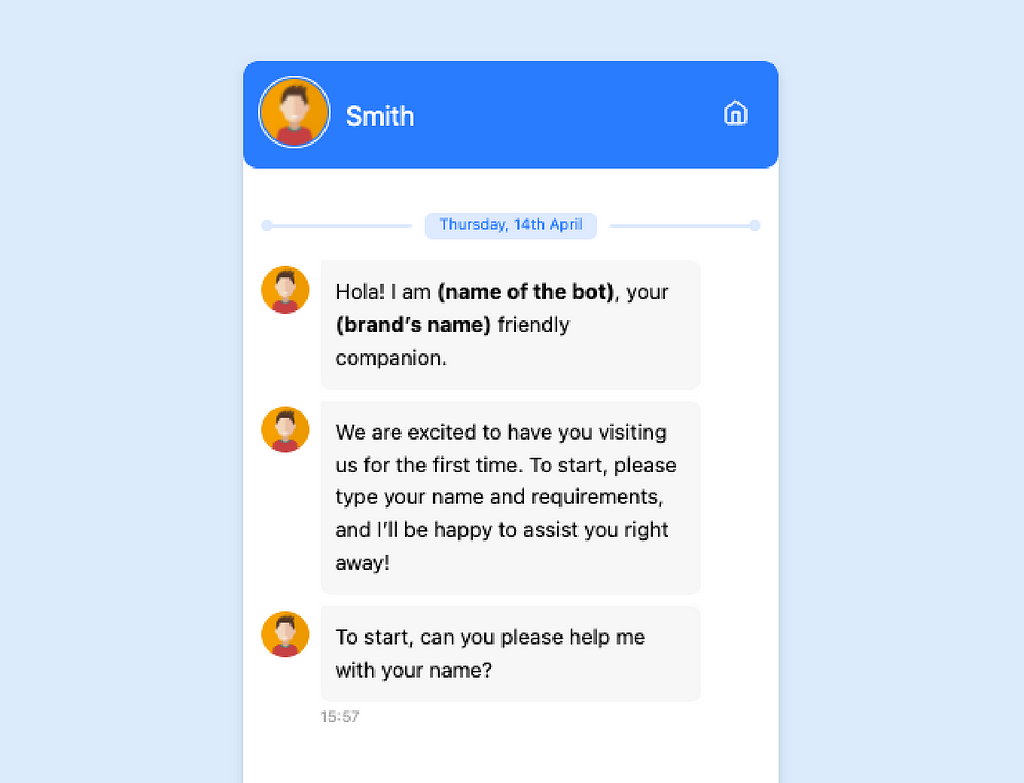
Another essential aspect of a greeting script is staying transparent and introducing your bot to your audience. Here’s an excellent welcome chatbot script example-
2. Scripts for Follow-ups
Online shoppers in the US are expected to reach 291.20 million by 2025. To make sure your sales are not thrown under the digital bus, it is important to strategically lure the users to trigger their desire and motivate them to purchase.
Follow-up chatbot scripts are the holy grail here. They are used to identify user pain points and address them, including but not limited to highlighting the product features, offering promotional discounts and free shipping, sending reminders, and showcasing positive feedback from the existing users. The underlying idea is to build an aura around the user’s mind about the product and motivate them to purchase.
Furthermore, since chatbots can analyze buyers’ shopping behavior and patterns, drafting a follow-up script based on the findings would be a wise decision.
3. Scripts to Prevent Cart Abandonment
While the majority of online shoppers complete their transactions, there are some who navigate away before checking out their cart. According to statistics, the average cart abandonment rate on E-commerce portals in the US is as high as a whopping 69.82%. Users might leave the cart filled due to several reasons, including higher pricing, missing information, end-minute new information, etc.
These numbers suggest a considerable revenue loss to the business. E-commerce chatbot scripts can help!
Writing the script to remind the user that the cart has items pending for purchase and offering irresistible offers like huge discounts or free shipping as an incentive is one of the ways to stimulate sales. Secondly, to vacate the abandoned cart, the chatbot script should also engage with the user as much as possible.
Take the following chatbot script example:
Paul logs into his account on an E-commerce portal, add a belt and a wallet to his cart. He goes to the checkout page and finds a shipping fee of $50. When he doesn’t click on the pay now button, the brand’s E-commerce chatbot appears.
Chatbot: Hey Paul! You seem to have left items in your cart. Is there something I could help you with to complete the purchase?
Paul: A shipping fee of $50? It wasn’t mentioned earlier anywhere.
Chatbot: The shipping fee is a standard fee charged by the seller on COD orders. You can opt to pay at the time of checkout with reduced shipping of $5. Would you like that?
Paul: Yes, how should I change my payment mode?
Chatbot: I’ve made the edits, and now your prepaid order will cost you a shipping charge of only $5. Enjoy your shopping!
Notice how the E-commerce bot script referred to the user by their first name to create a personal touch. And how it was triggered at the right moment. The tone in the script was light, casual, and friendly, thus increasing Paul’s chances to continue the purchase.
4. Script for Customer Support
Customer Support is a common denominator amongst all industries. There is always the scope to automate the process, so having a customer support chatbot seems like a wise option irrespective of whatever industry you’re in.
With AI chatbots prevalent everywhere and in reach of every user, far-reached customer support could be provided by incorporating good, user-friendly scripts. This way, the users can seek details about the products and get answers to FAQs.
A customer support E-commerce chatbot script should be personalized to deliver the best conversational experiences. Secondly, the bot script must contain industry jargon and terminology- as it would build credibility for your chatbot. And lastly, keep the language as natural and fluid as possible and put some humor in your script so that the user gets a natural human touch. 58% of users say chatbots have positively changed their customer service expectations.
5. Scripts for Promotions
Approximately 40% of people of all ages prefer to use chatbots when shopping online. And an E-commerce promotional campaign is a good way to acquaint the users with a brand’s products. Chatbot interactions could be leveraged to ask users to subscribe, share their contact information or make purchases.
The users might share their contact information, for which case an E-commerce chatbot script should be designed to attract them to complete the purchase. It should include key details and USPs of the product, a FOMO (fear of missing out) factor. And in-app notifications (mentioned below) will make users more likely to buy the product.
“Don’t forget to buy the best (product name) at a 20% discount.”
or
“Only 3 days left till it ends.”
Remember to include a reasonable time in-between the messages to avoid spam.
6. Scripts for Cross-Selling
You don’t want your customers to purchase just one time, do you?
Therefore your E-commerce chatbot must keep the customers informed and engaged even after making their purchase. Chatbots steer conversations and result in demand generation.
The trick is to do it strategically via implementing a user-friendly and personalized script. Are you worried it might offend the customers? Well, more than 70% of customers are interested in hearing from retailers after purchasing, especially if they provide personalized content.
Let’s take the following chatbot example of an online clothing and accessory store. Notice how the chatbot script performs cross-selling by engaging the customer who has purchased a tunic.
Day 1: Hey There! It is a bright sunny day! Don’t forget to wear your blue daisy tunic today.
Day 2: The color and print of the tunic are perfect for a sunny day. Oh, and you can wear it at an evening soiree too. It’s a perfect dress, isn’t it!
Day 3: How about you accentuate your look with some cool summery sunglasses and a chic handbag?
7. Scripts for Order Placements and Returns
To make the whole shopping experience easier, you can enable users to buy products directly from your chatbot widget. The E-commerce bot script could be designed to provide product possibilities and the price. Once the user selects the product, he should be able to order directly from the bot.
Secondly, implementing a chatbot for returning or exchanging the product also simplifies the process and enhances the user experience. The E-commerce chatbot script should allow users to return or exchange in a hassle-free manner, interact directly with the chatbot and receive status updates in simple text format.
8. Scripts for Customer Feedback
Getting the hang of how customers feel and view your products, services, and support is an invaluable asset for a business.
So, how do you collect customer feedback?
Forms over email?
Well, they have a 10% open rate and a less than 5% completion rate in the best of cases.
Can AI-written scripts help?
A. 100% yes.
Being conversational in nature, there is a good chance of customer interaction. The rule of thumb is to keep it simple. If answering the survey requires time and effort, customers might bounce off. The script should have options to the questions asked in the survey so that the customers don’t have to type anything.
Further, including GIFs, images, and color tones in the script will keep the customers more engaged, resulting in a successful survey.
Takeaway
Planning various chatbot scenarios and encompassing essential E-commerce chatbot scripts is essential for a good customer experience and sales boost. You need to trace customers’ buying patterns, identify their pain points, and then leverage them to create customized and personalized scripts.
If you’re wondering how to write a bot script, you don’t need coding. You can use the pre-designed chatbot templates or build your own message sequence.
Should you have some questions about how to write a bot script, reach out to us- we’re here to help!
As the world of customer service and support evolves, businesses are increasingly adopting a hybrid approach to support delivery, involving both automated systems and human agents. Organizations of all sizes must strike a delicate balance between auto-response systems and live human agents in today’s fast-paced digital landscape. Chatbots, on the other hand, are only as good as the conversations they’re programmed to have. And, the more your chatbot anticipates a question or resolves an issue, the better a support rep will be at directing users away from a bot conversation and into a human conversation. As a result, we’re at a loss as to how to improve their chat experience with a bot or even build one from scratch. In this blog post, we’ll go over how Zendesk Chat can help you improve your chatbot experience.
What is Zendesk chat?
Zendesk is an email-based ticketing system that helps businesses in tracking, prioritizing, and resolving support tickets. It can assist you in collecting customer requests submitted through various channels such as email, chat, social media, and chatbots and displaying them as tickets in a single dashboard. And using Zendesk Chat, also known as Zopim, you can instantly answer common questions and assist customers in submitting a ticket if their problem cannot be resolved right away.
Why do you want to integrate Zendesk Chat with Kommunicate?
Integrating Zendesk chat with Kommunicate will improve your team performance by taking advantage of features like:
Live chat: Provide instant support to your customers with live chat wherever they visit your website from.
Chatbot Builder: Using Kompose build and very own chatbot with no programming expertise
Allow your agents to view the chat history and respond to tickets directly from the Zendesk dashboard.
How to integrate Zendesk Chat (Zopim) with Kommunicate?
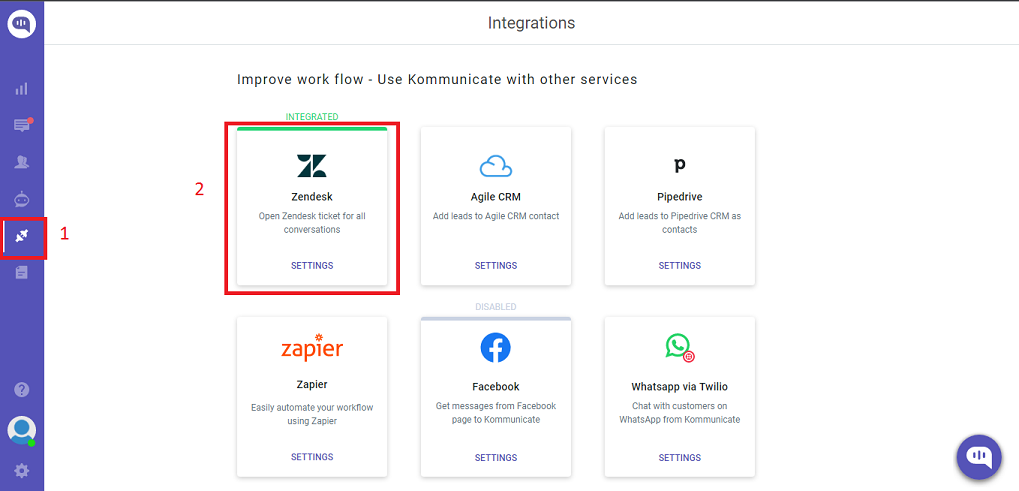
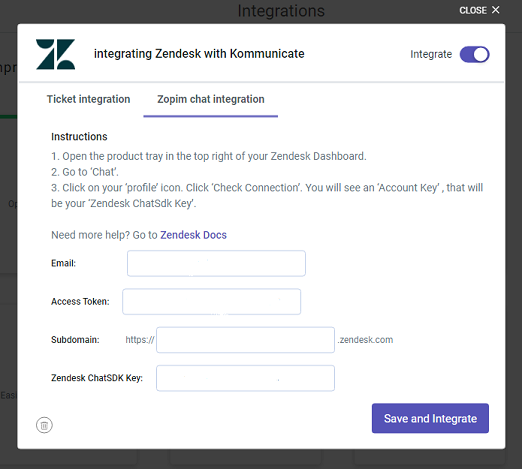
To set up the Zendesk chatbot, we will need a conversation automation tool for customer support teams, such as Kommunicate, to help them automate repetitive requests and focus on more complex tickets. When you use a tool like Kommunicate, the process becomes much easier. To integrate Zendesk chat with Kommunicate, follow these step-by-step instructions.
Step 1: Retrieve Zendesk credentials
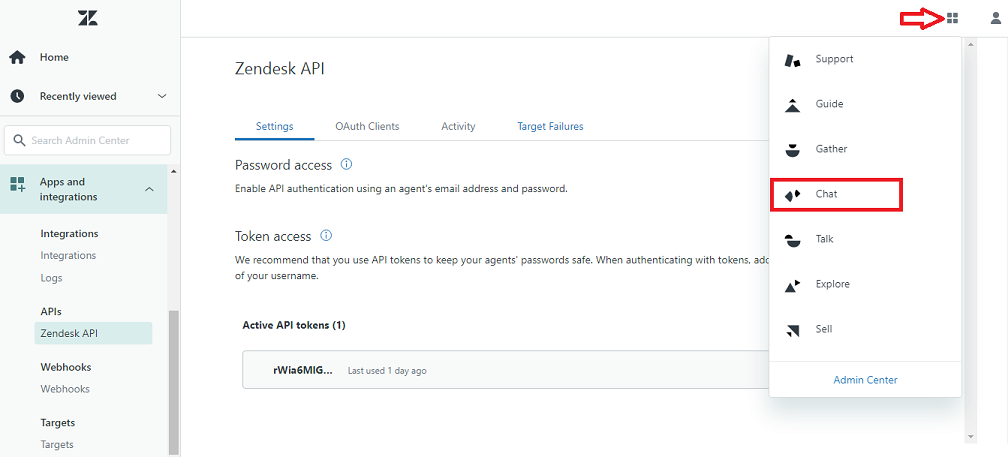
To begin, log in to the Zendesk dashboard and obtain the credentials listed below.
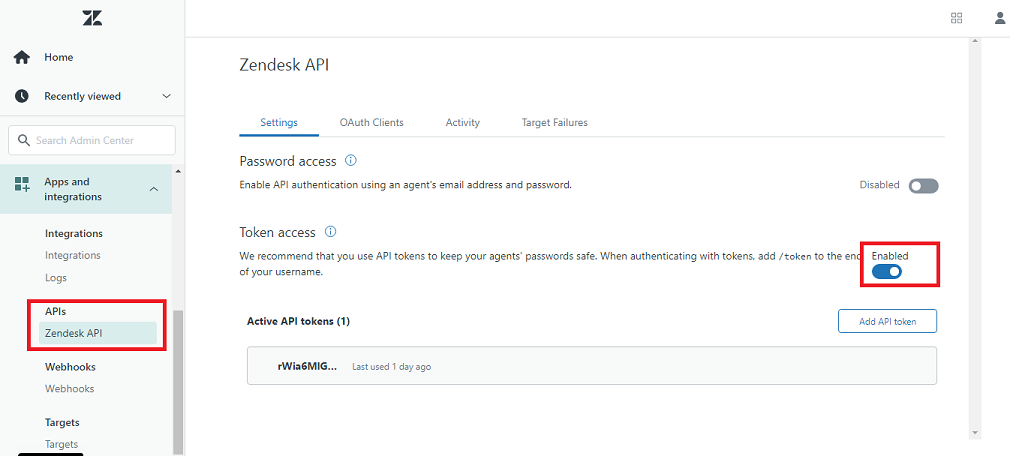
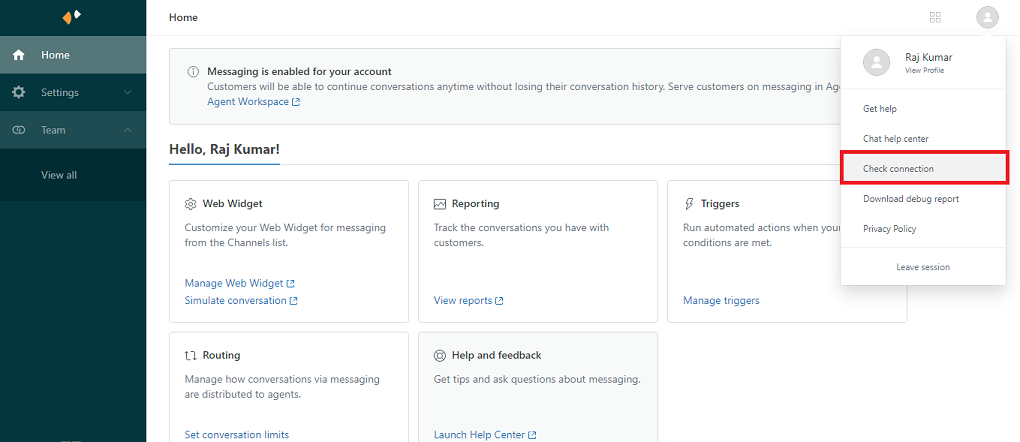
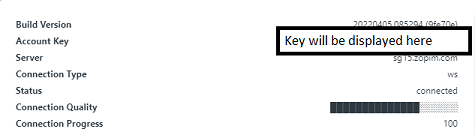
Access Token — To obtain the access token, Go to the Zendesk admin centre and select the Zendesk API from the Apps and integrations category on the left panel. Choose an active API token from the list in the section. If you’re creating an API token for the first time, remember to enable and activate it.
Voila! Start testing the Kommunicate chatbot, and the conversation will appear on the Zendesk chat dashboard once the integration process is complete. Agents can also respond to users directly from zendesk chat.
With this integration, you can easily build a chatbot that can answer your customers 24×7. You can now use Zendesk Chat for handling & routing customer queries and Kommunicate for managing everything else like assigning conversations to agents, setting trigger & reply automation, etc.
At Kommunicate, we are envisioning a world-beating customer support solution to empower the new era of customer support. We would love to have you on board to have a first-hand experience of Kommunicate. You can signup here and start delighting your customers right away.