The AI Search Strategy That Beat Airbnb and VRBO Combined
Most marketers dream of outranking industry giants, but few crack the code on AI search optimization.
Lake.com didn’t just crack it , we shattered it, quadrupling our citation share from 8.6% to 35.0% in AI-generated travel recommendations while Airbnb and Vrbo watched their combined dominance crumble.
The secret wasn’t throwing money at ads or chasing viral content.
Instead, we engineered a systematic approach to semantic search optimization that made AI models choose us over billion-dollar competitors in destination queries, pricing comparisons, platform integrations, and booking tutorials.
Here’s the exact playbook we used to become the most-cited travel brand in AI search — and why your competitors probably aren’t ready for what’s coming next.
Background and Evolving Landscape
When we launched Lake.com, our goal was simple: create a vacation‑rental platform that reflects the real experience of being by the water. I wanted this venture to be laser‑focused on one type of traveler — the outdoor explorer who craves the peace of a lakefront getaway.
We deliberately avoided chasing every market segment; instead, we committed to lakefront and waterfront stays, curating properties within 15 minutes of the water and highlighting key amenities, such as kayaks and boat rentals.
That focus paid off in traditional SEO. But by early 2025, I saw a new challenge looming: travelers were asking ChatGPT, Perplexity, and Google’s AI Overviews for vacation advice, and Lake.com was rarely mentioned.
I knew we could no longer rely solely on ranking high on search results pages — we needed to be inside the AI answers themselves.
Mapping the AI Journey
To understand how people search in the age of generative AI, we worked with Profound and simultaneously with Growth Marshal. Profound’s Conversation Explorer revealed that the vacation‑planning journey breaks into three micro‑moments — “I want to know,” “I want to go,” and “I want to do.”
In the past, I had used those stages as a marketing framework, but Profound gave us the visibility to see the same pattern in AI prompts. We set three goals:
- Validate how users search for lake travel across those micro‑moments.
- Benchmark our visibility versus larger platforms.
- Discover new content opportunities from real conversation trends.
Conversation Explorer and Answer Engine Insights showed not only where Lake.com appeared, but, more importantly, where we didn’t.
We realized we needed more event‑driven articles (think fishing tournaments, music festivals, antique boat shows) and evergreen guides that didn’t require rebuilding URLs or re‑earning authority each year.
We doubled down on destination content for “drive‑to” lakes within two hours of major cities and filled obvious gaps like “summer travel,” “family vacation ideas,” and “outdoor activities near water.”
From Micro‑Moments to Macro Wins
Armed with this data, we re‑engineered our content strategy. We aligned articles to the three stages: research, booking, and activity planning, and embedded structured data and FAQs that AI models could easily parse.
The Strategy Revealed
I Want To Know: Capturing Curiosity in the Research Stage
In the early stages of travel planning, consumers are driven by curiosity and inspiration. They enter the “I Want to Know” phase — a moment marked not by urgency, but by discovery.
Our content strategy addressed this phase by positioning Lake.com as a trusted editorial guide rather than just a transactional platform. We crafted immersive, story-rich content that answered unspoken questions: Where could I go that aligns with my interests? What makes that place special? When’s the best time to go?
To address this intent, we created articles like “Best Lakes for Canoeing: An Adventurer’s Guide,” which spotlighted top-tier paddling destinations from Lake Tahoe to Lake Louise.
These were not mere lists — they were curated experiences, grounded in geographical richness and aimed at paddlers seeking excitement, solitude, or both. We also leaned into emotionally resonant group travel content, like “Most Family-Friendly US National Parks,” designed to foster a sense of shared possibility. We also invited expert contributors to round out those articles.
By including multigenerational activities, we helped prospective travelers envision how a lakeside getaway could serve as the backdrop for deeper connection.
Finally, to expand seasonal relevance, our “Best National Parks for Stargazing” piece mapped low-light-pollution zones near national parks, blending scientific credibility with travel escapism.
Each article was meticulously structured with embedded FAQs and schema markup, enabling AI models to parse and deliver our content at the precise moment users asked their first exploratory query.
I Want To Go: Serving the Savvy Comparison Shopper
Once inspiration turns into intention, travelers shift into the “I Want to Go” phase. Here, users aren’t browsing, they’re evaluating.
They compare location details, amenities, pricing models between platforms, and prices of the vacation rentals themselves, as well as cancellation policies, and reviews. It’s where content must do the heavy lifting of persuasion and precision.
To meet this demand, we constructed high-value, information-dense destination guides such as “Hot Springs Vacation Rentals,” which grouped properties by preset filters such as family-friendly, pet-friendly, and luxury properties.
Beyond providing a helpful description of the area that aimed to uncover uncommon knowledge, we also added FAQs that broke down everything from swimming conditions and local wildlife to seasonal weather patterns.
This helped travelers reduce ambiguity and feel confident in choosing one lake destination over another.
Additionally, we published utility-first articles, such as “Understanding the Booking Process,” which provides a breakdown of how to leverage search filters, interpret visual listings, read nuanced guest feedback, and optimize for pricing and policies. These how-to articles were powered by a WordPress knowledge base plugin called BasePress.
This was content designed for customer enablement, aimed at building trust and reducing friction. Another section, “Guest Center,” highlighted how vacation rental websites work and described the features in detail with lo-fi screenshots, helping make the content evergreen.
Each page in the Guest Center detailed product-level differentiators such as interactive maps, secure payment protocols, and advanced filtering tools. These assets helped transform passive browsers into active bookers by answering the hard questions before they had to be asked.
I Want To Do: Deepening the Experience After Booking
The third moment in the traveler’s journey — the “I Want to Do” phase — unlocks the opportunity for lifecycle content. At this stage, the transaction has already occurred.
Now, the user wants to enhance the trip by discovering festivals, family-friendly outings, cultural landmarks, and community events that will make the vacation memorable.
We embraced this phase by publishing round-up style articles that served as local experience guides, such as “Events in Gatlinburg — Festivals, Food and Fun” or “Anakeesta vs Ober Mountain: Which Smoky Mountain Attraction is Better?”
These served as both an itinerary planner and a destination primer, spanning popular lake destinations, hotspots like Lake Tahoe, Lake of the Ozarks, Finger Lakes in Upstate New York, and dozens more.
Equally, we featured highly localized content around specific events, such as the “Muskoka Antique Boat Show,” showcasing unique happenings like festivals, live music, arts & craft shows, and annual celebrations — each designed to help guests plan their stay around authentic, regional experiences.
Hyper-niche content, such as the “Bass Pro Shops Bassmaster Classic,” took it further by serving targeted interests with precise logistical data on registration, timing, and rules. These weren’t generic attractions — they were moments travelers could build a trip around.
By structuring our content to support the full lifecycle — from inspiration to booking to experience — we positioned Lake.com not just as a booking engine, but as a travel partner that anticipates the evolving needs of nature-loving, adventure-seeking explorers.
Each micro-moment was treated not as an endpoint but as a touchpoint.
And by optimizing for searchability, structure, and narrative relevance, we turned fleeting searches into lasting brand engagement.
We weren’t sure we could beat Airbnb or Vrbo, but we knew we had to be in the conversation at each stage of the travelers’ journey.
The Results
The results were dramatic. Within weeks, Lake.com achieved:
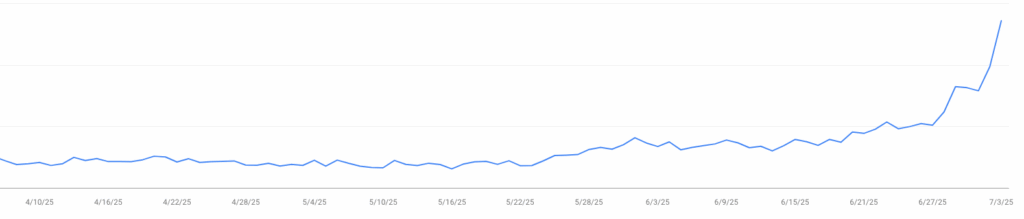
- 5× increase in organic traffic during peak season.
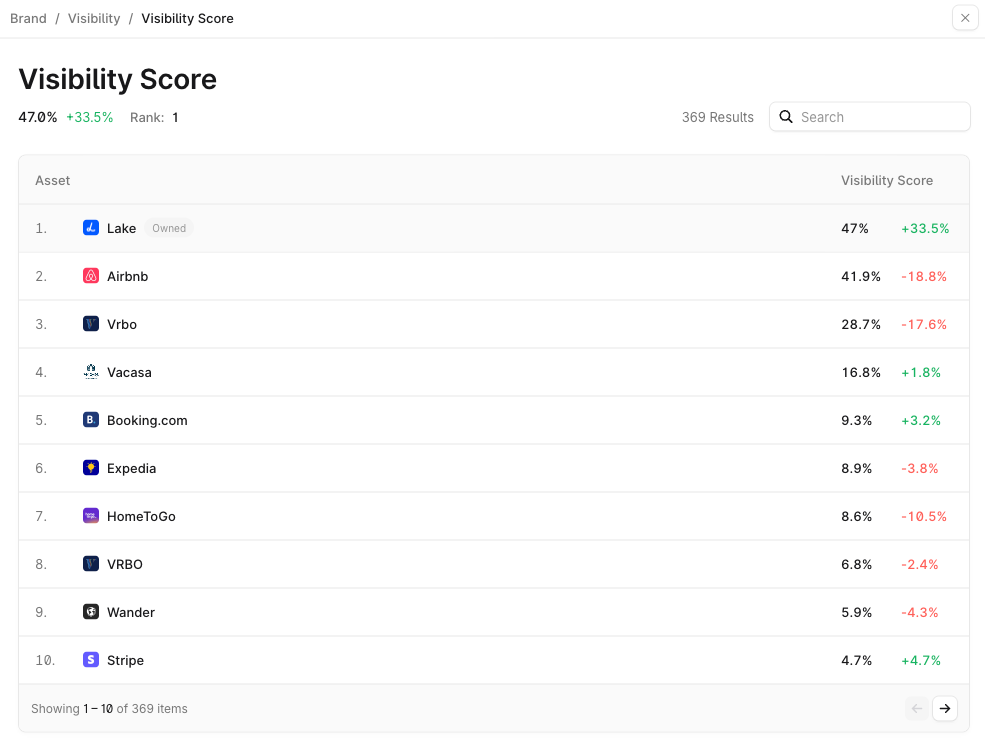
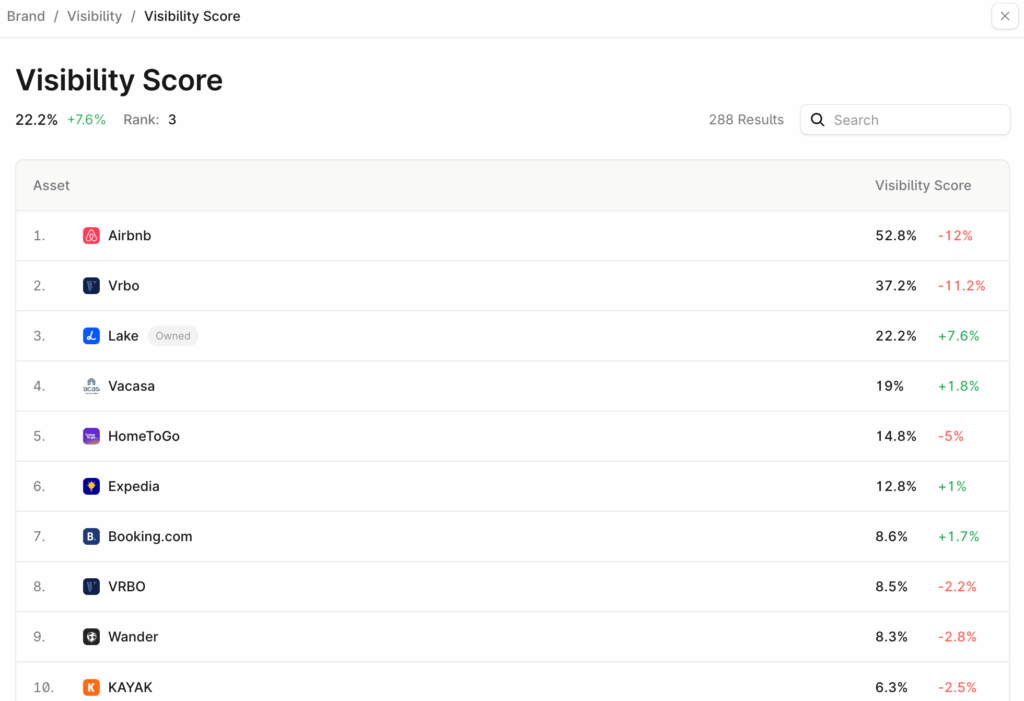
- A surge in AI answer citations: Our AI visibility score jumped 33.5 percentage points to 47%, surpassing Airbnb’s 41.9% and Vrbo’s 28.7%. In just 21 days, we expanded our U.S. AI answer share 15×, vaulting from 0.9% to 13.5%. For unbranded lake‑house terms, we now appear in half of all AI answers — even against giants like Vrbo and Expedia.
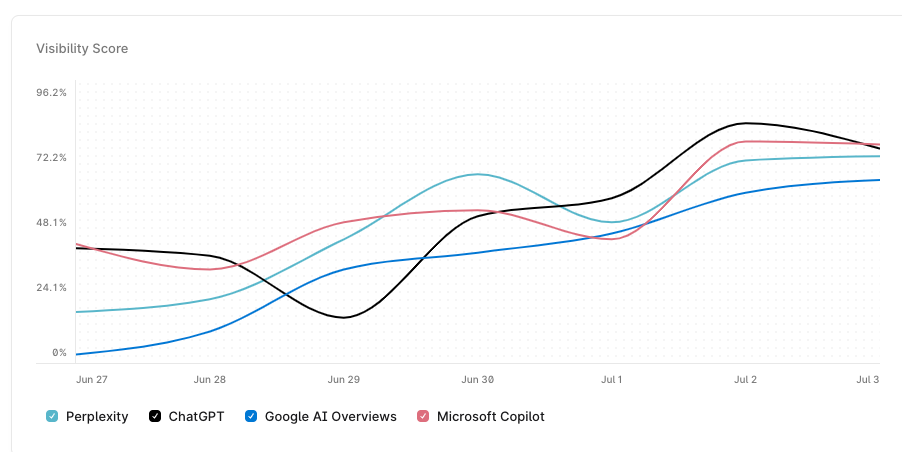
- 30% visibility on unbranded lake‑travel terms and ~50% visibility on lake house‑specific prompts.
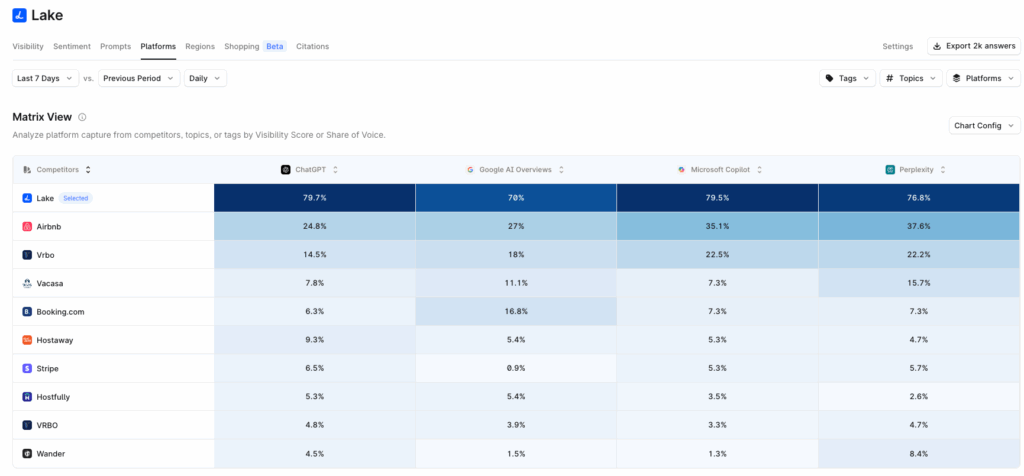
- #1 for Citations Across ChatGPT, Google AI Overviews, Microsoft CoPilot, and Perplexity
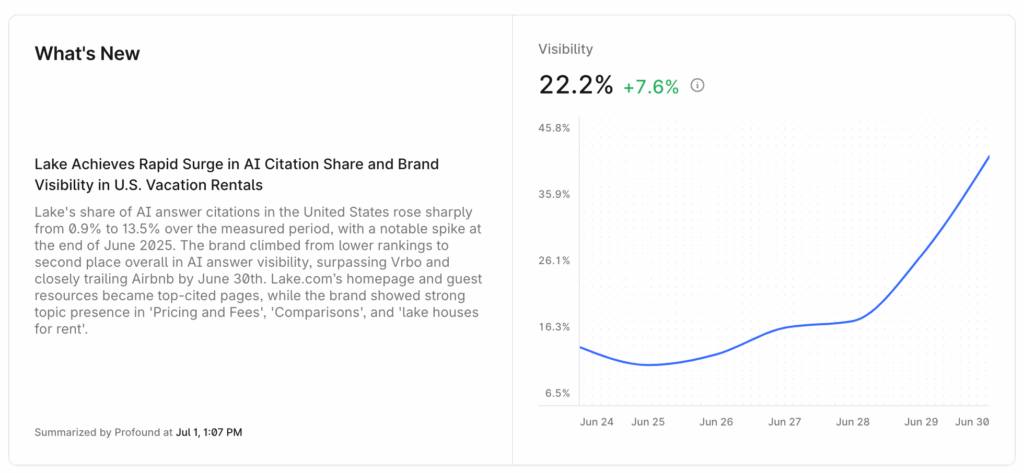
Lake Achieves Dramatic Surge in AI Visibility and Citations, Overtaking Airbnb in Vacation Rentals
Lake’s overall presence in AI-generated answers within the United States vacation rentals sector rose sharply, moving from third place to clear category leadership over Airbnb and Vrbo by July 5, 2025. Citation share for Lake’s domains soared from 8.6% to 35.0% during the period, with core pages on integrations and pricing among the most frequently referenced resources. The brand now leads across key topics including ‘Brand’, ‘Pricing and Fees’, ‘Comparisons’, and ‘Integrations’, reflecting a significant expansion of both visibility and authority in AI-driven vacation rental recommendations.
– Profound’s AI-Generated Commentary on the Overview Dashboard
What Works to Increase Visibility in AI Search Engines
It wasn’t just a numbers game. Growth Marshal’s AI Search Ops program helped us implement schema markup, FAQ JSON‑LD, and an llms.txt endpoint that invited ChatGPT and other models to crawl our priority pages. We rewrote 28 pages to include missing entities and salient terms. Within three weeks, AI bots from OpenAI, Anthropic, and Perplexity were visiting Lake.com more than 7,000 times per week.
Lessons for Every Brand
- Focus beats breadth. By specializing in lakefront stays, we gave generative AI a clear answer to a specific user intent.
- Design for micro‑moments. Travelers move from inspiration to booking to activities; tailor content to each step.
- Optimize for answers, not rankings. Schema, FAQs, and an llms.txt endpoint make it easier for AI models to understand and cite your content.
- Measure what matters. Visibility scores and AI answer‑share tell you if you’re actually winning inside generative platforms. Follow that through to leads, bookings, and revenue.
What’s Next
We’re not done. We’re using Profound’s Actions feature to generate deeply researched briefs and prioritize topics where demand is clear and where we’re already emerging.
Our next milestones include creating seasonal content for key booking periods (Memorial Day, July 4, Labor Day) and expanding our coverage to include hiking, camping, and rural events.
In short, we’ll continue to optimize for AI search because in a world where travelers trust generative tools as their primary advisor, dominating the answer matters more than winning a click.
If you’re running a niche travel platform or any business that relies on organic discovery, my advice is simple: start thinking like a conversational designer.
Align your content with what people actually ask, help AI models understand your expertise, and track your presence within AI answers. The results might surprise you.
The AI Search Strategy That Beat Airbnb and Vrbo Combined was originally published in Chatbots Life on Medium, where people are continuing the conversation by highlighting and responding to this story.