I’m just looking for the best bang for your buck chat bot, one that has the ability to send pictures. I would prefer free one’s, but I’m sure they probably don’t exist.
How should I create pricing plans for a monthly recurring chatbot fee I want to provide basic chatbot development to advance e-commerce chatbot that can give the product recommendation or sentiment analysis
It’s no exaggeration to say that chatbots are a mainstream technology. A whopping 88% of web users chatted with bots in the previous year. What’s more, 7 out of 10 find the experience positive. However, despite these promising statistics, there’s still a significant portion of users who have less-than-stellar experiences with conversational systems.
The Dark Side of Chatbots: Common Complaints & User Frustrations
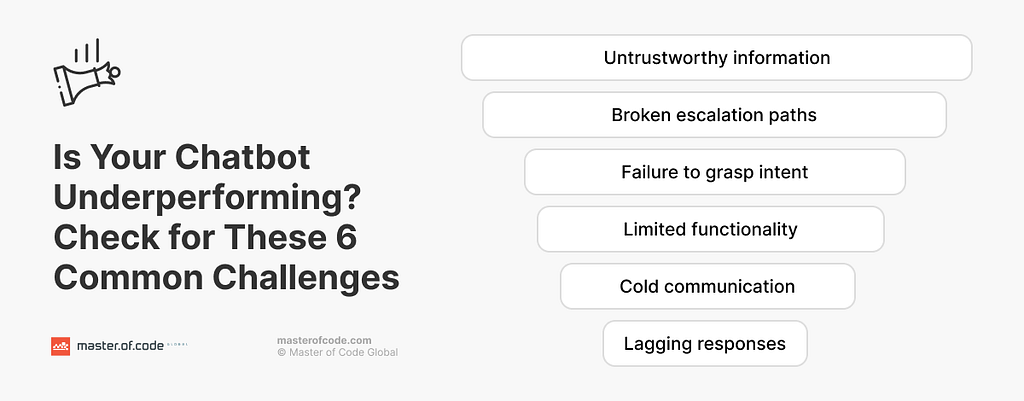
Many of the most common complaints stem from design flaws and limitations that can be addressed. Here’s a breakdown of the chatbot pain points — the things users find most frustrating:
Lack of Understanding: When chatbots fail to understand natural language, it’s like talking to a brick wall. Misinterpretations lead to frustration as users repeat themselves, rephrase questions, or simply give up. This breakdown in communication often stems from limitations in NLP capabilities.
Limited Functionality: If your chatbot can only handle a few basic tasks, users quickly hit a wall. They expect an AI assistant that can answer a variety of queries, perform different actions, and even learn over time. Constrained capabilities make bots seem more like a novelty than a truly helpful tool.
Impersonal Interactions: Nobody likes talking to a robot that sounds like a robot. Unpersonalized communication lacks warmth and empathy, leaving users feeling like they’re just another ticket number. This robotic tone can make users feel unheard and unvalued, leading to a negative perception of the brand.
No/Poor Handoff to Human Agents: When chatbots can’t solve a problem, users need a seamless handoff to a human agent. But if that process is clunky or non-existent, it’s a major letdown. A frustrating escalation procedure leaves users feeling trapped in an endless loop with an unhelpful bot.
Inaccurate Responses: Misleading replies are a major turn-off, especially when it comes to LLMs. If users can’t rely on the information they’re getting, why bother using the chatbot? Misinformation from a supposed “intelligent” assistant erodes trust and can have serious consequences, depending on the context.
Slow Response Times: In today’s fast-paced world, nobody has time to wait for a bot to respond. If your AI assistant is lagging, users will quickly lose patience and seek help elsewhere. A slow chatbot simply doesn’t meet the expectations of users who are accustomed to instant communication.
By understanding these common bot failures, you can take proactive steps to avoid them. Designing a chatbot that prioritizes comprehension, functionality, personalization, escalation paths, accuracy, and speed will lead to happier users and a more successful AI implementation.
Leveling Up Your Chatbot: A Conversation Designer’s Guide
To help you navigate these challenges and create a truly exceptional chatbot experience, our experienced conversation designers, Natasha Gouws-Stewart and Petra Gal, have compiled this list of 7 essential recommendations.
Many users get frustrated when AI chatbots can’t hand off conversations to real people. To keep your users happy, make sure your chatbot can smoothly pass the conversation to a live agent, especially if it doesn’t understand the user after two or three consecutive attempts. This way, users don’t get stuck in a loop of errors and can get the help they need. In addition, clear messages indicating that a live agent is taking over can increase trust and satisfaction.
Recommendation 2: Redirect to Other Channels and End Conversations Gracefully
We understand that not every AI assistant can have live support available 24/7 or, in some cases, not at all. When live agents aren’t available, it’s important to clearly state your live support hours and offer other ways to get help. For example, the assistant can suggest emailing customer support, calling a helpline, or visiting a FAQ page. This approach shows users you care about their experience, even if the assistant can’t solve their problem directly. In some cases, it might be best to end the conversation gracefully, instead of letting users get stuck in an error loop when the assistant doesn’t understand them and live support isn’t available.
Large Language Models vs. Deterministic Flows: Making the Right Choice for Your AI Assistant
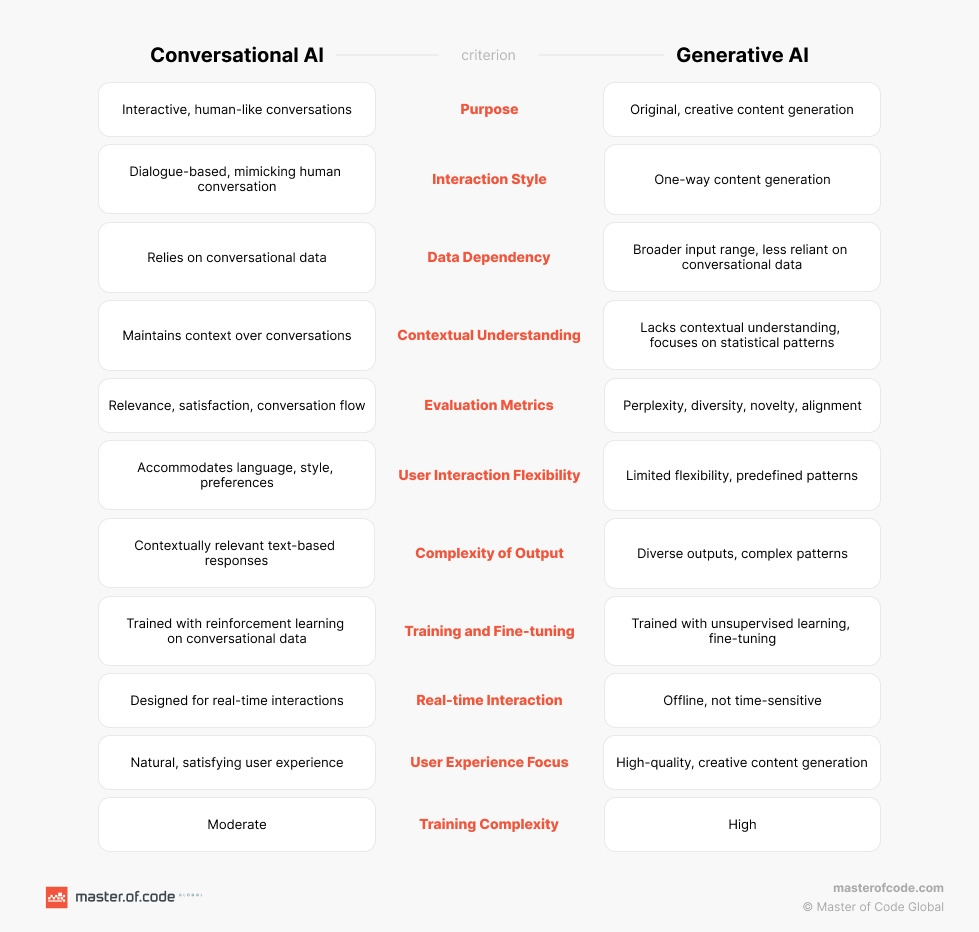
LLM-powered AI assistants are all the rage nowadays, but do they fit every use case? For your AI assistant, the answer might be no. While LLMs can produce more natural conversations and improve intent recognition, your LLM-powered assistant might be struggling with high costs, latency, and hallucinations. Most tasks handled by LLMs can be managed by deterministic flows, which are more predictable and cost-effective. If natural conversations are your goal, investing in a conversation designer and adding deterministic flows might be a better choice.
Performance and Scalability
Deterministic flows often have better performance and scalability compared to Generative AI. They require less computational power, which translates to faster response times and the ability to handle a higher volume of interactions simultaneously.
Control and Predictability
Deterministic flows offer greater control over the conversation path. This predictability is crucial for maintaining brand voice and ensuring compliance with regulatory requirements.
Cost and Maintenance
Generative AI might seem cheaper initially, but it can be more expensive in the long run due to the cost-per-contact. Since responses aren’t static and need to be generated repeatedly, costs can add up. Also, fully LLM-powered agents need close monitoring to prevent them from hallucinating.
LLMs are ideal for complex, dynamic interactions where flexibility and adaptability are needed. At Master of Code Global, we ourselves have seen how LLMs can significantly improve more complex flows, such as data collection processes. In a deterministic flow, gathering data from a user typically involves a step-by-step process. This often includes complicated logic for editing or updating responses and performing regex checks on each input. In contrast, an LLM enables seamless data collection from users in a single interaction, allowing them to edit multiple answers simultaneously with ease.
Master of Code implemented this approach to assist a large broadcasting corporation. By doing so, they enhanced the company’s ability to efficiently gather extensive information from users to troubleshoot issues with a paid service that appeared to be down.
However, it is important to note that deterministic flows excel in scenarios with well-defined procedures and predictable user inputs, such as customer service queries, and booking systems.
Best of Both Worlds
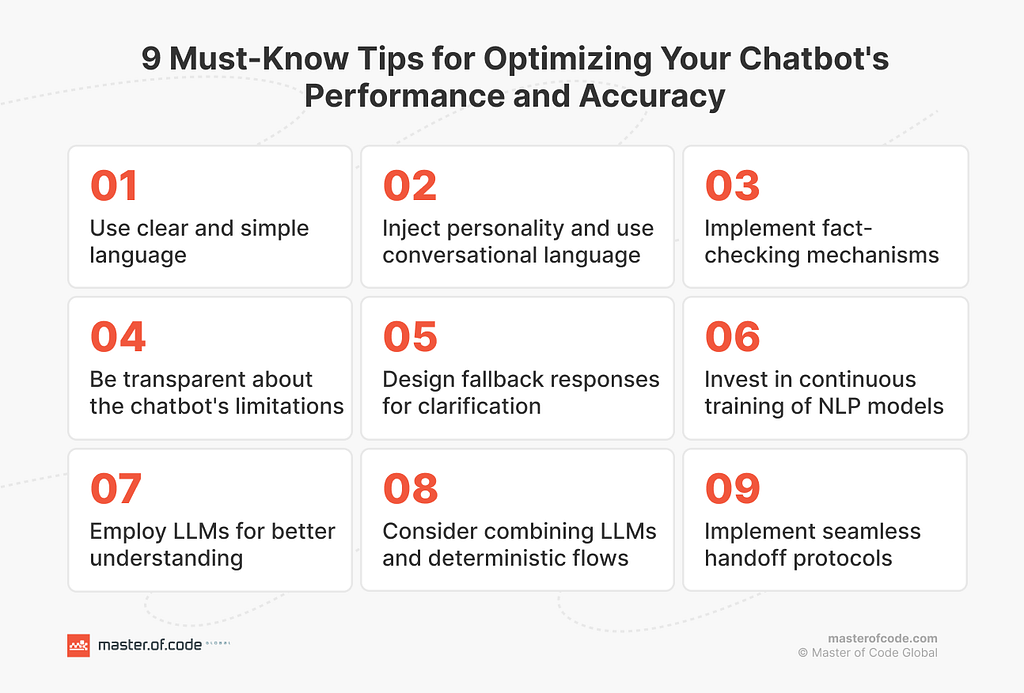
Combining both approaches can leverage the strengths of each. Use LLMs for open-ended, creative interactions and deterministic flows for structured, transactional tasks. This hybrid strategy can optimize performance, control, and user satisfaction.
Improving an assistant’s ability to understand users and reducing instances of misunderstanding is crucial for building trust and encouraging repeat usage. Customers are often unforgiving when an assistant fails to understand them, leading to abandonment and a slim likelihood of a second chance.
Recommendation 1: Continuous training
Regularly train and update the NLP models with new data to keep them relevant and improve their understanding over time. Study your users’ utterances and add (or remove) training phrases based on what real users are asking.
As mentioned, LLMs may just be a better fit for your use case. Employing an LLM can help your assistant understand context, nuances, and varied phrasings, significantly improving comprehension.
Maintain context throughout the conversation to understand references to previous messages from the user. Use session memory to store and recall information provided by the user earlier in the conversation.
Recommendation 3: Fail gracefully
It’s a given that your chatbot won’t understand everything your users ask. Rather than trying to prevent that, ensure you can ‘fail gracefully’ by designing fallback responses that ask for clarification when the bot does not understand. For example, “I didn’t get that. Please rephrase your question.” Make sure your chatbot can smoothly pass the conversation to a live agent if it doesn’t understand the user after two or three consecutive attempts.
Additionally, make sure your assistant can identify errors and guide the user back on track, minimizing their frustration.
Recommendation 4: Multilingual support
If you offer services to your customers in multiple languages, ensure you implement language detection in your chatbot as well to understand and respond in the user’s preferred language.
It’s crucial to remember to always keep your responses clear, concise, and simple. Users typically scan answers quickly, so design your responses to accommodate this behavior. Avoid technical jargon and complex sentences unless you know the user’s level of expertise.
Recommendation 2: Get real feedback
Regularly analyze customer feedback using metrics like NPS or CSAT. Make sure your post-conversation survey includes an option for free-form answers. If you don’t have a survey at the end of your interactions, now is the time to implement one. You’re missing out on valuable real-user feedback that can help you identify issues you might not catch on your own.
By analyzing real customer feedback and conversational transcripts, we at Master of Code have been able to significantly improve our client’s CSAT scores and identify new opportunities/improvements. For example, our Apple Messages for Business Bot for a leading electronics retailer achieved an average CSAT score of 80%.
Recommendation 3: Recognize various inputs and provide guided conversations
Use buttons, quick replies, and menus to guide users through the conversations, reducing the risk of misunderstandings. However, it’s important to balance the experience by allowing the customers to also enter free text where appropriate while ensuring your assistant recognizes various inputs such as typos, slang, and shorthand.
Wrapping Up
By implementing the strategies outlined in this guide, businesses can transform their chatbots from frustrating liabilities into valuable assets. However, we understand that not every company has the in-house expertise to navigate these complexities. That’s where our team of chatbot consulting experts can help.
If your bot is struggling to deliver a positive user experience, we can diagnose the root causes and provide tailored solutions to improve its functionality, understanding, and overall effectiveness. We can help you build a digital assistant that not only meets but exceeds user expectations, driving engagement and boosting customer satisfaction.
Don’t let a poorly designed chatbot tarnish your brand’s reputation. Contact us today to learn how we can rescue your chatbot and maximize its potential.
We built a hallucination detection tool that allows you to use an API to detect hallucinations in your AI product output in real-time. We would love to see if anyone is interested in learning more about the research we’re doing!