Optional Text: Can’t wait to go to the #ChatbotConference Online on May 25! Really looking forward to talks from Google, Salesforce, CoCoHub, and Rasa. There are only a few spots left, join me before tickets run out!
Once complete, email me screenshots at stefan@chatbotslife.com and I’ll send you a free Day 1 Pass (value: $199) for the Chatbot Conference on May 25th!
Over the past few years, chatbots have become an integral part of our lives when it comes to interactions with businesses. More companies rely on conversational solutions for better operations, lower costs and an easier recruitment process, so it doesn’t surprise anyone that chatbot market size is projected to grow to $10.5 billion by 2026, according to recent research. However, virtual agents can help organizations and projects that we usually do not view as tech-savvy. We’d like to explore how nonprofits and social responsibility projects, whose budgets are often tight, put Conversational AI to good use and make the most of it.
Conversational agents to the rescue
Even though it’s becoming more common for corporations to support nonprofit and charity organizations, most of them exist only because regular people like us make donations or help in some other way. So, nonprofits must establish proper communication with potential donors. And conversational agents can be of great help here.
For example, Upsala Circus, a nonprofit organization that comprises a professional theatre group, inclusive performance projects, and classes that socialize troubled or foster teens through performance arts, decided to get to know people who donate on their website. So they built a chatbot using chatbot builder Aimylogic by Just AI, which gathers information from the website visitors conveniently and securely: who they are, what kind of support they can provide, what kind of questions they have, also providing further instruction. Part of a long-term strategy, this chatbot will help the nonprofit make a donor segmentation and build communication properly. If someone is looking to be a volunteer, it hardly makes sense to explain how to donate money.
Getting more people to donate or make those donations recurrent requires reaching out across a variety of channels, and voice here seems to be one of the most natural ones. Alexa donations, for example, list 337 nonprofits — from American Childhood Cancer Organization to Children’s Miracle Network — that allow users to send money to charity via Amazon’s voice assistant. Some nonprofits create voice skills to encourage donations — for example, Need Help charity foundation that helps to raise funds for other nonprofit and charity organizations, launched a voice skill for Yandex’s voice assistant Alice (#1 voice assistant in Russia). Named “A Rouble a Day,” the voice skill enables users to choose from over 150 nonprofits and make a regular donation. To encourage smart speaker users to donate, voices of popular actors and media personalities explain why even such a small but regular sum can make a big difference.
Building communication with donors is also about being accessible across a variety of channels. Being in touch 24/7 is challenging even for regular businesses, but it’s especially tough for nonprofits as it requires extra staff. So, here’s when conversational agents and smart skills come into play — they can address the most frequent questions, navigate website visitors and offer necessary instructions. For example, NRDC uses an Alexa skill to help people avoid throwing out good food. The Save the Food skill offers advice on storing food to last longer, checking whether it’s still good, and even reviving food that’s past its prime. Among the users of Aimylogic chatbot builder, there is a nonprofit waste sorting project supported by IKEA named Rules of Sorting. They designed a social messenger chatbot to advise users on what kinds of plastic can be recycled, which recycling stations accept certain kinds of waste, and help users locate them.
Conversational agents can also become an interaction channel for those who cannot communicate verbally due to physical challenges. A great example here is a social responsibility project by professional haircare brand Indola, which is part of Henkel. Their chatbot enables hearing-impaired hairstylists to consult their clients online. There is also a chatbot called Mera Mitra, that serves as a companion for persons with disabilities, providing all kinds of the necessary information. Designed by two Indian developers, this chatbot is available in Google Assistant and Facebook Messenger.
Many charity organizations are successfully adopting conversational technologies: launching voice skills, chatbots, and even bespoke voice assistants. For those weighing the pros and cons of Conversational AI (CAI) projects, here are a few ways they can create value for nonprofits:
Automating communication
Full-time contact centers require a lot of resources, but nonprofits and businesses can efficiently use AI-powered conversational agents to automate communication with donors, website visitors, or just about anyone. Chatbots and virtual assistants can answer FAQs and address most common user queries, being available 24/7 across multiple channels.
Adopting new communication channels
Voice is yet another channel to communicate with the audience. So a skill for a voice assistant is a great way to tell people more about your organization or campaign, encourage users to donate, or conduct a survey.
Getting to know your audience
A chatbot can greet website visitors and start a conversation. This way, nonprofits can find out more about people coming to their website and build further communication more efficiently.
Reaching out en masse
Automated voice bots or text bots are crucial when you need to contact many people at once: be it a volunteer instruction, a new member registration campaign, or informing visitors of your charity event about the details.
Things to consider before starting a CAI project
First, it is necessary to understand that conversational AI agents are no panacea but rather a tool that, if used wisely, can improve certain processes over time. But, just like any tool, it needs to be created first and then constantly taken care of. Before you start working on this tool, please consider — what is it you want to achieve? Improve user experience, survey donors, or automate FAQs?
Think about the resources you have to create the bot — as it’s a full-blown IT project. Even when complete, the bot requires further training and honing — only in this case will it become truly smart and address most queries properly.
Another important thing is the bot’s efficiency because there are quite a lot of things that will define it and those need to be considered before any actual work is done:
What channels your bot will serve
A bot can be implemented anywhere — from WhatsApp to Facebook messenger, to Alexa. Some channels are quite similar, while for others you might need to create an entirely new UX scenario. Depending on the chatbot software you choose, you might need to create custom bots for every channel unless this tool allows for multichannel integration when you create a bot once and then deploy it across many channels.
What chatbot software you should choose
There are many kinds of chatbot software — from no-code visual bot builders to advanced platforms. It all depends on how much you’re willing to spend on your bot and the manpower you have at hand. Of course, the low-code chatbot builder options are great for short-staffed nonprofits, as such projects do not require a professional developer at the early stages.
Will you have the resources to continue training your bot
Even after your bot goes live, you’ll need to keep analyzing bot-to-users interactions to improve it. And there’s always something to improve when it comes to conversational agents. Launching a bot and forgetting it exists for a year, means you’ll have your time and money wasted.
How many topics your bot will cover
Even a small nonprofit will have many topics: donations, volunteering, to many other ways people can help the organization. There will also be topics that a bot is not supposed to address — usually, those requiring empathy — and should be able to transfer those to a human.
To sum it all up, conversational tech is advanced, diverse, and offers tools that require little to no coding skills. And, as long as a company understands what it wants to achieve with a conversational agent, it can start a CAI project on its own and then grow it evolutionarily.
With millions of people forced into working from home by the current situation, companies are finding ways to keep teams connected across the globe.
One tool is quickly emerging as the most popular of the remote collaboration bunch: Slack.
Slack has a treasure of bots and apps, and integrations, that can be used to make daily efforts in the workplace easier.
In this article, you’ll find 17 Slack bots to build an amazing team culture, increase engagement, and improve collaboration:
1. BirthdayBot
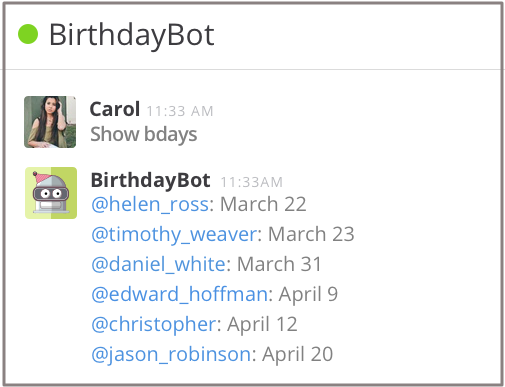
BirthdayBot is the app to keep track of office birthdays and anniversaries. BirthdayBot keeps everyone informed about upcoming birthdays. It also ensures all the members of your team get a proper b’day celebration!
2. Trivia
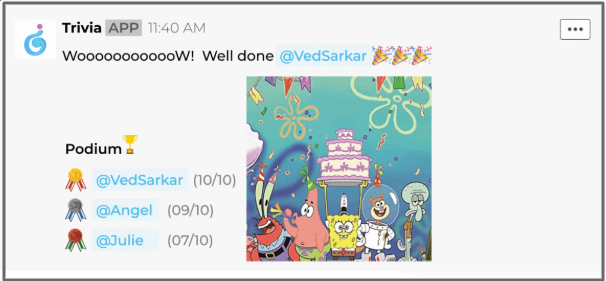
Trivia is the new way to connect with your remote team while playing exciting quizzes on Slack and Microsoft Teams! Get summarised results at the end of every Trivia quiz and find your very own Quizzard!
3. Moodbit
Are you looking to increase employee engagement? Have you ever dreamed of having a highly engaged and productive team? Moodbit is definitely the right app for your team.
Moodbit is an app for everyone in the company: managers, employees, executives and more. Moodbit helps to provide a clear understanding of what is going on in the workplace.
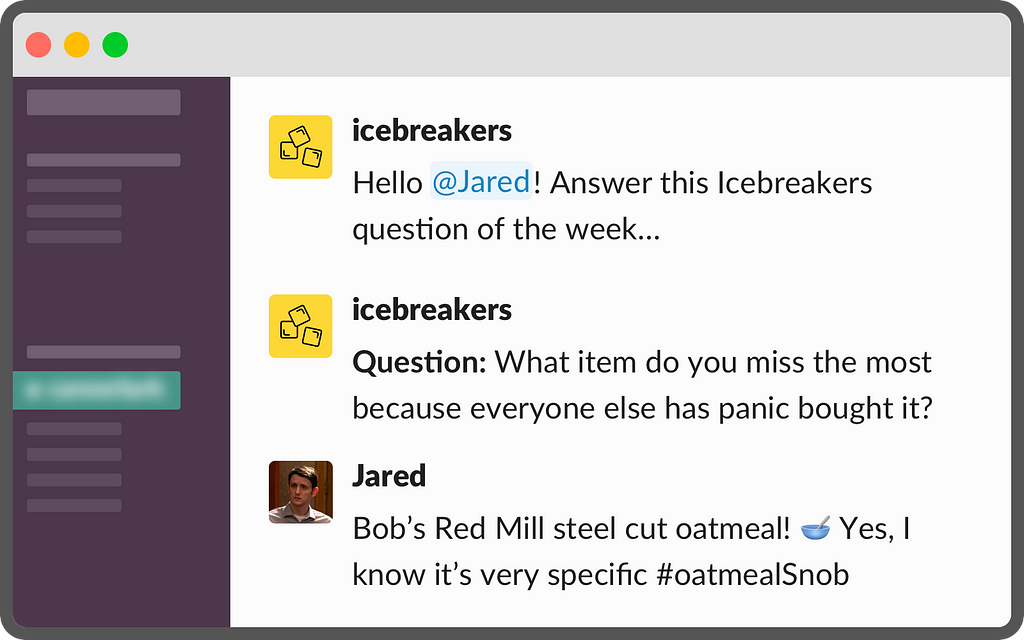
Icebreakers helps you to get to know your coworkers. Icebreakers nudges your teammates on Mondays to share about their weekend highlights or fun links, and another day later in the week with a rotating question. Questions range from light-hearted to thoughtful.
5. EngageWith
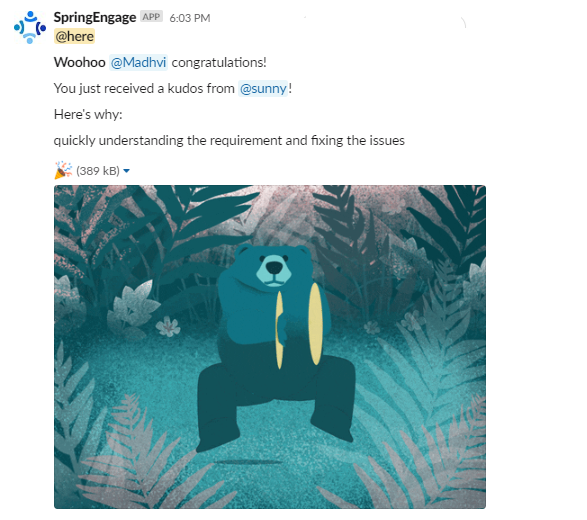
EngageWith is an employee recognition and rewards platform that enriches your company culture. It virtually brings recognition and fun within your Slack and MS Teams workspace. With EngageWith, everyone across your organization can publicly recognize everyone else by giving points that add up to valued rewards (employees can redeem their points).
6. Niles
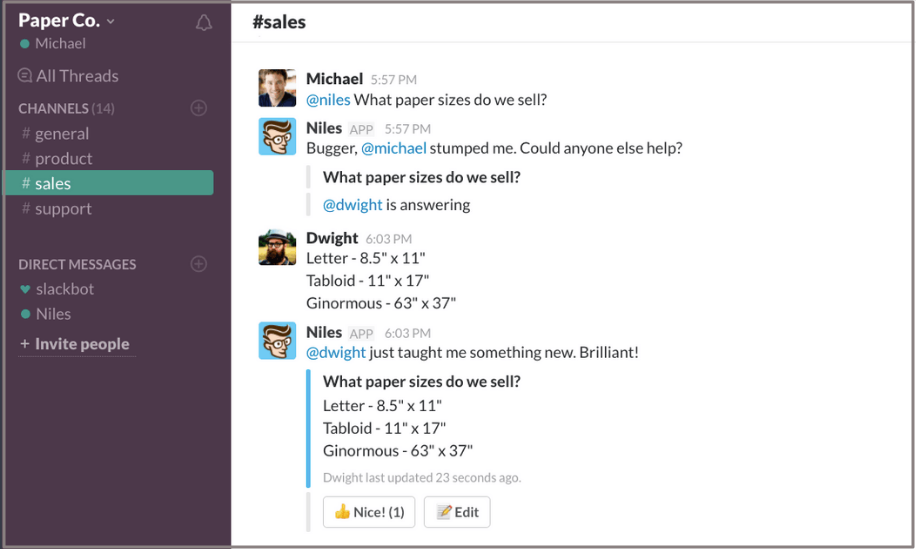
Niles is a wiki bot that organizes your team’s knowledge and answers common questions directly in Slack. What if he doesn’t know the answer? No problem, Niles will suggest adding it to the knowledge base for future reference.
7. Lunch Train
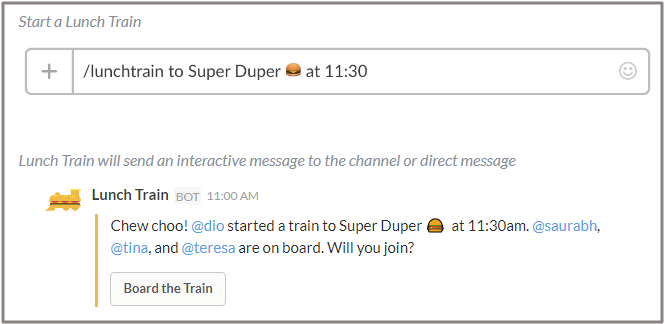
Lunch Train makes planning lunch outings with your team simple and pleasant (and, dare we say, fun). Want sushi for lunch? Start a Lunch Train with a quick slash command, and your teammates can easily board the train and receive a reminder when it’s time to depart.
8. GreetBot
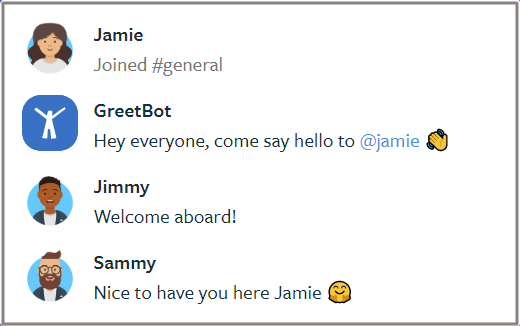
It greets people. It sounds simple, but GreetBot is your onboarding assistant for Slack. In a few easy steps, it helps you make your colleagues, collaborators, customers and community members feel welcome and informed when they join your workspace.
9. Slido
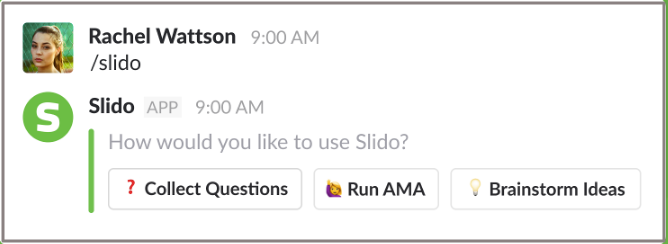
Slido brings to Slack an easy way to capture and address your team’s most burning questions and ideas. Companies use Slido at their meetings to involve their employees in the conversation and keep everyone on the same page.
10. bob
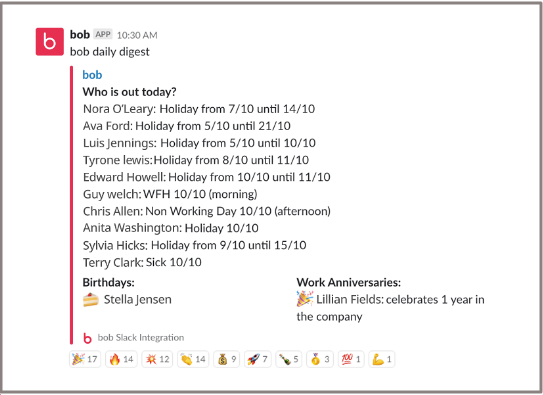
Hibob is a people management platform on a mission to improve the employee experience. Connecting to Slack seamlessly enables bob highlights such as daily digests and shoutouts, updates on real-time events, and a command center for quick questions.
11. Water Cooler Trivia
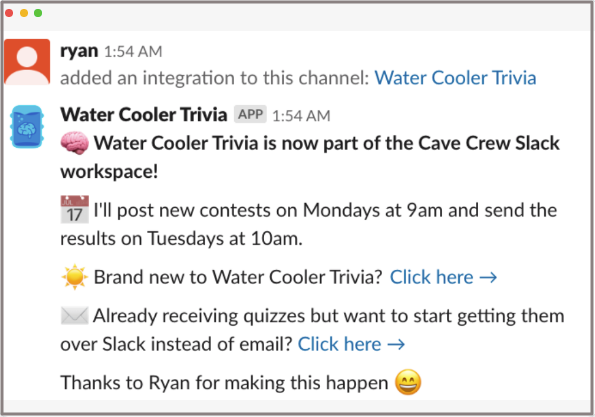
Water Cooler Trivia makes the work week more fun with weekly trivia contests that the whole office can participate in. The conversations sparked by trivia bring people together.
12. Pinpon
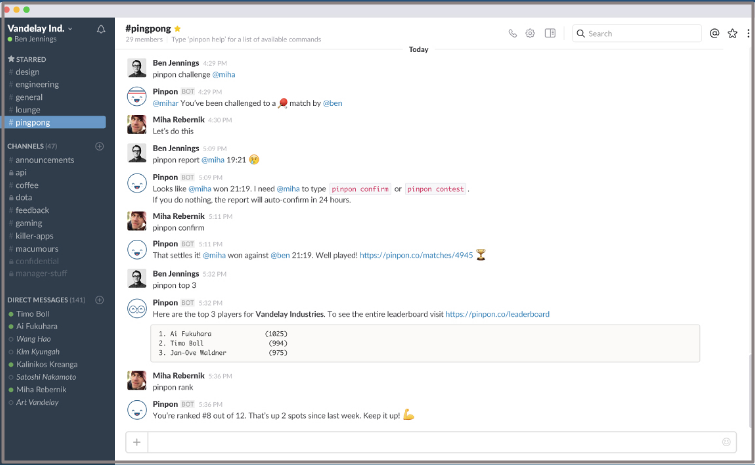
Pinpon helps keep track of every ping pong game your team plays. Challenge your colleagues, record games and keep an eye on your rank all within a simple text-based interface.
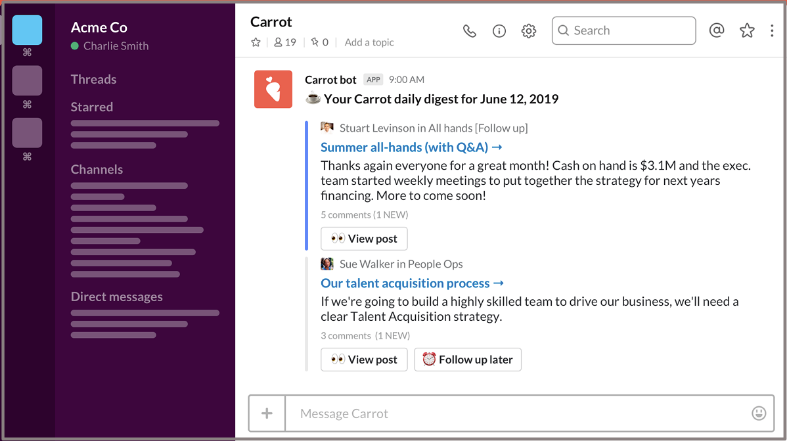
13. Carrot
Slack teams use Carrot to share important news, updates, and decisions nobody should miss. Slack teams use Carrot to share important news, updates, and decisions nobody should miss.
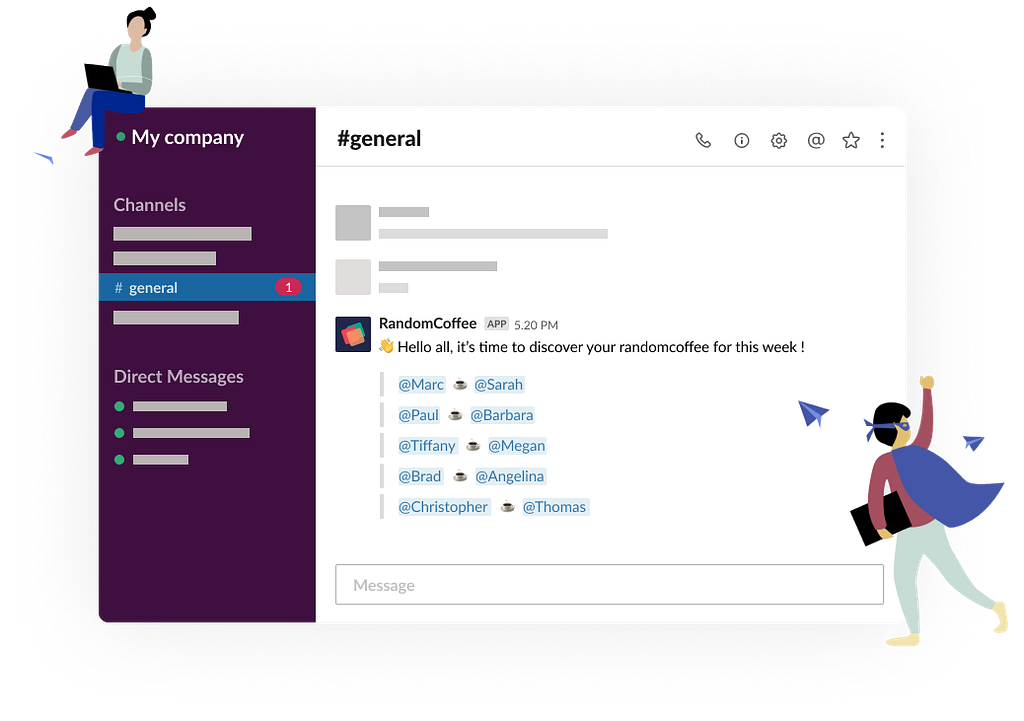
14. RandomCoffee
RandomCoffee creates targeted connections between employees at work with a unique matching platform. Create automated employee-matching campaigns and generate hundreds of targeted introductions in a single click.
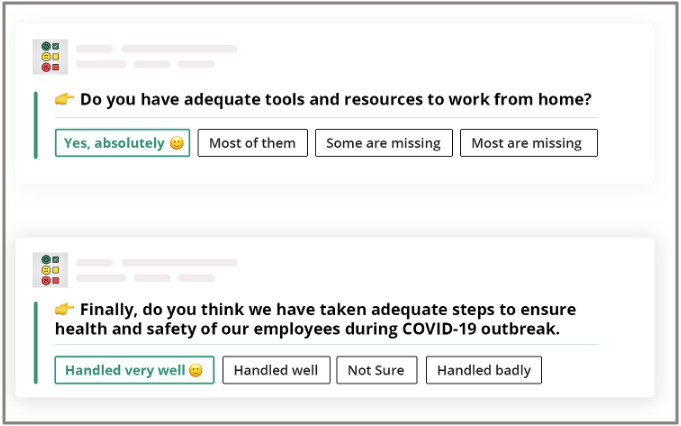
15. WFH Surveys
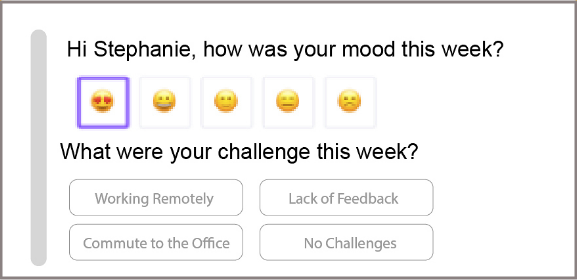
WFH Surveys helps you take feedback from your remote employees via AI-enabled interactive chat. This slack app asks questions about employee well being, team coordination and challenges faced during remote working.
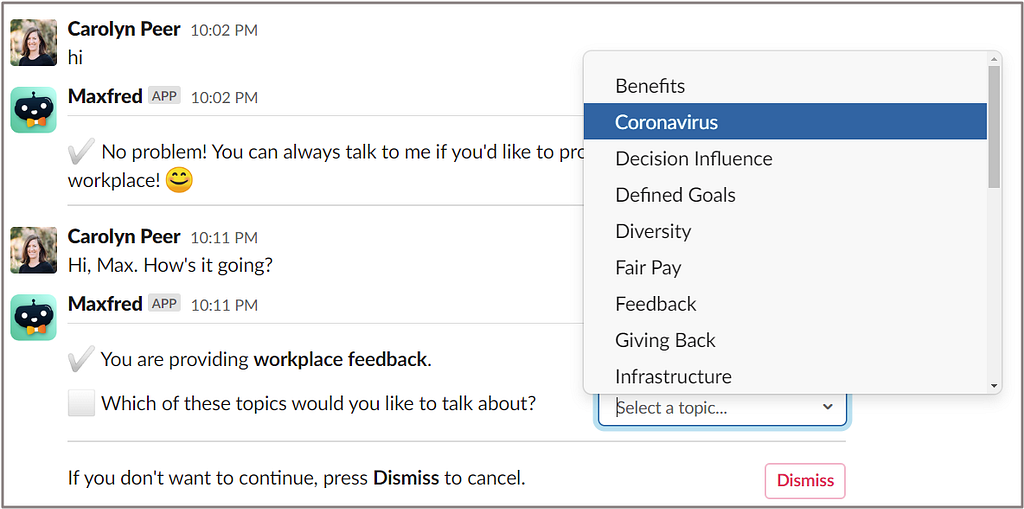
16. Max
Max is a fun, useful bot that lives in Slack. Max asks for feedback, starts discussions, offers mentoring, and delivers recognition. Use our AI Assistant to automate engagement.
17. Butterfly
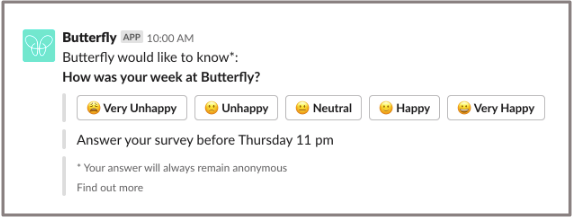
Butterfly helps team managers improve their emotional leadership by keeping a trace of their team’s happiness through open communication consistent, feedback loop and artificial intelligence.
People want to become the best version of themselves — so as to say, they seek validation and the strength to break down barriers that hold them back from the life they want. By helping to bridge that gap, you’re empowering others to walk their own path while allowing your brand to stride alongside them.
The most important ways to make your chatbot memorable rely on the programmers’ ability to ensure the right responses come at just the right time.
1. Write To Their Future Self You have the power to awaken people to channel their ideal self through speech. Chatbots, when properly developed, can work to draw your customers into a state of activity. They’re not just consuming content anymore — they’re actively seeking something, something that you’ve instilled with value. That something might be a solution, or it may be an optimization, but how they view it starts with you.
If you can help them see how your offerings fit into their ideal life, it will be far easier to connect with them and sway their hearts.
Speak Like They Are Already There In seeking to speak with their future self, an excellent way to start is simply addressing them as though they’ve already found some footing in the life they want to lead. By directing their focus to their future self, you’re helping them find the path to where they want to be. You’re effectively helping welcome them into their ideal tomorrow, today.
Guide Them To Their Future Self Though you may speak to their future self, you still must guide them into that tomorrow. Freelancers, for example, would benefit from an educational conversation with a chatbot. Perhaps it could hold a short discussion regarding the niche(s) they are considering during a pivot. https://pixabay.com/photos/doors-choices-choose-open-decision-1587329/
2. Build The Bot With Your Brand Voice
When you’re seeking to influence others, you must ensure that your chatbot mirrors the voice of your brand seamlessly. If the bot is off-beat, people will sense that disparity. When people sense disparities, their subconscious begins searching for others with greater prejudice. Seeking out reliable web design services is the first step to ensure your site mirrors your brand.
Once your site has been aligned, you can start to pull key phrases and important sentiments from your site content. Using specific phrases and sentiments is a simple but effective way to ensure you’re speaking the same language across all of your brand assets.
If your brand doesn’t match your voice, that little voice in your users’ ears will tip them off. Further, it will search for any other discrepancies with added fervor. Fortunately, you have a lot of options when you’re building the chatbot for an established business. On the other hand, the chatbot can play a major role in forming the brand for younger companies.
Bridge Your Brand With Their Life Don’t be afraid to step into the thick of things and really work to help your customers. Service is one of the terms that gets tossed around, but it develops a unique meaning with each company. You can bridge into others’ lives in countless ways, but some companies do it better than others.
eBay, among others, has stood out since COVID shut a notable part of the world down.
Sometimes you have to slow your selling pressure and reinvest in the community that is — or will be — supporting your own business model. Chatbots can be a wonderful way to achieve this, even if it’s something as simple as asking a user about their day and well-being.
3. Tell A Story That Delivers Value As your users incorporate your brand into their lives, they’re going to attach to your brand for one reason or another — based specifically on which problem you solve or benefit you provide. Ensure your brand story, as told by the chatbot, aligns with your real offerings in order to ensure your story retains value for users. If the story differs notably from your real offerings, users will encounter notable frustration when they buy-in and realize they didn’t get what they wanted.
Solve One Problem, Really Effectively
Some businesses are able to solve several issues at once, though most businesses that do so are pre-established and already have a well-built brand to lean on and support the cash flow needed to develop additional solutions. Smaller businesses generally see the most success in solving a single issue very effectively.
By keying in on one specific point, your business will be able to develop a far more comprehensive solution than a generalist company who sorta-but-not really serves the need. In fact, finding online communities that are experiencing frustration like that can provide great information about new and emerging market opportunities.
Don’t Hesitate To Really Connect In an age where computer screens have replaced virtually all forms of interpersonal socialization, connecting with users is now among the top focal points for brands. It makes sense because many people are living much of their life from behind a screen. ZoomsGiving, ZoomsMas, and Zoomintines Day replaced the holidays, underpinning much of the modern retail cycle.
Online retailers were able to swoop in and capture a massive amount of commerce while also helping limit the number of people in physical stores, and therefore help to stop the spread of COVID.
In order to make your chatbot unforgettable, you must accomplish three things. You need to speak to your users’ future selves, help them find their path into that ideal tomorrow, and solve one specific problem that is keeping them away from that tomorrow. In doing these things, you’re building a lifelong loyal customer.
Earlier this year, I had a task to create a knowledge bot for an enterprise level platform. The users were primarily the employees of the organization and intention was to use the knowledge bot to share the offering and usage of platform.
There are quite a lot of frameworks in the market (each with its own pros and cons) hence it is very important that one selects the right framework depending upon the kind of bot that you are targeting to create. In case of creating the knowledge bots the typical requirements are –
1. The main purpose of the knowledge bot is to provide the information about the offering via a guided chat. If the user wishes, he should be able to come out of the guided chat and ask adhoc questions about the offering and go back to the guided chat.
2. The knowledge bot should be able to perform simple tasks like booking a demo of the product.
3. Knowledge bot should provide the Right information about the selected domain (in this case platform offering) correctly in the first time rather than covering a very broad domain with answers which are ~70–80% correct.
4. While it should provide ability to perform NLU and understand user asks but the overall criticality of those asks is limited. As such generally there is little requirement of contextual chatting for the case of knowledge bot.
I started evaluating the available chatbot frameworks in the market on the parameters of cost, flexibility, ease of use, maintainability, scalability, ease of development, future extensibility, integration, community support and zeroed in on below 2 platforms –
i) Rasa — “Rasa is the leading conversational AI platform, for personalized conversations at scale. With Rasa, all teams can create personalized, automated interactions with customers, at scale. Rasa provides infrastructure & tools necessary for building the very best assistants — ones that meaningfully transform how customers communicate with businesses.” — from Rasa’s site.
— Salient features include —
NLU based, default NLU engine provided is open source.
Comes with both open source (limited features) and paid enterprise license (more features).
Creation of Chatbots more inclined towards Developers.
Supports advanced features like calling external API, Intent Identification, Slot filling etc.
Can be embed into website. On-prem/Cloud deployment. Creation of chatbots using stories and training data (developer oriented) is not via web-based GUI framework.
Good community Support.
Platform is built around AI with training data being key to improve performance. Not a flow based so bit of black box.
ii) Botpress — “Botpress is an open-source platform for developers to build high-quality digital assistants. We have put together the boilerplate code and infrastructure you need to get a chatbot up and running. We propose you a complete dev-friendly platform that ships with all the tools you need to build, deploy and manage production-grade chatbots in record time.” — from Botpress site.
— Salient features include –-
NLU based, default NLU engine provided is open source.
Comes with both open source (limited features) and paid enterprise license (more features).
GUI based creation of Chatbots.
Supports advanced features like calling external API, Intent and Entity Identification, Slot filling etc.
Can be embed into website. On-prem/Cloud deployment but provide web interface.
Good community Support.
Primarily Flow based with support for NLU capability. Debugger support and control.
The main strength of Rasa lies in its NLU engine and the contextual chatting experience it offers. By contextual, I mean each input from user is taken in context of the ongoing conversation and then responded. However, training the bot to get those conversations right requires lot of efforts, compute and skills and as the conversation domain increases, the total number of stories needed to be written increases exponentially.
On the other hand, Botpress uses a mix of AI and rule-based engine to create the chatting experience for the user. It is not so strong on the contextual conversation but has a rich GUI offering for providing guided information.
While being a Senior Data Scientist, my initial feel was to go with Rasa (you know the contextual AI offering does sound attractive) but once I evaluated pros and cons in relation to the task at hand, I found Botpress to be more suited for creating knowledge bot with combination of rule based guided tour and NLU based adhoc questions (QnA feature of Botpress) given the time and resource constraint that we usually have in IT projects.
Below are the features that Knowledge bot developers should look in the bot framework. I have also mentioned how Botpress fulfils those.
Ease of development — How fast can you get a basic version of your knowledge bot up and running. Does it require very specialized skill set or even the citizen data scientists can work with it? How easy it is to do a rebranding of the bot?
With Botpress, you can get a basic knowledge bot up and running using its GUI with absolutely no coding in a couple of weeks. It also offers simple way to brand the bot by just changing the style sheet. It provides widgets such as cards and carousal to share the information in a GUI rich manner.
Integration — Bots always need to be integrated with the main portal and must support other channels (e.g. Microsoft Team) as well. While selecting the bot framework we should see whether these integrations are natively provided and can be done with minimal efforts.
In Botpress, Integration with the main site is very easy with just a single script to open the bot in an iframe. It also provides integration with other channels such as Facebook, Telegram, Microsoft Teams and Slack to name a few.
Future Extensibility — While the initial knowledge bot might start with a limited scope, the fact is that the scope will keep increasing once the management realizes its benefits. The bot might not longer be limited to providing information but would also be expected to do simpler tasks like booking a demo etc. Hence it is important that the bot framework that one selects has support for these features.
Botpress provides extensions to write custom code to call backend APIs to perform complex tasks. The features such as Intent, Entity and slots are used to capture intention of the user to do a particular tasks by identifying the right Entity, capture the required values using slots and then have your custom code call the back end API to perform the tasks. These tasks could be ranging from sending an email to booking a conference room or a flight ticket or ordering a pizza.
Scalability — Often you would be required to build the knowledge bot for internet traffic and hence it is very important that the bot framework that you select can be scaled.
Botpress has a cluster based horizontally scalable architecture. One can leverage a load balancer to distribute traffic amongst bots.
Maintainability — As with all IT projects, it is never a deploy and forget scenario. We live in the world of DevOps where there is a continuous deployment of the application into the production. Hence it is of paramount importance that the bot framework does have a model that deals with scale and complexity especially when you are looking for a GUI based development.
In Botpress, the development happens by means of creating a flow chart, the structure is modular. It has the capability to create sub flows with entry and exit point defined for the sub-flow. This way we can create the knowledge bots using many simpler, smaller flows instead of one big flow.
NLU — While guided flow is good for providing the information, that alone is not enough. The main intention of providing a bot is that user should be able to chat as if there is an individual sitting behind the bot. This means that bot should be able to understand the nuances of language and provide a proper response.
In Botpress, there is an QnA module which allows you to cater to random questions that the user might ask about the product. You can provide multiple questions against an answer and train the Botpress NLU engine to neutralize the questions against semantics and grammar. While the NLU engine is not as powerful as Rasa’s I found that its fits the purpose. We had around 110 answers to be trained against ~1100 questions. After training, I found that the NLU engine did a decent job and got us the right answers more than 97% of time. Botpress NLU engines makes use to 2 services –
a) Duckling — For extraction of system entities which make it more robust during implementation of tasks based on entity and slots (e.g. ordering a pizza or booking a flight ticket).
b) Language Server — This provides the word embeddings and has support for multiple languages.
Context Switching — The transition between asking Adhoc questions and taking a guided flow should be seamless. The flows should not be very long, provide a break points to user where he can ask the questions and then go back to flow whenever required.
With the use of ‘flow wide transitions’ feature provided within Botpress, the context switching between a guided tour and random questions can be implemented easily. Also, from the question and answer section Botpress gives ability to go back to a node which is part of guided tour hence taking the user back to guided tour.
There are other features of Botpress such as multilingual ability, Dockerization, Human In the loop, using 3rd Party NLU, SSO integrations, Clustering, Monitoring and Altering, Strong community support which can make the overall experience more robust.
Summary — Next time you wanted to build a knowledge bot in a short span of time, consider a bot framework that leverages both the rule based and NLU powered engines. Botpress is a strong contender for the same especially if cost and ROI is a decision-making factor.
Abhinav Ajmera
Senior Data Scientist, Atos
The opinion of the author are personal and author is in no way associated with Botpress.
Don’t forget to give us your 👏 !
Knowledge bots was originally published in Chatbots Life on Medium, where people are continuing the conversation by highlighting and responding to this story.
Businesses are now expected to respond to and solve customer queries instantly to ensure customer satisfaction and loyalty.
Customers no longer wait for businesses to respond. They need their answers, and they need them now.
Businesses need to evolve to meet changing customer demands. They also need to scale their operations to cope with the increasing volume of customer engagement through digital channels.
The customer service industry has been revolutionized. The innovation responsible — conversational automation via chatbots.
Scaling customer conversations through automation is an essential business strategy to save costs, engage customers, and maximise revenue.
According to Userlike, 91% of consumers expect to engage with a business through a chatbot. With such an overwhelming demand for messaging, businesses can no longer delay chatbots as a priority.
Below we’ve shared why your business needs to make a chatbot its top customer service priority.
1. Consumer Readiness: Customers Want to Engage with Chatbots
2. Organisational Squeeze: Chatbots Reduce Costs and Increase Revenue
Reduce Cost to Serve
Maximise Revenue
Beyond the Hype Phase
Consumer Readiness: Customers Want to Engage With Chatbots
To quote Queen; “I want it all, and I want it now,” sums up how the modern consumer operates.
They want immediate and accurate responses to their queries and constant up-time no matter the time of day. They also want simplicity. In our VUCA (Volatile, Uncertain, Complex and Ambiguous) world consumers simply have too many things competing for their attention.
The use of chatbots has grown by 92% since 2019, making it the communication channel with the largest growth in recent years. This is not surprising. 66% of consumers prefer communicating with brands via messaging applications, according to Twilio.
Much of this stems from the popularity of Facebook Messenger, WhatsApp, and WeChat. It’s quick, it’s easy, and it’s engaging. While originally a personal channel of communication, consumers expect to connect with businesses in the same way. Leading brands have been quick to adopt this approach — and they’re reaping the rewards.
Modern consumers will only deal with a human if they have to, or because they’ve been told to. The large majority are steering clear of call centres. Connecting with businesses through messaging channels is a strong preference that is only growing. Businesses need to adjust to this change in behaviour. Failure to do so will propel adopters of new digital channels forward even further.
The best businesses don’t wait until they are ready to meet consumer demands. They make decisions and take action based on what their customers are telling them. They adapt and move fast. Consumers are not only ready to use chatbots, they want to — they expect it. Leading businesses see this, take initiative and deliver early. Is that you?
The businesses that don’t prioritise a chatbot, or who constantly delay, will only see others rise above them. They’re essentially giving competitors an advantage that is difficult to claw back.
Organisational Squeeze: Chatbots Reduce Costs and Increase Revenue
Regardless of their business, somewhere in most organisational strategies you’ll find one of two things, decrease the cost to serve and increase revenue.
Managing these successfully is the difference between life and death for businesses, so naturally, these are a priority for any business leader
Decrease Cost to Serve
Chatbots enable businesses to decrease their cost to serve. They do this by automating conversations at scale. Where humans can only serve a single customer at once, a chatbot is capable of conversing with unlimited volumes of customers at any point in time.
Gartner suggests that over 40% of today’s live volume could be diverted to self-service channels such as chatbots. Research suggests customer service reps spend 80% of their time solving the same 20 enquiries. Most of these are low value, repetitive tasks that are costly for businesses to solve with a human. By automating these with a chatbot, businesses solve customer queries faster — reducing their cost to serve, and allow reps to spend more time on higher value tasks.
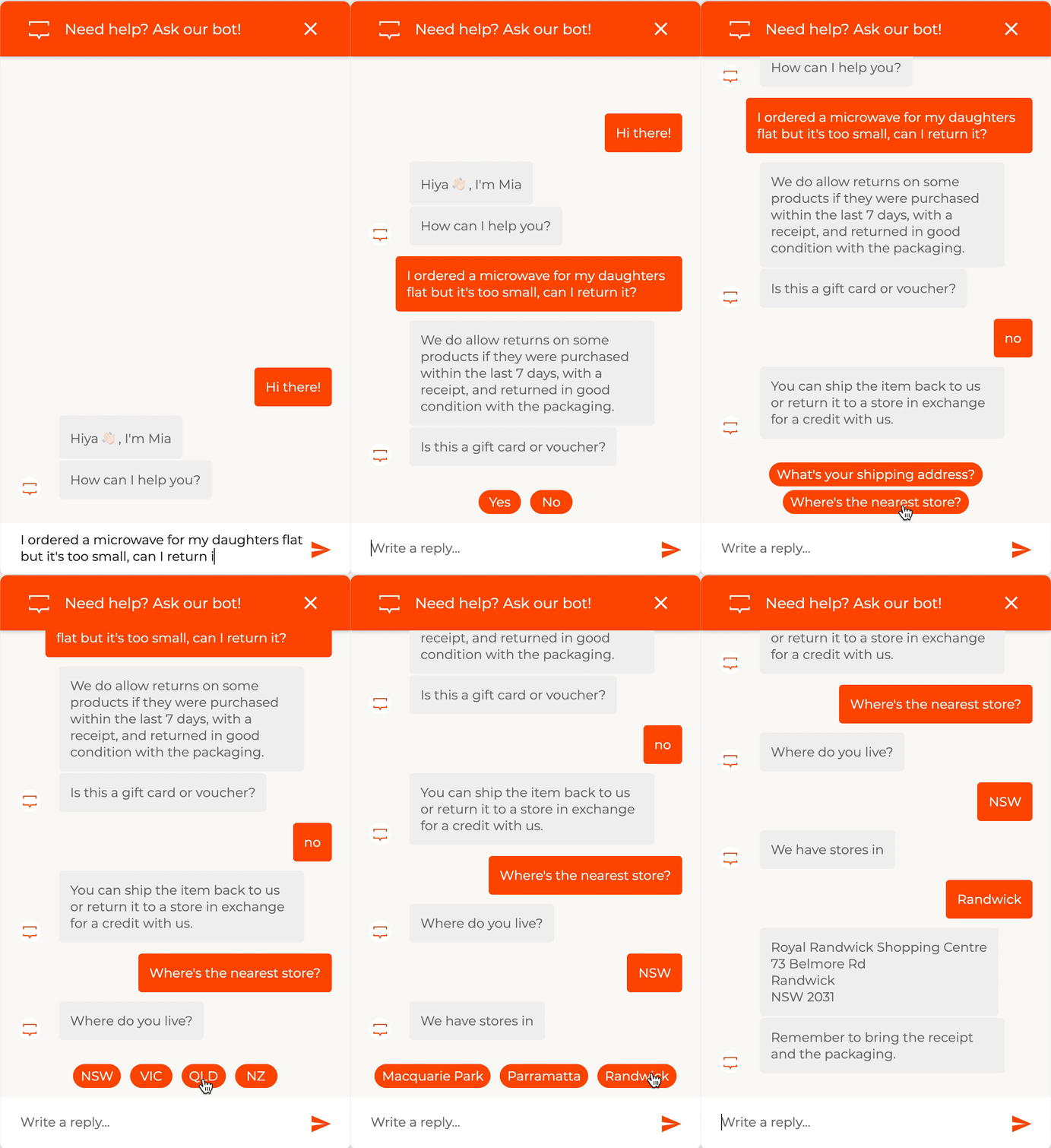
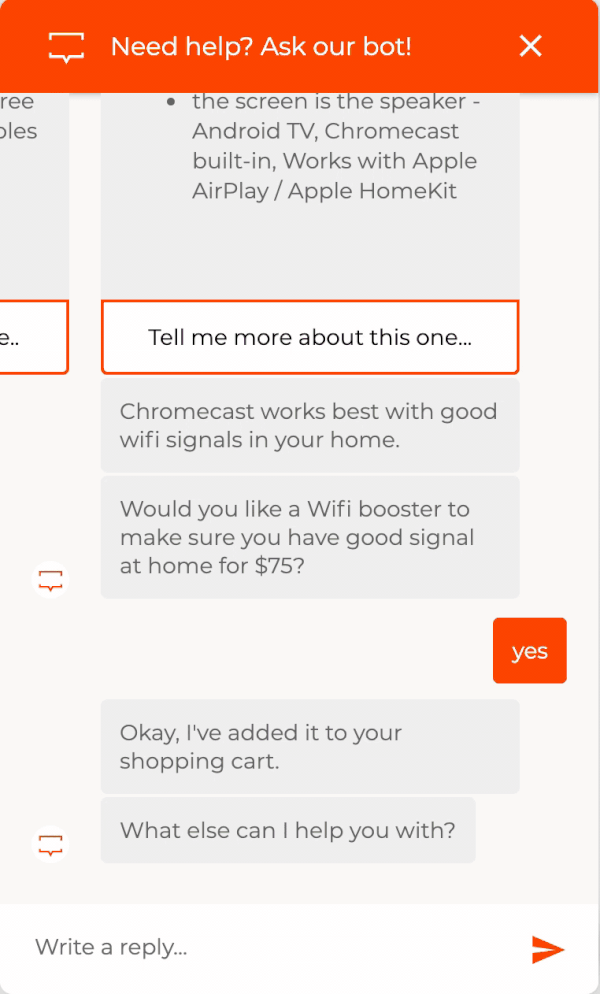
Example of a chatbot managing a return enquiry and using an address lookup feature to find the customers nearest store.
According to IBM, chatbots save businesses up to 30% in customer support costs. With customers expecting 24/7 support, staffing a contact centre around the clock is extremely costly for businesses. Chatbots are available 24/7 and provide an always-on framework to give customers the support they need, without the same level of expense.
Maximise Revenue
Businesses who engage their customers with chatbots are benefiting from increases in sales and revenue. Forbes reports that chatbots have increased sales by 67% according to business leaders. They empower businesses to deliver additional sales channels and automate lead generation.
As consumers demand more personalised buying experiences, businesses are adopting AI to provide a deeply engaging experience that is tailored to each customer.
By taking into account previous buying and engagement history, chatbots can automatically identify which products and services are most relevant to up-sell or cross-sell for a particular customer.
Example of a chatbot upselling an additional item, and adding it to their ecommerce cart.
Businesses are increasing basket sizes, and maximising revenue as a result. Salesforce has reported that when shoppers follow AI-powered product recommendations, their average order value increases by 14%. The proof is there. As e-commerce volumes explode, chatbots act as a digital sales assistant, guiding buyers to their next purchase.
Chatbots also have high engagement rates of nearly 98%. Not only do consumers engage with this channel, they interact to a deeper level than with many others. High conversation completion rates mean consumers see more of what businesses are sharing with them. This gives businesses a greater chance to convert and close potential buyers.
Beyond the Hype Phase
Chatbots are not a new innovation, they’ve been around for years. Some of the early stage bots may have put companies off including them in their strategy as developers navigated the possibilities of this technology. Today’s bots are more mature. They’ve evolved and have proven themselves time and time again to be an integral piece of the customer service puzzle.
Gone is the hype-phase. Businesses can no longer overlook the importance of a chatbot to the success of their business. Customers expect them. The use cases are there. The value is undeniable. And it’s only going to increase.
Don’t delay. Make a chatbot a priority for your business today. All it takes is a conversation with an expert to set you on the right path.
Are you a business owner? Does your business really need chatbots?
The answer to the above question depends on the type of business and the intensity of innovation and technology that drives you. In recent times, we have seen how businesses are desperate to introduce chatbots! Today, the tough competition makes it mandatory for every business to adopt innovative technology.
Businesses must catch a unique trend to be early enough to grab profit immensely and maintain a successful algorithm for the long term. For a couple of years, AI chatbot and chatbot development have emerged as the most followed trend.
Making a chatbot in Amazon Lex and making a chatbot in Twilio are vastly different endeavors, Lex involves making a chatbot through a more AI-based approach, and with Twilio we can make a simple question-answer bot, don’t get me wrong both approaches have their pros and cons which we will be looking at in this article. Firstly, we will be looking at Lex.
Amazon Lex(v1)
Firstly, in Lex there are intents, they denote the intention of the user, which are sophisticated functions that activate when the user enters some sample utterances. Secondly, there are sample utterances which are a part of intents, they do the work of deciding based on what user enters which intent to call, if you enter some sample utterances the AI will make sure if someone enters something similar then also it will trigger the intent. Then there are slots, which are used to store user input in different variables.
They already have some predefined slot types which are very useful in case you want to take a standard input like Date, Time, Name, Phone Number, Email, etc. They are really helpful because the user can enter in any format and it will convert it to a single format which is super useful and you don’t have to worry about taking input where the user has multiple choices to enter the same thing, for example, we need the user to enter data there are many formats in which a user can enter a date. Lex understands every format there is without any extra effort. This helps a lot when making a standard bot.
In Twilio bot the way to make a chatbot is very different than Lex, what do I mean by that? I mean that in Twilio everything has to be done by creating a flow chart as in how should a conversation will flow, this is done through a set of drag and drop options whatever you want you can drop it from the list and integrate it with the flow
chart. There are various options like send a message, send a message and wait for a reply for the user to enter something, then then you can perform different things based on what they enter. This way you can customize the flow however you want. It gives you incredible flexibility on how you want your chatbot to behave.
I’m an AWS expert and AWS Certified Architect, AWS Certified Sysops Administrator and AWS Developer Associate. I take up AWS assignments as well. You can reach me at Linkedin.
Chatbots for Learning: Can AI-Powered Chatbots Drive a More Sustainable Society?
There is an abundance of uses for chatbots, the most common being used for business support like customer support and sales. Here at Noodle Factory, we use it to create chat-based learning environments.
Currently, chatbots are impacting sustainability as there’s an increasing number of chatbots supporting research in sustainable and environmental causes.
Let’s look back at Earth Day and celebrate by learning how integrating chatbots in businesses can encourage sustainability in our society.
I saw a post about Flowrite from a few months ago here and would like to know if anyone has leveraged the tool.
I read about Flowrite (AI powered email productivity tool) over the weekend on Product Hunt; does anyone have experience using it? I’m on their waitlist and hope to get access soon but would appreciate learning about anyone’s firsthand experience. If you’re not familiar with the tool, you can check it out here (note: the link is my referral code provided by flowrite).