FinChatBot & Go-Insur partnership promises powerful new e-trading capabilities for brokers & MGAs
A tie-up between Pancentric’s cloud-based digital insurance platform Go-Insur and conversational AI experts FinChatBot promises powerful new distribution and e-trading capabilities for brokers, MGAs, and scheme providers.
“We’re on a mission to make the best and latest digital capabilities available to the rank and file of the insurance community, beyond the elite few — and to improve online sales and servicing experiences for insurance customers more widely. Our researchshows 70% of brokers are held back by technology and the majority of MGAs say innovation is key to growth”, says Simon Fenn, Director of Pancentric Digital.
“Our partnership with FinChatBot puts conversational AI into the hands of many more SME players, which is great news. Powered by our Go-Insur insurance rating engine and with the benefit of ready-made cloud policy admin and CRM integration, this is an exciting, joined-up solution that offers imaginative new distribution opportunities for the insurance sector, unlocking growth and enabling effortless management of that growth”.
Versatile Low-Cost Customer Servicing Approach
The conversational chatbot format provides a versatile alternative to more traditional form-based data collection and is shown to be highly effective in low-cost customer acquisition and many areas of policy servicing.
The FinChatBot technology can be deployed on standard websites, within client mobile apps and also in WhatsApp and other social media.
Says Richard Marsden, Director of the UK Market for FinChatBot, “We have run many successful deployments on websites, WhatsApp and other social platforms, using chatbots to quote and sell insurance from within the platform. It’s instant and convenient for customers. Quote & conversion rates can be excellent. The format can also make light work of simple MTAs, kicking off claims and retention and recovery. It’s self-serve with the human touch, enabling redeployment of costly people resources into value-add customer growth & servicing activity.”
Go-Insur is aiming to be the trusted, go-to digital insurance software brand for SMEs as well as an agile digital partner for larger players encumbered by legacy systems and who want to undertake rapid testing of new market propositions and innovations.
Don’t Overlook this Simple Retention Tactic: Put Today’s and Tomorrow’s Customers in Need of Auto Repair and Service in the Driver’s Seat
Overlooking a Simple Retention Tactic
Sending out service reminders via e-mail or text, making follow-up calls, mailing postcards, scheduling next visits at the time of car delivery — there are many tactics automotive service-repair businesses can use to retain customers. But one simple tactic is often overlooked: empowerment.
The customers of today, and tomorrow, live in a digital world where they’re empowered by fast access to information. And they make quick buying decisions based on that information. For example, think about the last time you searched for a product or service on a major retailer’s website and made a buying decision quickly based on the information that was presented to you.
The New Digital Shopping Experience
This shopping experience has become the new normal as the pandemic has drastically expanded the range of digital consumers far beyond millennials and Gen Z. All generations are now confirmed online shoppers.
So, what does this mean for automotive service-repair businesses?
In order to retain the customers of today and tomorrow, automotive service-repair facilities should be offering them the online shopping experience they’ve come to expect. For starters, that means communicating with customers in the ways they’re most comfortable with on their own timetable.
Text messaging has become universally popular because it’s quick and convenient, providing consumers added control over their time. It’s also, in part, what makes digital engagement tools like Openbay Otis so uniquely powerful.
Otis serves as a virtual service advisor that appears on a shop’s website as a smiling icon that says, “Hi. Need help? We’re online now if you have questions.” Visitors type in a question or select from a menu of options. Otis — which is powered by artificial intelligence, or AI — then engages visitors in a text-style conversation.
It’s similar to the way Amazon Alexa, Apple Siri or Google Assistant provide quick answers to commonly asked questions.
Otis can deliver price estimates for mechanical service and repair nearly instantly and book an appointment, too. Otis also has a full tire catalog that will generate tire options, pricing and installation fees based on vehicle year, make and model (and tire size too).
Roughly 35% of Otis conversations take place outside normal business hours. Otis gathers and records all information from each conversation. If necessary, service advisors can then follow up using the visitor’s preferred method of communication — a phone call, text or e-mail.
Otis eliminates the need for site visitors to navigate a shop’s website, search through menus or fill out forms as they look for answers to their questions. Instead, they’re able to get the information they want when they want it and how they want it. In other words, putting them in the driver’s seat.
Have Otis greet and Start a Conversation with your Website visitors
Otis installs on your website in minutes and it’s easy to use.
Retaining customers starts with time-honored essentials: solid mechanical service using quality parts, good value, a comfortable experience, great communication and a personal touch. And businesses that are able to level up by allowing customers to drive their own experience — using automated digital engagement tools like Otis, for example — are poised to earn more customer loyalty now and into the future.
To discover how Openbay Otis, the intelligent, automated chat and messaging platform can boost customer retention and new customer acquisition, contact Openbay today.
The ability to audio communicate with a chatbot is due to a technology called Speech Recognition, and this is what we will talk about in this article.
If you were curious and want to know how this feature benefits chatbots, read on!
What is Speech Recognition?
There was a time when having robots help you with certain tasks was just something out of a movie. Yet, faster than we thought, chatbots appeared. And after a while, those same chatbots evolved and started talking to us and us with them.
In addition to Speech Recognition, this technology is also known as Speech Recognition, ASR (Automatic Speech Recognition), Computer Speech Recognition, or Speech to Text (STT).
How does Speech Recognition work?
As the name implies, this technology allows recognizing the user’s voice commands and their conversion into text to be processed by the system.
These are speech recognition systems that require training. In this training, a speaker reads texts or just loose vocabulary to feed the computer’s knowledge base.
This type of Voice Recognition is more accurate since it analyzes the person’s voice in question and tunes the system to recognize that particular voice.
2. Speaker-independent
On the other hand, these speech recognition systems do not require training. They do not recognize specific voices but analyze and translate into text what has been said.
An example of the use of this software occurs in telephone applications.
The Correlation between Speech Recognition and Artificial Intelligence
Artificial Intelligence or AI is the science that enables a machine to perform tasks, once performed by humans, and to mimic their reasoning process. In other words, it provides, so to speak, some level of intelligence to a system.
AI is currently used in many different areas, and depending on the technologies implemented, the software can perform certain actions.
Sometimes confused, AI and Machine Learning (ML) are distinct yet related concepts. Simply put, Machine Learning is a branch of Artificial Intelligence and is the technology that allows a machine to learn without the need for human intervention.
For a system to learn, it needs to be fed large volumes of data to recognize patterns and thus characterize them.
Speech Recognition and AI are intertwined by learning processes and data processing.
As we mentioned earlier, Speech Recognition software needs large volumes of inputs to provide the best possible performance. That’s where AI comes in with the automation of these processes.
In addition, there is also NLP (Natural Language Processing), another branch of AI, which enables the processing of human languages. For example, English, Portuguese, Spanish, etc.
Chatbots are possibly one of the most accessible ways to see Artificial Intelligence in action.
These conversational agents use areas of AI, namely ML and NLP, to communicate with humans.
Through these technologies, they can understand and extract the information given to them by written messages and respond.
Chatbots are service automation solutions often found in various digital communication channels, such as company websites, WhatsApp, Facebook Messenger, etc.
On the other hand, there are voice bots or, more often known as virtual assistants.
These, just like chatbots, have the goal of automating certain processes but with a more personal role.
They work as a kind of personal assistant that responds to voice inputs. The most common examples are Siri and Alexa. But every day, more companies launch their own voice bots.
So, to summarize, companies mostly use chatbots to automate their services (internal or customer support), and their inputs and outputs are written messages. As the name might suggest, voice bots only receive voice commands and respond in the same way. Moreover, they have a more individual support role.
Speech Recognition: The Ears of Your Chatbot
Knowing the difference between chatbots and voice bots, it’s also possible to add a third option involving both solutions — speech recognition chatbots or voice chatbots.
As we mentioned earlier, Speech Recognition technology is what allows a system to convert voice commands and translate them into text.
Once translated, that information goes through the same processing that a written text message would have in a “normal” chatbot.
Just like giving OCR the ability to read the text contained in images, you can also give your chatbot the ability to listen.
If you were curious about what OCR is, you might be interested in the following article: OCR: Give Eyes to Your Chatbot.
The Benefits of Speech Recognition Chatbots
Users are becoming more and more interested and demanding regarding these technological solutions.
If it’s to be as similar to human dialogues, then both chatbots and voice chatbots have to meet the demands and characteristics of those same conversations.
Eliminating waiting time, getting answers that correctly answer our questions are two examples of what your customers expect. Be it by message or by voice.
Nobody likes to be talking and get an answer that has nothing to do with the topic. In such cases, you might as well send the user to human assistants via Live Chat.
Still, between writing and speaking, no doubt speaking is much more natural for a human being. For this reason, the inclusion of voice commands takes your chatbot to another level.
A voice chatbot gives you the following benefits:
1) Provides more “human-like” interactions
As we already mentioned, speech is much more natural than writing. For this reason, you get communications that are more spontaneous and not as thought out, as is the case with written messages.
This spontaneity is very useful for your chatbot, as it increases its knowledge base and improves its AI with the various commands it receives.
2) Improves user experience
Companies are very concerned about the usability and user experience on their website and communication channels.
If a chatbot already greatly improved the user experience when navigating to your website, having the ability to talk to the chatbot improves it even more.
3) Enables multitasking
Also related to the consumer experience, the voice option allows the consumer to do other tasks while asking your chatbot for information.
This factor, as well as the others, greatly increases customer satisfaction in that they don’t have to stop doing what they are doing to communicate with the bot.
4) More inclusive solution
Despite being an almost non-existent factor (thankfully!), there are still illiterate people who, for some reason, have not learned to write.
Other than that, there are people with motor disabilities that do not allow them to use keyboards or other types of tactile devices.
Voice can be the ideal solution to include and show that all your customers are taken into consideration.
Visor.ai Voice Chatbots
Visor.ai chatbots are a great option to enhance your Customer Support or internal employee support services.
Our solutions rely on in-house developed NLP and Machine Learning to meet our requirements and our customers’ needs.
This way, we make sure that our customers get the results they want and, if changes are needed, we don’t have to rely on third parties.
Besides being quick-to-implement solutions, they’re easily adaptable with any integration the customer wants, including voice functionality.
Learn more about how to include these spectacular solutions in your digital communication channels… Contact us!
As the world becomes more digital, businesses must keep up with this evolution and adapt to new technologies. To do this, various industries need to invest in digital transformation. And one simple way to drive this transformation is through chatbots.
Keep reading this article to learn more about digital transformation, how a chatbot can be a great tool to improve your services and increase your customers’ satisfaction and experience.
This concept is related to companies that want to reach further and stand out from the competition.
The world is a place where communication and globalization are increasingly emphasized while at the same time making a certain topic known.
But what exactly is digital transformation? — you ask.
Well, digital transformation, as the name might imply, is the adaptation of an entity (company) to new technological trends, thus becoming more digital and innovative.
The integration of new technologies totally changes the way products/services are offered to consumers, which they highly value.
Users are more demanding and losing interest in companies that do not keep up with the times.
The updating and investment in innovative solutions are fundamental to have global satisfaction, both from customers and employees.
Which areas should you transform digitally?
Digital transformation cannot occur in just a certain part of a company.
Have you seen what it would be like if half your employees benefited from the perks of new technology and half didn’t? Or that customer service was all revamped, but on the other hand, you had your employees in less advantageous situations?
That wouldn’t be good, right? Then the answer is simple. Do a general upgrade, even if it’s in phases. But don’t leave anyone out.
As we have already mentioned, you must make your employees happy in addition to your customers.
Improving the quality of work of your employees is crucial. So invest in solutions that improve their performance. Namely, machines that perform the most physically demanding tasks, for example.
In retail companies, for example, try to upgrade the production lines for your products.
Externally (Customer Support)
Your customers expect you to always be on top of the latest trends, both in products and service.
No one has time to wait around anymore. People want to be attended to immediately. And if not, they will turn to other solutions.
Besides, if they can solve their problems themselves, without having to talk to someone else, all the better.
Self-service is a trend that will not disappear any time soon, and any service will use it.
Digital Transformation with Artificial Intelligence
Today, any company that wants to offer a higher level of service turns to Artificial Intelligence.
Artificial Intelligence is the field of Computer Science that enables machines to simulate reasoning and perform human activities.
According to Andrew Ng, AI is the new electricity. By this, the computer scientist and professor at Stanford means that it’s as important to the present day as electricity was when it was discovered.
It’s a matter the world can no longer live without and is indispensable to its progress and evolution.
Online shopping and advertising
Strategies with AI used in retail are exciting, as they allow brands to offer a more personalized service to each customer.
Web Searches
It’s already known that only the best blog posts/articles appear in the first positions in search engines. But how do we know which are the best?
This work is done by AI bots that automatically check all sites to deliver the best results.
At first, programs like Google Translate had their limitations and were not very efficient. But as their knowledge bases grow and they have a greater volume of data to analyze, they become more and more correct.
AI-powered systems can help recognize and counter threats to systems by recognizing patterns and mapping attacks.
Combating Misinformation
Just like the previous point, to combat disinformation, we can use AI. That is, nowadays, anything can go viral. This can be great for spreading information, except when it’s incorrect and baseless.
The role of Artificial Intelligence, in this regard, is to prevent and combat false information from spreading.
In a way, this use of AI was driven by the coronavirus pandemic, where anyone had their theories about the cure and prevention methods.
Virtual Agents
Probably the best-known use is virtual agents or chatbots.
These systems are process optimization and automation solutions that are more and more implemented in companies with large contact volumes.
Digital Transformation with Chatbots
Chatbots, being virtual agents, help optimize your company’s services, both internally and with the customer.
The implementation of more digital solutions enhances growth and increases the satisfaction of your customers and employees.
1) Customer Service
Investing in automation solutions such as chatbots is a key step if you want your institution to stand out from the rest, especially in customer service.
One of the most frequent complaints from consumers is the time they wait to be attended to.
So, if the waiting time is a factor to be taken into account and you suffer from this problem, maybe investing in a chatbot is not unreasonable.
Instead of keeping the user waiting, let them deal with their problems by themselves, and only if they can’t solve them, refer them to a human assistant.
Many of the questions received by contact centers are repetitive and easy to solve. That said, there is nothing like a chatbot programmed and trained to answer your customers’ most frequently asked questions.
2) Sales Support
In addition to customer support, a chatbot can be an essential solution to help you in pre and post-sales.
In pre-sales, it can help educate your prospects about your brand or make suggestions for services and products that complement what they are purchasing.
On the other hand, it can be an option for problem-solving in the post-sale, such as complaints or other situations.
3) Lead Generation
A virtual agent is also a great marketing tool. Especially in the world we live in today, where social networks and digital channels are some of the biggest means of expansion and propagation of brands.
Implementing a chatbot on the digital channels your customers use the most or your persona is on is a great strategy to expand. And, at the same time, start creating a connection with your target audience.
For example, program your chatbot to greet and introduce your product to people who pass through your channels.
One of the most interesting features of a chatbot is the metrics collection.
With these communicational agents, in addition to assisting your customers, they can gather information about them, namely demographic data, the product they are most interested in, etc.
5) Internal Relationship
Besides customer service, you can also implement a chatbot internally. That is, for employee support.
This implementation can increase the satisfaction level of your team and, simultaneously, create and maintain greater proximity between employees and the company.
Visor.ai Helps You with Your Company’s Digital Transformation
Visor.ai offers solutions for chat and email automation. Both use Artificial Intelligence.
Visor.ai’s chatbots and email bots are easy and fast to implement. They come with a low-code platform, where you can customize and edit your bots autonomously.
Because they are cloud-based solutions, we can implement them remotely into the platforms you already use-namely, CRM systems such as Salesforce, etc.
Besides, Visor.ai follows all privacy policies, ensuring the security and privacy of your company’s and your users’ data. It also offers the possibility of VPC (Virtual Private Cloud).
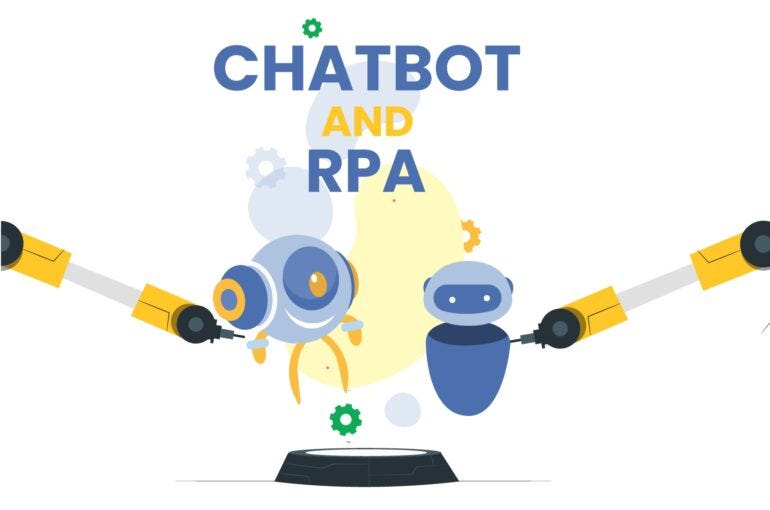
Because they are related to automation, people may think that RPA and chatbots are the same thing, but they are not. In this article, we clear up all the doubts about what they are, what each one does, their differences, and some use cases.
Automation with Artificial Intelligence
Humans have long tried to find ways to automate repetitive processes that become monotonous.
More than ever, process automation is crucial to the evolution of industries.
Utilities, manufacturing, energy, finance, healthcare, and most industries have already adopted some form of automation, and it is towards a more automated world that we are moving.
An area closely associated with automation is Artificial Intelligence (AI). This gives machines the ability to perform tasks that humans once performed. In addition, it allows us to simulate some of our reasoning.
What is RPA?
RPA stands for Robotic Process Automation. It’s an Artificial Intelligence technology that, as the name implies, uses software robots to automate certain tasks.
As we already mentioned, RPA robots take charge of repetitive digital tasks, such as filling out forms or copying and pasting information. To do this, these robots access information from your IT systems.
Attended RPA: is an assisted automation, where the robot works under supervision.
Unattended RPA: is independent automation. That is, it does not require human intervention. However, it is controlled by other software systems.
Hybrid RPA: is a combination of the two previous types.
Regarding the tasks that each type of RPA performs, the first case is used to complement human tasks, and the second is more used for tasks that involve repetition and large volumes of data.
Well, that will depend on the actions you want to automate in your company.
If they are to support your employees, assisted RPA is probably the best option.
If you want to automate large volumes of information, unattended RPA is the solution.
And Chatbots? What are they?
You already know what RPAs are, now is chatbots’ turn.
Chatbots are conversational robots, also known as AI bots, conversational AI, or virtual agents. They are chat systems generally used in companies to automate and optimize their Customer Care services.
They are systems that also use Artificial Intelligence, recognizing the requests made by users and giving them an answer.
When the questions are more complex, they forward the customer to Live Chat, where the customer is assisted by a human assistant who helps him solve the problem.
What are the Differences between Chatbots and RPA?
Although chatbots and RPAs are automation solutions, they are quite different.
One of the differences that stands out the most is that chatbots can communicate with a person, while RPAs are not.
RPAs, unlike virtual agents, do not have any language recognition technology associated with them, so it is not possible to communicate with them.
Therefore, as we have already mentioned, they are ideal for back-office tasks that do not involve interactions with third parties.
Confronting one solution with the other, we can see the following differences:
RPA
No linguistic knowledge
The goal is to automate processes
Focused on back-office processes
Receives structured information
Supports IT teams
Chatbots
Has linguistic knowledge
The goal is to automate conversational processes
Focused on clarifying user doubts
Receives different forms of information
Support for business teams
Why Implement RPA and Chatbots in your Company?
Now that you know what RPA and chatbots are and their differences let’s see what you gain by having these two automation solutions. And how, together, they can be an asset to your company.
8 Advantages of RPA Solutions
Speed and Consistency
People once carried out the processes that are currently performed by these bots.
They usually involve large volumes of information, and to have reliable results, high levels of attention are required. In other words, the degree of error due to human failure can also be high, as can the time it takes to process the data.
However, RPA technology allows these procedures to be performed quickly and with low error levels since a bot can perform the same task over and over again without going off schedule.
Cost-effective
Besides being fast to perform repetitive tasks, they are cost-effective solutions.
Since there are no failures, there is no need to repeat procedures. So you save money. And even if you have to start from scratch, it’s much faster and again saves resources.
Increased Productivity of your Employees
As we have already mentioned, RPA enables the automation of repetitive and monotonous processes that were once performed manually.
Without the need to occupy your workers with these procedures, you have a freer and more focused team on more complex and less repetitive processes.
In this way, your team’s performance level increases.
Increased Customer Satisfaction
Although RPA solutions are implemented for back-office tasks, they also have an impact on your customer satisfaction levels, since they allow you to offer a higher quality service.
Therefore, in direct relation, you have more satisfied customers who will certainly be loyal to you.
Versatility and Connection between several Systems
RPA technology is very versatile, as it can be implemented and have various applications depending on the industry.
For example, in the financial sector, it can automate information validations, create reports for customers, form filling, among others.
Another example, in the retail industry, you can automate the extraction of product information or automatically update the inventory on your website.
Improved IT management and support
Because RPA improves the operational quality of the back office and monitors your network, it allows you to deal with potential problems in less time and therefore without requiring extraordinary resources.
What your Company Needs is a Chatbot with RPA!
The benefits of RPA and chatbots are very similar. However, and as we have already pointed out in the section on the differences between the two solutions, chatbots have the ability to understand and communicate with their users.
Still, it’s possible to merge the two solutions and create RPA Chatbots.
RPA Chatbots combine the processes automation of RPA and the communication capabilities of chatbots with Artificial Intelligence.
For example, while the chatbot talks to your customers, the RPA bots gather information from external systems. This way, you can offer an even more complete service without overloading your employees.
Moreover, if you have an internal chatbot to support your employees, you don’t need your staff to learn how to work with different platforms.
Just provide them with a chatbot in which they ask for information, and the RPA bots linked with your chatbot will gather that same data.
Furthermore, users can, for example, request updates from CRM systems, among others.
This saves time and makes your team’s work more efficient!
Want to enjoy the benefits of automating your processes and communications? Let’s Talk!
Hi all, I was curious as to how the AI works on PersonalityForge. What does the rating mean? There’s also a thing for AI to “remember” you but I’m unsure of how that works, it didn’t seem to when I reloaded the page on mobile.
I’m building a chatbot builder that allows users to drag and drop boxes with expressions, intents, and responses that later gets summarized into a JSON file for the backend server to process and create the chat bot. Assuming the NLP stuff and bot creation process is all done already (i.e if you feed it a JSON it spits out a chatbot), is there an open source library or framework for creating that tree structure + drag and drop model?