Voice assistants have taken off in recent years, and the number of devices equipped with voice control is growing. Marketers and developers alike are turning their attention to these new voice-enabled devices considering the growing need for a voice app developer.
What is a Voice Application? A voice application is every app that relies on the users expressing their requests or searches queries through spoken commands and then responds to you by completing the required action or providing information based on the users intent.
The Amazon Echo, the Google Home, and the Apple HomePod are becoming more integrated into consumers’ daily lives. We are using such devices to provide us with useful information and entertainment.
Voice-activated devices, and the apps that control them, are a promising new area for both businesses and brands.
For a guaranteed success in this new world, every brand needs to learn a few tools and the basic Voice UI design principles, which normally are covered by a voice app developer. They’ll need to learn some of the best practices for building and launching them on different platforms like Amazon Alexa or Google Assistant.
Planning a proper voice strategy
As a voice app developer, the first thing you need to do to attract customers towards a voice app is to know what they want. This can be a daunting task since you could be entering an entirely new and unknown marketplace. However, it’s just like any other marketing strategy. The first thing you have to do is understand how your customers use voice — where, why and how they use it.
To create a voice app, the critical things needed in order to start the building process are understanding what type of skill is best one for the use case of your app and what will be its purpose
Skill type will determine what components you need to complete the application. Those components are the voice user interface, customer journey, free and premium content, and so on.
Voice technology is simply too new to provide the accuracy and unique insights that businesses need. That’s why a voice app developer needs to use multiple data sources to get reliable, usable information. This way you can provide highly targeted, personalized, and frictionless experiences.
Another important factor to consider is how your competition is using the same platforms and how to overcome them. If none of them has a voice strategy, that’s even better because you will have a chance to get ahead of the competition.
VUI Design as a Voice App Developer
VUI designers are responsible for creating a smooth digital interface between the user and their voice-activated smart assistant. They ensure users have easy access to the features they want, including those needed for day-to-day tasks.
The designer has to consider how the user interacts with it, whether it’s through a smart assistant built into the user’s smartphone or a speaker situated in their house
The VUI design is where a voice app designer settles how functional and user-friendly a voice app will be.
Voice is an important new form of user interaction. You must design it with consideration for the complexities involved in working with voice. Voice designers design user interfaces that use voice to solve customer problems. Also, for providing solutions to user needs while maintaining a high level of user experience.
Therefore, the questions to answer for a VUI design, in this case, are similar to those encountered by UX designers. Questions like who the persona is, implementing a solution to the user’s pain point, and what problem is being solved.
Another important skill for a voice developer to learn is being able to optimize content for voice search.
It’s all about the smart optimization of a site for voice-activated searches. Also, a voice-activated search is different from traditional search engines, such as Google, Bing, and Yahoo.
These types of searches are executed through the use of voice assistants like Amazon’s Alexa, Google Assistant, Apple’s Siri, Microsoft’s Cortana, and Samsung’s Bixby.
There are two main points to consider:
Voice searching is mostly made using naturally spoken phrases and not stimulated ones. That’s what normally happens with queries written on a search engine like Google.
The type of contents written in a conversational tone are the ones that tend to rank higher in voice searches.
However, finding the right information you need to become a professional voice app developer is a hard task. Especially if you want it all in one place.
Here at Ipervox we had it easier thanks to our Founder and CEO, who is an Alexa Champion. His long experience developing voice apps for numerous companies and brands has given him all the skills needed to plan, build and launch a successful voice application.
The best of all is the fact that such experience is that now we have accumulated into a full training. It is available for you and everyone interested in building voice applications for Amazon Alexa or Google Actions. You can use it to build a full-time career or for your company. Just follow this link and check it out yourself.
Conversational AI allows making human-like interactions. This set of technologies empower the applications to send automated replies.
Conversational AI is the next wave of satisfactory customer experiences. It is the linchpin for any customer-oriented business nowadays. It, indeed, is the core objective of companies nowadays that needs to be prioritized.
The mantra of keeping the customer happy rests in the idea of being completely available to them and being highly responsive to solve their queries and concerns.
Customers appreciate the responsiveness and availability that businesses can deliver them and there is no denying that Conversational AI is an ideal solution to do so.
Simply put, intelligent AI tools can help evolve the complete customer experience and deliver modern-day enterprise solutions.
For example, a company’s decision to outsource their call center service will probably save money. However, the fact is that until the chatbots are indulged in the process, the firm will barely be able to deliver a satisfactory customer experience.
Eventually, employees alone (without AI tools) will fail to do many tasks like storing all important mails, important voice messages not recorded, and not interpreting the data or information as it originally was.
“In a report, Gartner predicted that almost 40% of the users would majorly rely on the new apps that support conversational UI with AI. By 2022, more than 20% of customer service will primarily be handled and managed by conversational agents.
These numbers are shocking, and it is an alert siren for all the companies and managers who did not introduce themselves to Conversational AI. It is advisable to roll out your conversational AI strategy soon within three to six months to keep going in this market.
In fact, by 2025, as many as 95 percent of all customer interactions will be through channels supported by artificial intelligence (AI) technology, according to Servion Global Solutions. And AI-powered chatbots will be a crucial component in helping the next generation of customer experience. — Source
Conversational AI — What is it?
It is a programmatic, innovative, and intelligent approach to deploy a conversational experience to mimic conversations with real people using telecommunication and digital technologies.
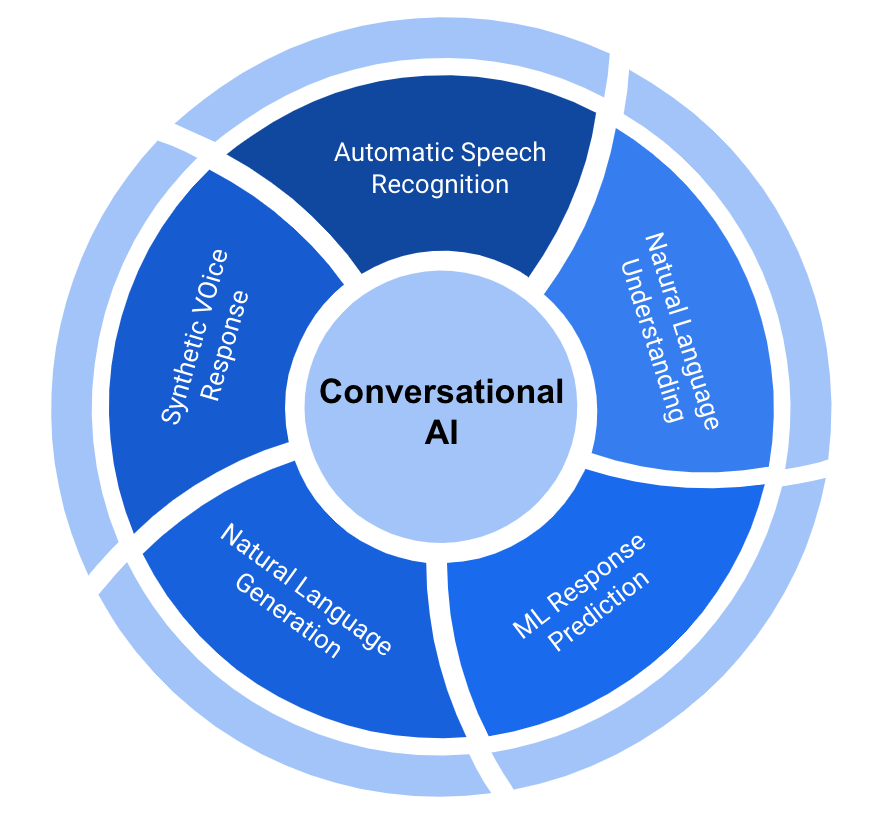
Conversational AI uses massive data, natural language processing, and machine learning to imitate the interactions, identify the speech patterns, and send text messages in different languages.
The significant role of NLP is to flow into the constant feedback loop with ML processes for improving the algorithms of Artificial Intelligence. Together these processes allow Conversational AI to understand the process and generate an intelligent response in the most natural way.
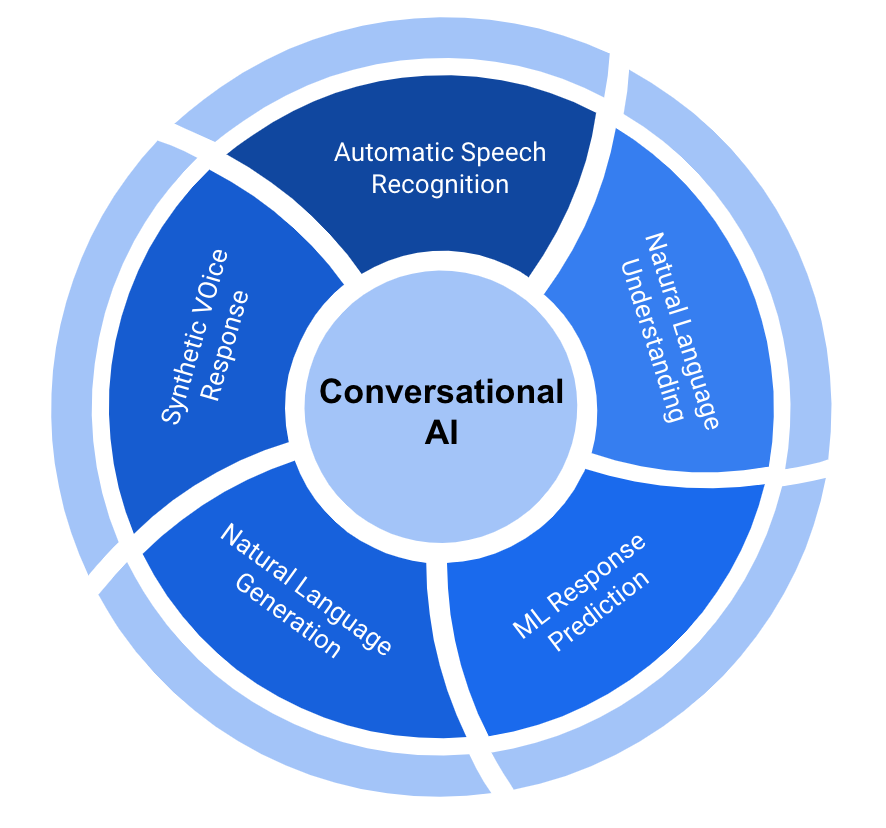
Here are the components of Conversational AI explained:
1. Natural Language Processing or NLP
Usually popular as NLP, it is an intelligent method to analyze the language (using ML) in conversational AI. Deep learning is believed to be advancing NLP in the future, allowing businesses to experience much more advanced NLP for better customer service.
NLP or Natural Language Processing involves four significant steps:
Input generation — Users provide particular input and the format of which can either be text or voice.
Input Analysis — In the case of text messages, conversational AI will use NLU or Natural Language Understanding to interpret the meaning of the input. If it is voice-based, then NLU and ASR or automatic speech recognition will generate the natural reply to the user.
Output generation — Natural language generation (a component of NLP) generates a response to send to the user.
Reinforcement learning — ML algorithms refine the responses to ensure accuracy in the replies.
The entire process is about transforming the unstructured data into an accessible format quickly understood and readable by the machines/ computers. The machine learning algorithms prevailing in the algorithms enhance the quality of response, with time, as it learns the process. It completely supports the idea of automated conversations and responses for any business using cloud telephony.
2. Machine Learning
It is a sub-field of AI, an innovative and intelligent combination of algorithms, data sets, and features bound to grow and improve with time. With time and capacity of input, recognizing machine learning patterns better deploy chatbots much smarter predictions for intelligent customer service.
Conversational AI is a cost-effective solution for improving the customer service of your business. There are considerable benefits that any business can experience if they incorporate effective business communication solutions like Conversational AI in their processes.
Here are some notable benefits of using Conversational AI:
1. Cost-Effectiveness
A customer-oriented business will always find new ways to improve the results for their customers. And, staffing a customer service department is nothing new that companies won’t think of. However, the cost, in this case, would be pretty unpredictable and definitely on the higher side.
On the other hand, if you opt for Conversational AI, it is easier for you to reduce the business costs that would otherwise have gone into training the staff. Besides, their salaries become a significant constraint for the company too. Conversational AI saves all these costs while delivering much more intelligent and quick responses to the customers.
Take chatbots, for example — they will be available 24×7 to your potential customers, without needing you to be there all the time. Besides, chatbots ensure the response is quick so that your customers don’t have to waste time waiting for the replies.
With a projected worldwide market size of more than $1.3 billion by 2024, chatbots will be a driving force for business communications. (Intellectyx, 2019)
Apart from the quick response, chatbots even minimize the errors in the response. It is intelligent enough not to send repetitive messages to customers, unlike humans. Hence, a better customer service experience for your customers.
2. Higher Customer Engagement
Customers are constantly engaging over their mobile phones nowadays. Hence, businesses need to prepare themselves to provide real-time information for the customers. Conversational AI allows the customers to engage with the brand using AI tools using mobiles easily.
With conversational AI, businesses establish a quick connection with customers so that the users don’t keep waiting for hours. It is a good sign for your business, as you are not letting your customers wait for a response from your end. You have a great chance to promote your products or let them know about your brand.
3. Scalability
Conversational AI gives you complete access to add infrastructure to support it at a much affordable cost and quickly. That’s not the case when you hire a staff to do so. One example of it could be expanding your product market in another country or a geographical area within the shortest possible time. Conversational AI can be a helpful tool to do so without adding to your budget or time.
4. Optimal Collection of Data
AI is an intelligent and innovative tool that helps you collect data. It analyzes the favorite products by your customers for future purchases to improve marketing and sales practices.
You can easily connect with customers and offer them more information about the products of interest. Conversational AI can even help you determine the best way to connect and engage with your customers to deliver satisfactory customer service within time. With optimal utilization of data, you can efficiently have a sufficient customer service experience for the users.
5. Reduce Churn
Conversational AI delivers instant support to customers for solving their problems almost instantly. Since customer’s issues are resolved immediately, it is easy to keep the customers for longer. Besides, this benefit of Conversational AI enhances customer satisfaction.
6. Unlimited Stream of Patience
Customer queries can sometimes be silly and repetitive, which can visibly irritate customer service agents. The constant similar questions and complaints can make customer service reps bothered sometimes. However, when you use Conversational AI, you can avoid such situations. Unlike humans, AI tools like chatbots and virtual assistants offer an unlimited stream of patience.
7. Multilingual Support
Customers prefer speaking their native language when possible. They expect a response from you in the same language to establish a good connection with your brand. So, even if businesses consider the English language as the lingua franca of today, it will not always serve your customers.
With Conversational Tools, you can convey your message in multiple languages, allowing you to better communicate with them. Besides, there is barely any need to hire a translator or interpreter to conversate with customers in their language.
AI tools use multilingual chatbots or voice assistants to show the customers that you are trying to connect with them in their language. Hence, customers will count those extra efforts.
67% of millennials in the US reported that they would likely purchase products and services from brands with chatbots. (Chatbot Magazine, 2018)
Challenges of Conversational AI for Your Business
Conversational AI, undoubtedly, is beneficial for your business. However, it still is a technology, and every technology has some advantages and disadvantages.
Here are some challenges that Conversational AI brings in:
1. Language Input
That can be a pain point for Conversational AI where the input from the user is voice or text. Text messages (to a certain extent) are acceptable to address. The issue is faced when the voice inputs are taken care of. AI can have difficulty understanding the voice input in terms of dialects, accents, and background noises, which can impact the quality of the input.
Besides, the biggest challenge for Conversational AI tools is to bring human value and emotions into the conversation. The emotions, tone, and that human connection will probably not be that strong when such tools are used.
2. Security/Privacy
Conversational AI highly relies on collecting massive user data to give proper responses to customer queries. The security and privacy of user data are at stake, and it can even be exposed to security breaches sometimes. Hence, a conversational AI that supports high security and confidentiality should be invested in. So that both the customer data and their privacy are entirely secured.
3. Data Sharing Constraints
Users can be apprehensive about sharing their sensitive data with businesses. They may doubt sharing personal data with machines too. Hence, it is difficult for people to share information with conversational AI. Data sharing constraints will exist until a robust security system is designed for the technologies and tools.
Hence, there is a strong need to educate customers before expecting them to share their data with you. Once they understand what you (as a business) are trying to share with them, it would be much easier for them to trust you. Plus, they won’t hesitate to share their data to enhance their customer experience further.
Conversational AI Helps Businesses Improve Customer Service
Honestly, conversational AI is a reliable technology for improving customer service. However, it is time we bust the misconception that AI alone can handle all incoming inquiries from the customers.
Without human support, it is quite a slippery slope to handle or improve customer experience. So, your business needs to identify a balance between conversational AI and human help to enhance your customers’ overall experience.
AI can optimize the workflow of your business. However, it can not understand the emotions of a human. Hence, a healthy balance between both machines and humans is required.
So, go ahead, strategize your business accordingly using your staff and conversational AI for optimum customer satisfaction.
Do not fear chatting with conversational AI. It is here to help you (source: unsplash.com)
The advantages of conversational AI for both companies and customers
Imagine having an important online meeting ahead, and the internet isn’t working. As you call customer support, the voice that picks up the phone introduces itself as a robotic assistant.
You might get hesitant if your issue can be solved anytime soon. The robot, however, quickly understands your problem and provides clear instructions on how to restart the router. No repetition and unnecessary questions are needed. Everything works just fine in a few minutes. This is exactly how the call centres and technical helpdesks might look soon.
In some parts of the world, digital voice assistants and voice bots are a common part of the call centre structure. This trend is slowly coming into the Czech Republic too. In the past, Czechs could only encounter artificial intelligence on helpdesk chats. Today, this technology reaches a new level — the voice level, and it is profitable for several reasons. Voice bots help not only the companies but also the customers and clients.
Studies show that over 80% of people are willing to spend more money on a company they had a positive customer experience with. Although they may not seem so at first glance, voice bots are a great step towards improving that experience. Both companies and customers are often afraid that digital voice assistants will not fully replace human interaction. At the same time, they often overlook many benefits that a voice bot’s involvement in the contact centre brings.
Communication evolves constantly, and voice bots are the next step forward (source: unsplash.com)
Between the IVR and human interaction
The digital voice assistant takes the communication with customer centres to the next level. Voice bots never sleep, and they can solve different routine problems at any time. Additionally, they have essentially unlimited call capacity. These advantages significantly help to reduce waiting times during, for example, mass outages, when many people suddenly need the help of a helpdesk. Besides, compared to an interactive voice response (IVR) system, that people often mistake for digital assistants, communication with a voice bot equipped with humanlike manners is much more enjoyable.
In comparison with IVR, digital voice assistants excel in every possible way. During interaction with voice bots, you do not need to repeat questions constantly and press buttons to proceed in the answer scheme.
Artificial intelligence itself will ask you to describe the problem and quickly understand its nature. If it can, it will propose a solution.
Furthermore, digital assistants easily recognize when they reach the conversation dead end. Instead of bombarding you with more unnecessary questions, they connect you to an available and qualified human operator.
Artificial intelligence and natural language processing prevent digital assistants from getting stuck in the wheels of absurd questions. Whenever you call a voice bot because your internet isn’t working, the assistant first asks you to describe the problem. You can explain the situation in your own words because the assistant already knows all the related words and phrases. “I can’t use the internet, our router has stopped working, the wifi is not running again.” It doesn’t matter how you phrase your issue because an assistant armed with artificial intelligence understands and proceeds to ask an additional question.
Digital voice assistants shape the new face of call centres (source: unsplash.com)
Helping hand in the Covid times
There are even more advantages to digital voice assistants. One of them is undoubtedly security. If someone calls bank support and requests a forgotten credit card code, the human operator does not have the authority to look for it for obvious reasons. These restrictions do not apply to artificial intelligence since it will not reveal the card code to anyone but your authenticated self. Similarly, it is beneficial to use a voice bot while addressing topics such as health conditions. The digital assistant is discrete and will never make fun of your medical conditions in front of his colleagues.
Today, when everything is affected by Covid-19, other benefits of digital voice assistants have emerged. Some institutions, such as health insurance companies, face an enormous number of callers asking various questions related to the epidemic. The capacity of their helpdesk is unfortunately often limited, sometimes even due to preventive measures. At that moment, the voice bot, which can learn to deal with dozens of often repeated requests quite quickly, has the opportunity to shine. He manages a variety of routine problems as well as his human colleagues and saves them a lot of time to deal with more complicated topics.
With all the advantages mentioned above, the development of technology towards digital voice assistants seems logical. After all, the spoken word is the most natural way for people to communicate their needs and desires.
And although we may see an increasing reluctance to make phone calls in many ways, research still shows that more than half of people prefer oral communication when solving problems.
Of course, artificial intelligence still has a lot to improve in comparison to the human brain. But if, by any chance, you will be connected to a digital voice assistant while calling customer service, do not worry. If it was programmed to solve your problem, it will do it as good, maybe even better, than its human colleagues. If not, it will happily transfer your call to an operator who will.
Workbots are gaining a lot of traction on the customer side of the business. How about workbots infiltrating internal departments as well? While organizations are using workbots primarily for automation and digitization of businesses, they are rapidly transforming business functions, particularly in Human Resources Management. By introducing workbot automation for your core human resource functions, you minimize the amount of time HR professionals spend on routine administrative tasks and unlock new opportunities to automate processes to elevate your organization’s overall employee experience.
Achieve higher ROI on HR Workbots
Workbot by BOTSPICE is rapidly changing the face of current HR management practices, providing new opportunities to improve the employee experience. It is defining the new age paradigms in operating businesses. It has the power to change the way how human resources operate today. HR teams are dealing with a lot of challenges with seemingly conflicting objectives. HR functions are no more limited to administrative and transactional tasks of recruiting resources, conducting onboarding sessions, and payroll management.
The advancement in AI and machine learning has dramatically evolved HR functions over the past few years. They are not only recruiting assistants. They have also become strategic business partners, employee experience boosters, brand builders, communicators, and catalysts in increasing employee satisfaction. Therefore, organizations must focus on simplifying functions like onboarding, recruiting, training, performance analysis, retention, offboarding, etc., or risk left behind in the competition.
BOTSPICE workbot can be exploited to achieve a great ROI. It automates several repetitive tasks within seconds to reduce the burden of HR, allowing them to focus on other challenges like reducing employee churn. Imagine your employee interacting directly with workbots when they need help with training, understanding company policies, etc. Workbot interacts with your employees just the way your HR executives do, but with greater speed, instant availability, and consistency in response.
Ever wondered why few candidates lose interest in the interview process? Recruiting is a challenging and time-consuming job. HR teams often screen thousands of candidate applications. It is not only challenging for HR but also exhausting for candidates as well. They spend an enormous amount of time preparing for the interview and often struggle to find the right platform to raise queries about the interview process, company policy, job description, etc. They end up dropping emails in the HR mailbox that frequently goes unanswered.
What if there was a solution that filters candidate profiles
and carries out people management seamlessly?
Workbot automation is real and growing at a rapid pace.
It filters candidate profiles, shortlists candidates,
communicates with candidates for follow-ups, schedule interviews,
handles incoming queries, and provide informative videos to candidates.
Upskill Employees and Increase Engagement
The development of employee’s skills is an essential factor for the success of an organization. As organizations prepare for an unknown future of work, they are betting on employee training and skill development to create a workforce that can future-proof their business. However, it comes with a big-time investment. Investment is not the only challenge. Organizations have long grappled with low engagement and knowledge retention levels for mandatory training and learning modules. Despite attending training sessions, most employees are rarely engaged or driven in active participation in the training.
BOTSPICE workbot can help in increasing engagement levels and help employees plan and keep track of their goals before and after training. By integrating workbots into training, employees can easily interact with workbots and access training resources and subject matter experts at their convenience. They can query the workbot using keywords or simply ask a question. Workbots will then suggest relevant training courses to help them upskill for career advancement. Well, this is just not it. Workbots can also assess your knowledge with quizzes that come with scores and instantaneous feedback.
Respond Instantly to Employee Enquiries via FAQ Workbot
HR team’s inbox often gets flooded with employee queries. Commonly asked questions should not be directed to the HR department. It is a waste of time to put effort into answering a question more than twice. Oracle press release study suggests that around 64 percent of people prefer bots over managers/HRs when seeking information. Upload FAQs to workbots and motivate employees to interact with workbots to get their queries answered in real-time.
Conclusion
In this technology-disrupted world where organizations are striving hard to beat the competition, It is imperative to adopt solutions like workbots to automate, streamline and make data-driven informed decisions. It eliminates human bias in HR decision-making. Workbots give you intelligent employee sentiment analysis, helping you reduce unwanted attrition. BOTSPICE workbot integration into human resources will make the organization better and stand out from its competition. Get in touch with our experts to embark upon a new Workbot culture.
Short introduction: I’m Jerry Udensi, CTO of a Nigerian-Malaysian tech company: Lyshnia Limited. Prior to working full time with Lyshnia (a company I founded in 2013 with my elder brother), I worked in the AI industry in Malaysia and Singapore. I have built Natural Language AI systems for large corporations such as Allianz SE, and Insurance Technology for companies like Malaysia’s Insuradar Sdn.
The reason for my short introduction is to show you my background in building AI powered systems. Natural Language Processing is a field I’ve actively been in for over 3 years now so you’d think building a Transactional Chat Bot that sells only 10 products shouldn’t be an issue for me right? Well you’d be right if the customers were people who read.
In the paragraphs to follow, I will highlight what I’ve learnt building and maintaining Jane B(Just another Non-Existent Bot) which attends to approx. 1000 customers every day.
Many Nigerians DO NOT Read
There’s this old saying that goes “if you want to hide something from a Black Man, put it in a book”. Unfortunately, this is the case with over 70% of the Customers who used the bot.
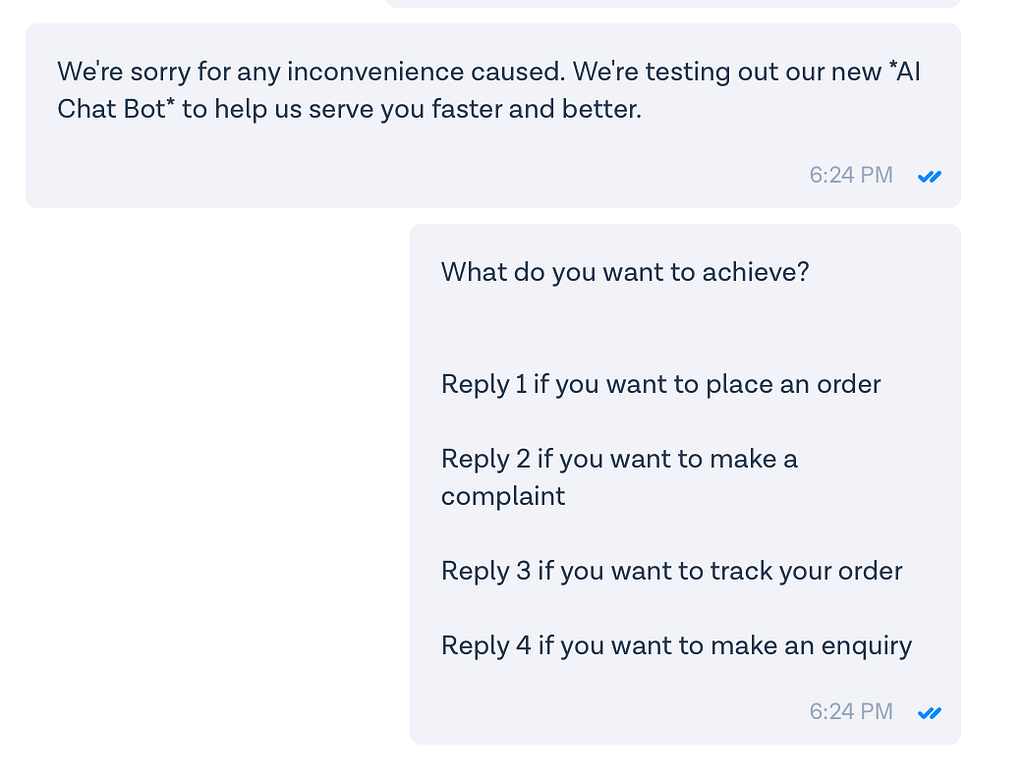
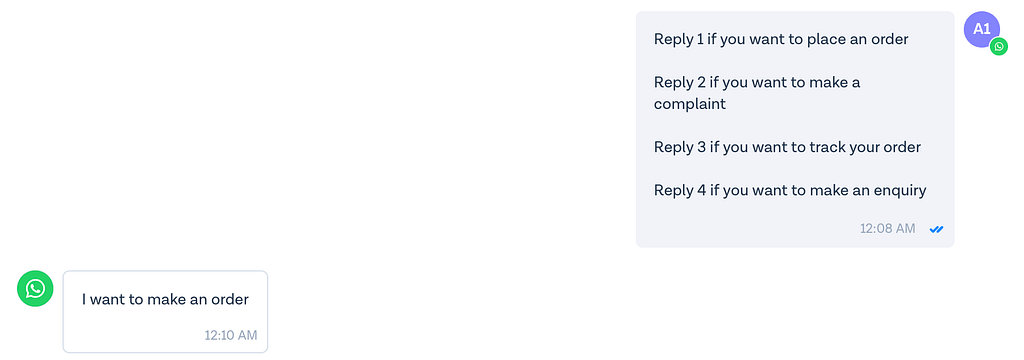
When you first message the bot, it greets you, let’s you know that you’re chatting with a Bot, then gives you 4 options to choose from.
The first 3 messages you receive after chatting the first time.
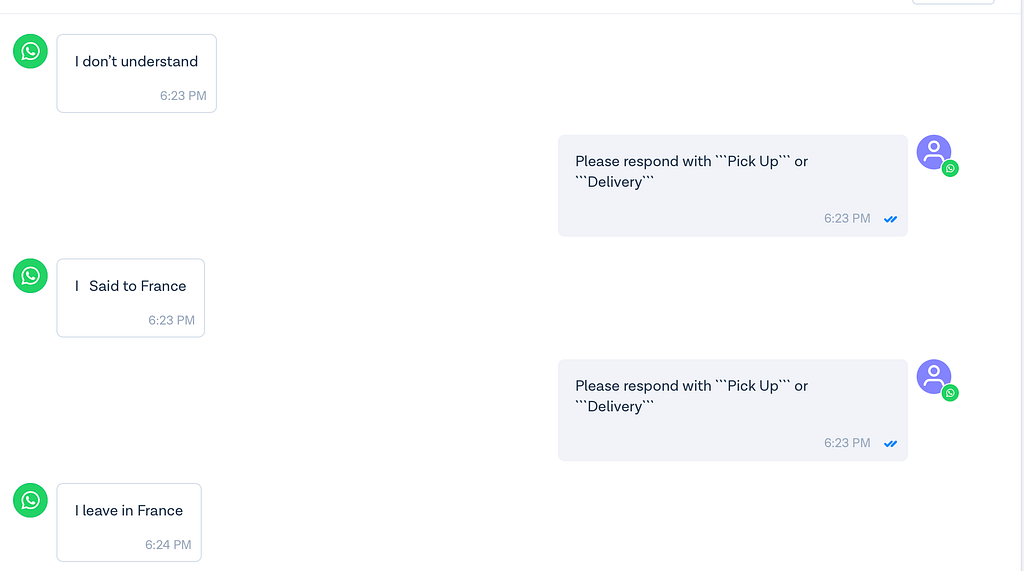
5 out of 10 people ignore the initial message and go ahead to write what they want, 2 out of 10 people would read but not understand and therefore reply confusedly like in the image below:
A customers reply
For the 5 who initially ignored the Menu message, we automatically resend the message, and 4 out of 5 would go on to reply appropriately, while 1 of 5 would complain of how stressful the process is and probably never chat again.
Yes, we get it. You live in France, but do you want it Delivered or will you Pick it up? (some customers send people in to do a pick up for them)
Jane has been simplified to understand even incorrect English, and giving the customers hints on how to reply, yet a lot of those who chat her simply ignore instructions, and rather type a thousand words than one that Jane would understand.
Ok
You would think it’ll be easier and less stressful for customers to simply reply “1” rather than type out “I want to make an order”, but no. Chat after chat, you will realise a lot of people are saying unnecessary things before or after their actual intention. For Chat Bot providers, this can be a nightmare because the Chat Bot asked a question and is listening for a Natural Language answer which is very hard to predict if the users response is in line with your desired answer.
Even for a human, it is hard to understand another humans intentions when spoken out of context
For the Chat above, the Bot was asking the user to confirm the items she wants to buy, but the user instead replies saying where they live. Totally out of context.
Humans love Instant gratification
Getting instant replies is a drug people are addicted to. Customers are told that this is a chat bot which only takes orders and track orders, then given another number to chat for consultancy to speak to a human. Yet, they keep coming back just minutes later to complain to the Bot that they’re not getting responses there.
Something else I noticed while analysing the chat response times is that the Customers get so hooked on the instant replies that if at any point, the chat bot delays their response for even just 1 minute they start asking why they’re not getting any response.
On the good side, customer who read and follow the short and simple instructions are able to place their orders in less than 2 minutes from a platform their comfortable with (WhatsApp) while feeling like they’re chatting with a human.