Author: Franz Malten Buemann

  • What are chatbot flows? How do you build them?

    Your chatbot flow is the most critical factor when it comes to creating a bot that feels natural. But how do you make one that takes into account every possible scenario?

    In this article, we’re walking you through the art of building chatbot flows that feel right. Let’s get started!‍

    What is a chatbot flow?

    A chatbot flow is a structure that determines how a conversation will take place, taking into account the questions your chatbot would ask and the various replies that a user could provide. A chatbot flow is a series of paths that a user’s responses could trigger.

    Each path would consist of nodes that either display, request, or process information. Some of these nodes could even be used to integrate your chatbot with third-party software.

    ‍Questions to answer before building your chatbot flows

    1. What is your chatbot’s purpose?

    Determine what you intend your chatbot to do. I’m not saying that your bot has to have only one goal. It can have multiple objectives, but you need to outline them clearly. This is the foundation upon which you will build all your chatbot flows.

    Do you need it to drive sales? Maybe you need it to schedule appointments. Perhaps you want to use it for 24/7 customer service.

    Whatever your goals are, you need to define them clearly.‍

    2. Who are your users, what do they need, and how do they behave?

    Identify who your chatbot’s primary users will be. Are these going to be prospects who are just hearing about you? Are they new customers who haven’t quite understood how to best use your offerings yet? Are your bot’s users customers who face sudden issues with your offerings and need help?

    There could be many other types of users. You need to identify your primary customers, the ones you seek to serve the most through your chatbot.

    Now, what are the most common issues they face? What do they already ask your sales and support teams about the most? These are the issues that you need to train your bot on the most. Your bot needs to be able to resolve as many of these queries as possible. In case some of these are too complex for the bot, you need to make it possible for your chatbot to transfer customers to a live agent.

    Finding out how your users most commonly behave is also very important for building chatbot flows. Understand how they navigate across your website, which sections leave them confused, and where they would be most likely to ask your bot a query.‍

    3. Who is your bot?

    You don’t want to leave your customers talking to a dull bot. You need to give your bot a personality, preferably one that matches your brand. Give your bot a persona and a story.

    For example, when George Hanshaw, Director of E-learning at Los Angeles Pacific University, was building a chatbot for a nursing course, the team built the bot based on a colleague’s personality.

    This colleague had earned the name Agent R because she was always going on trips to distant lands before the pandemic and coming back with fascinating stories. They lent her personality to the bot and even created an avatar that wore a nurse’s outfit and sunglasses to display a cross between a nurse and an agent.

    Giving your bot a personality makes it vibrant. It even fascinates your users. So, what’s your bot going to be like?

    After you answer that, it’s time to get started with the chatbot flows.‍

    Trending Bot Articles:

    1. How Conversational AI can Automate Customer Service

    2. Automated vs Live Chats: What will the Future of Customer Service Look Like?

    3. Chatbots As Medical Assistants In COVID-19 Pandemic

    4. Chatbot Vs. Intelligent Virtual Assistant — What’s the difference & Why Care?

    How do you make a chatbot flow?

    Sure, you could dive straight into the platform and wing it. But we’d suggest preparing in advance. Get out a pen and a paper (or a whiteboard) and design a rough flow chart for your conversations.

    You don’t need to fill in the actual responses just yet. Just keep the general purpose of the message in mind.

    Once you have a rough draft, you can finetune it on a tool like draw.io. You can get a little bit more specific in this step.‍

    How to make a chatbot flow‍

    Once you’re done with that, you can replicate it on Engati’s no-code visual flow builder.‍

    Making the flow on Engati’s chatbot builder‍

    Fill in rough messages in the nodes for now. Don’t spend too much time here; you can always fine-tune them after your flow is ready.

    While you could build your entire chatbot flow in a single path, that isn’t the best idea. Creating separate paths for different scenarios will make it easier for you to understand your flow and edit it in the future. These paths can be connected using the Trigger Path node.

    Once you’re done making your flow, proceed to polish the messages in the nodes. Make sure that they match your bot’s personality.

    Now, it’s time for your to test your flow. You can test individual paths by pressing the play button on the top left corner of your path builder.

    Building your chatbot flow is not a one-and-done task. You need to keep improving it as your customers, and your business evolve.

    You can train your chatbot in two different ways on Engati.

    First, you can upload FAQs either individually or in bulk.‍

    Uploading individual FAQs‍

    Uploading FAQs in bulk

    ‍However, you don’t need to upload these FAQs manually. With Engati’s DocuSense technology, you can automate the training process. All you need to do is upload your documents. Your chatbot will use cognitive search to parse through your documents, 12 pages every 8 seconds. It will pull answers directly from your documents and deliver them to your customers.

    And the best part? You don’t even need to format your documents into questions and answers.‍

    Train your bot via DocuSense

    ‍Now that you know how to build a chatbot flow, it’s time to address another question.‍

    How do you end a chatbot flow?

    Too many companies allow their chatbot flows to end abruptly after a user’s questions are answered. That’s far from ideal.

    It feels unnatural. Worse, it looks as though you though care enough about your customers.

    Make sure to conclude the conversation by thanking your users for giving you the opportunity to help them. And don’t forget to let them know that you’re always there for them, just one message away.‍

    A list of nodes that you can use in your chatbot flow

    These nodes can be segmented into four categories:

    • Display Information Nodes
    • Data Input Nodes
    • Processing Nodes
    • Integration Nodes‍

    1. Display Information Nodes

    These nodes are used to present information to the end-user.

    • Send Message Node: This node is used to send basic text and emoji messages to your users.
    • Send Message With Options Node: Use this node to send a message with predefined options for your bot users to choose from.
    • Send Image, Video, and Audio Nodes: These nodes allow you to make your bots more interactive by sending images, videos, and audio files.
    • Custom Card Node: With this node, you can create your own custom code via HTML and CSS
    • Send Carousel Node: This node helps you send interactive messages with images, text, subtext, links, and buttons. It is primarily used to display offerings.
    • Randomize Messages Node: Use this node to send messages from a particular set at random.‍

    2. Data Input Nodes

    You can use these nodes to collect information from end-users.

    • Feedback Node: This node allows users to provide feedback in the form of ratings.
    • Identity Node: Use this node to collect user input in an input form and add an authentication validation
    • Request User Data Node: It enables the chatbot to read inputs and save them as attributes or entities. It is beneficial for generating leads and personalizing experiences.
    • Slider Node: It allows the user to provide inputs visually using a slider.
    • Form Node: This node gives you more control over the validations of each field. It’s critical for lead generation and data capture.
    • File Upload Node: This allows your users to upload files to your bot. They do this either as a public upload, a private upload, or a direct upload.‍

    3. Processing Nodes

    These nodes help you handle & process information and make conversation flow branching decisions.

    • Script Node: It allows you to insert custom Javascript code to get executed along with the path. This helps you build complex flows with logical operations, data processing/transformation, etc., without having a separate backend infrastructure.
    • Filter FAQ Node: This allows users to limit the category/categories of FAQs addressed in a path.
    • Send Email Node: You can configure an email node anywhere in the bot and send out notifications to your users.
    • Pause Node: Use this to slow down the conversation, allowing the user to process the information you have sent.
    • Send SMS Node: It allows you to send SMS notifications to your users.
    • Trigger Live Chat: This node routes the conversation to one of your live agents.
    • Trigger Path Node: Use this node to send your user down another path.
    • Subscribe/Unsubscribe From Campaign Nodes: This allows your users to opt-in or opt-out of the campaigns you’re running over your chatbot.
    • Decision Node: With this node, you can direct the chatbot flow based on the user and the bot’s interaction.
    • Webview Node: This is used for use-cases that involve a third-party web interface. It has inbuilt parameters for Stripe and Google OAuth.

    4. Integration Nodes

    These nodes allow you to extend your marketing and support systems by integrating them with Engati.

    • Salesforce: Integrate Salesforce with Engati to make it easier for your bot and your agents to handle tickets.
    • Zendesk: Use Engati with Zendesk to create tickets, retrieve ticket details, and update them directly over your bot.
    • Freshdesk: Like Zendesk, integrate Freshdesk to create tickets, retrieve details, and update them from your chatbot.
    • Google Sheets: This node allows your bot to pull data from the sheets, add new data, and modify existing data.
    • Google Calendar: It allows your bot to schedule appointments, demo calls, time slots for activities, and team meetings.
    • Zapier Integrations: You can use Zapier to integrate Engati with any of the cloud services they support.
    • JSON API: Engati allows you to use JSON REST APIs with the GET, POST, and PUT methods.‍

    Best practices for building chatbot flows

    1. Inform users that they’re chatting with a bot

    Do not mislead users into thinking that they’re chatting with a human. Let them know that they’re conversing with an intelligent bot, and if need be, you can route them to a live agent.‍

    2. Cut your messages short

    You wouldn’t want to read a message that looks like a massive chunk of text. Don’t force your customers to do that either.‍

    3. Give your customers a chance to reply

    Don’t send too many messages in rapid succession. Give your customers a chance to read them and respond.‍

    4. Collect feedback

    Ask your customers how they felt about their interaction with your bot. You can use the feedback node to collect ratings. You can even ask them for subjective feedback. This will not only help you improve your chatbot flow, but it will also make your customers feel like you care about them.‍

    5. Enable small talk

    Don’t assume that your customers just want to talk business and keep it to the point. Your bot should be able to respond to questions like “How are you doing?” or “Good morning.”

    All you have to do is go to the Conversations section in the Configure tab and enable small talk.‍

    Engati’s chatbot builder screen for enabling small talk

    There you have it. Everything you need to build chatbot flows that your customers will love. Now it’s time to give it a shot yourself. Try Engati’s visual chatbot flow builder today!

    Don’t forget to give us your 👏 !


    What are chatbot flows? How do you build them? was originally published in Chatbots Life on Medium, where people are continuing the conversation by highlighting and responding to this story.

  • Personality forge

    I’m wondering some bots are openly saying that its ok to do simulated “illegal” things with them. But despite the tos being very vague about such things I slightly worry. I’m not in to anything like that mind you but my fetish(shortstacks) could be misconstrued as that. Is personality forge safe for shortstacks? or is there some sort of pseudo rule about anything that could be seen as underaged/loli content I don’t know about that might tag me?

    submitted by /u/comanderikari
    [link] [comments]

  • Instagram Automation was just announced.

    Here is the rollout schedule: Phase 1: everyone with more than 10k June 2 Phase 2: 1k followers – July 1 tentative Phase 3: everyone – August 1st tentative

    Are you planning to use Instagram Automation? What features are you most interested in. I am excited about the Comment to Message trigger. I have been playing with it for a couple of weeks in the beta and it is awesome.

    submitted by /u/KellyStellar
    [link] [comments]

  • Facebook Chatbot: A Proven Case Study for Restaurant Order Management

    Facebook Chatbot Case Study for Restaurant Order Management

    Do you know that 33% of consumers want to use a chatbot for making a hotel reservation? An online hotel booking chatbot is a convenient reservation option. You don’t have to call the hotel manager back and forth. Based on the date and table availability, the chatbot would automatically make your booking. With Facebook chatbot launched in 2016, their business adoption has become seemingly high.

    There are different types of chatbots for hotel reservation management. The three primary ones are rule-based (answering specific questions), AI-based (learning from environment & conversations), and live chatbots (customer service representatives). A Facebook messenger chatbot uses AI to converse with people. It can also answer pre-preprogrammed questions. Some companies use Facebook messenger chatbot integration for customer service as well.

    In this article, we will look at the reasons behind the use of chatbots. The main purpose is to understand the importance of the Facebook messenger chatbot for business. After that, we will focus on a proven case study built by BoTree Technologies, a leading chatbot app development company. The case study is an online hotel booking chatbot that simplifies the process of making restaurant reservations. Keep reading to know more.

    Checkout How AI Chatbots drive better Customer Engagement

    Why use Facebook Messenger Chatbot for Business?

    Chatbots can cut operational costs by 30%. A custom software development company can build chatbots using Facebook, Skype, Slack, and other messengers. However, we will focus on the Facebook Messenger chatbot that Python developers always keep on talking about. Let’s look at why a chatbot — and more important — Facebook messenger chatbot API is useful for any business.

    • 24×7 availability
      Today, people use Facebook whenever they get the time. A Facebook Messenger chatbot is available 24×7, 365 days a year. More than 60% of internet users love the 24×7 feature of chatbots. Whenever a query or problem arises, they can connect with a chatbot. The quick response ensures that they are getting the answers on time.
    • Personalized experience
      A Facebook messenger bot for websites enables you to directly reach your customers. People are more likely to connect with your Facebook bot than with marketing emails. In fact, most Ruby on Rails development services providers recommend a chatbot over automating email marketing. Chatbots give a personal experience to each customer they connect with.
    • eCommerce bot
      You can also get a Facebook messenger chatbot for ecommerce transactions. Chatbots can do upselling by recommending products and accepting payments by directing the customers to payment gateways. Chatbots increase your sales and reduce the cart abandonment rate. They can show ads that can redirect directly to the payment page on your website.
    • Remarket services
      You can engage with your customers that visit the hotel. By sending them offers and discounts on table bookings through chatbots, you can turn them into repeat customers. There’s no extra Facebook messenger chatbot price for retargeting customers. A single bot can handle both new and recurring customer visits.
    • Appointments & bookings
      You will find the best Facebook messenger chatbot example in appointment scheduling. Making hotel reservations becomes a breeze for customers using chatbots. The bot will ask questions about the date and time. It will then make reservations by looking at the table status. It doesn’t take more than 5 minutes to make a reservation. You can also schedule or cancel bookings easily.

    Trending Bot Articles:

    1. How Conversational AI can Automate Customer Service

    2. Automated vs Live Chats: What will the Future of Customer Service Look Like?

    3. Chatbots As Medical Assistants In COVID-19 Pandemic

    4. Chatbot Vs. Intelligent Virtual Assistant — What’s the difference & Why Care?

    Facebook Messenger Chatbot: A Proven Case Study

    Now that you understand the importance of Facebook messenger chatbot for business — particularly in hotel reservation management let’s move on to a case study. At BoTree Technologies, we build Facebook chatbots for different industries. In this case, our client is a restaurateur who wanted to simplify the process of taking orders and reservations. We did it by building an online order-taking chatbot.

    Introduction

    The chatbot we built is capable of taking online reservations and orders from customers. It simplifies the process of taking orders online by enabling customers to place orders easily. The AI-based bot asks a few questions, based on which it assists the customers with ordering their food. The entire process does not take more than 10 minutes. It is easy as a breeze and enables quick service delivery.

    Challenges

    Steve’s (the client) restaurant missed a lot of business. He couldn’t attend and take orders from his customers at the right time. The major challenge was that most customers felt that Steve wasn’t considerate towards them by not attending them. However, he wanted to deliver orders on time to every customer but couldn’t do it without any help.

    The Solution

    We used two technologies — Ruby on Rails and Facebook messenger chatbot API. With the help of Rails 5 as the backend technology, we did Facebook messenger chatbot integration in one-click. Our solution included the following –

    • The chatbot was a real-time two-way communication tool using AI for understanding customer queries.
    • The chatbot presented various options from the menu. Customers could choose from multiple cuisines, categories and place their orders by tapping them.
    • It saved a lot of time in placing orders as the chatbot directly sent the orders to Steve. The same chatbot was used as a communication tool from another device that the restaurant had.
    • Since Steve had a Facebook page, it became easier to reach more customers. Anyone who followed the page could easily connect with the chatbot and place orders.
    • The customers could place orders from their past order history, check out the latest promotions, and share their orders with friends.

    We provided complete chatbot development and testing for the restaurant. Facebook messenger chatbot for business has much better reach than a mobile application for restaurant ordering. Since most people would prefer Facebook over an application for a restaurant, it made sense to build a chatbot for that purpose.

    Conclusion

    Before you go for mobile app development services, consider the prospect of having a chatbot. Facebook Messenger chatbots are becoming increasingly popular amongst small businesses. They are perfect for reaching out to customers, booking appointments, rescheduling them, responding to customer queries, and overall providing a personalized customer experience.

    BoTree Technologies can assist you with a Facebook messenger chatbot and enable you to target more customers through a trusted medium of communication. Contact us today for more information.

    Don’t forget to give us your 👏 !


    Facebook Chatbot: A Proven Case Study for Restaurant Order Management was originally published in Chatbots Life on Medium, where people are continuing the conversation by highlighting and responding to this story.
  • Conversational AI for Hyper-Personalized Customer Conversion

    Huge volumes of traffic coming to your site is good but is only useful when a high percentage of them actually convert and do what you want them to do. So, along with focusing on bringing a huge volume of traffic to the site, it is also important to have a solid customer conversion strategy that brings a lot of customer conversion rates.

    Among others, Personalization is an important driving force for customer conversion. Right now, Conversational AI has a huge potential for providing a greater degree of personalization easily.

    Many companies are implementing Conversational AI in their sales conversion strategy and their customer conversion metrics prove the importance and effectiveness of the technology.

    In this article, let us examine the usage of Conversational AI for hyper-personalized Customer conversion and how it helps

    But before diving into how Conversational AI is helpful for conversational sales, Let us answer some of the common questions that many people have regarding them:

    What is Conversational AI?

    As its name indicates, Conversational AI is basically a technology that is powered by highly sophisticated machine learning and artificial intelligence algorithms that can carry out conversations with humans and solve their needs. It can be used as an AI virtual sales assistant that guides your customers and succeeds in completing your sale.

    What makes Conversational AI powerful?

    Conversational AI would be trailed by huge amounts of data using much powerful and tested machine learning and artificial intelligence algorithms. They remember what your customers say & base the flow of users on that. They let you automate sales assistant with ai and create a conversational sales platform that discovers the needs and interests of our users and increases the chances and speed of conversion.

    With more research and work being done to increase the effectiveness and efficiency of these, certainly, they would be more powerful in the coming years.

    Trending Bot Articles:

    1. How Conversational AI can Automate Customer Service

    2. Automated vs Live Chats: What will the Future of Customer Service Look Like?

    3. Chatbots As Medical Assistants In COVID-19 Pandemic

    4. Chatbot Vs. Intelligent Virtual Assistant — What’s the difference & Why Care?

    Does Conversational AI have a high cost of implementation?

    When we talk about the cost of incorporating new technology or way of working into the business, we do not talk only about monetary costs but also the organizational or any other costs that could be incurred.

    While many people might be convinced that Conversational AI like a sales AI assistant would be a huge benefit, they could be concerned about the price they have to pay.

    Fortunately, incorporating a proactive conversational ai technology would not cost so much as you might generally think. There are many companies who already have a developed technology that only needs your specific inputs to work!

    Also, we can surely say that conversational AI can be self-paying because it highly increases conversions and increases profits exponentially!

    Now that you know what Conversational AI is and understand that it is easy to incorporate into your systems. Let us now discuss how Conversational AI helps with hyper-personalized customer conversion and can be a key part in your marketing strategy.

    How Conversational AI improves personalization in the customer journey:

    As you might already know, your customer goes through a journey or a “sales funnel” in different stages before they finally convert and buy your product or avail of your service. Conversational AI can be used throughout the Customer journey conversion funnel. Not only as chatbots, you can also have proactive conversational AI for utilities of communication such as social channels. Social channels might sound a bit regular and fashioned, but if done right, it is still a great way for attaining conversions.

    Let us now see how conversational AI can hyper-personalize interactions in different phases of the sales funnel and get more conversion. The different phases in the funnel would be described by different people in different ways, the basic essence stays the same: The user gets the awareness of our product, takes some time to learn the features, and makes the decision. Some people might also include retaining them in the funnel.

    Inquiry Phase

    In this phase, the user just got aware and might want to know certain initial information. They might ask general questions or problems. A Scope of personalization here is that by knowing the recent activity of the user, your automated sales assistant could suggest telling some additional information that they might want to know and incite interest in your offerings. An important thing here is that the chatbot must feel human and conversational AI can do a great job at that.

    Discovery Phase

    In this phase, your customer wants to know more about your product to finally consider whether they want to avail your service or buy your product. A Conversational AI Solution will help here by remembering their initial inquiry and can speed up the discovery process by providing personalized answers so that your visitor gets the exact answers they want.

    As said earlier, not only chatbots but conversational AI also send emails to your potential customers fueling their path down the funnel.

    Nurturing phase

    The Discovery phase might not always lead to conversion. The user needs to be nurtured to convert. AI-enabled conversation emails can cleverly follow up people and send announcements or other messages that are personalized and designed to pique their interest and get them on board again!

    Final Words

    Conversational AI is a powerful tool that can be used throughout the customer journey for conversion. Conversational ai services are powerful enough to use the large amounts of data of your users and then hyper-personalize your services to them.

    An AI-based sales assistant can provide hyper-personalization in all the phases of your customer’s journey through the funnel and finally improves the customer conversion rate. With this, it is safe to say that Conversational AI pays for itself!

    With more work diverted to increasing the effectiveness and efficiency of this technology, you can safely think that all the current limitations would be gone.

    Considering all these, it is imperative that conversational AI be one of the most important elements in your conversion marketing strategies.

    Many companies already developed conversational AI technologies in a way so that would be cost-effective and flexible. So, provide the inputs specific to your business, you can get a conversational AI for your needs right away!

    Don’t forget to give us your 👏 !


    Conversational AI for Hyper-Personalized Customer Conversion was originally published in Chatbots Life on Medium, where people are continuing the conversation by highlighting and responding to this story.
  • Building A Power BI Chatbot Using Power Virtual Agents

    Have you ever wondered if accessing data from Power BI can be made faster? And manually skimming through various dashboards and filtering the unwanted information might not be the only way to get the required data? If yes, then integrating chatbots with Power BI might just be what you are looking for. Sounds interesting, right?

    This blog will discuss the current challenges in accessing Power BI data, the benefits of chatbot-Power BI integration, and why you must consider building your Power BI chatbots using Power Virtual Agents (PVA). more –> https://botcore.ai/blog/power-bi-chatbot-power-virtual-agents/

    If you have any other information on Power BI chatbot. please do comment in the section below 🙂

    submitted by /u/Sri_Chaitanya
    [link] [comments]

  • Chatbot Development Companies

    Hi!

    The posts I mostly see in this community are ones promoting chatbot building platforms or asking questions about the development process. That’s really great and useful content 🙂

    But anyways, I’ve decided to share an article about seasoned custom chatbot development companies in case somebody would like to consider this option too: https://itexus.com/top-chatbot-development-companies/

    submitted by /u/itexusinc
    [link] [comments]

  • Create Telegram Chatbot

    In January 2021, Telegram announced that it reached 500 million monthly active users. By 2022, it expects to cross a billion users.

    In a world where privacy is a major concern, Telegram has made explicit attempts to protect its users’ data. That’s why it’s got an astoundingly loyal user base.

    Due to its focus on privacy and security, consumers all over the world are shifting towards the app. That gives your business a great opportunity to engage with customers on a platform where they feel safe and comfortable.

    But, how do you engage and support your customers at scale on Telegram?

    By creating an intelligent Telegram chatbot that can automate the resolution of your queries!‍

    What can your business use your Telegram chatbot for?

    1. Marketing

    An AI-driven telegram chatbot can help you deliver personalized marketing messages to your prospects and even help you upsell your current customers.

    You can use your telegram bot to broadcast messages about promotional offers and new arrivals. You can even drive targeted marketing campaigns over your chatbot.

    Your NLP-driven chatbot can even help you generate leads. You can collect customer details and auto-populate them in spreadsheets.

    By creating a Telegram chatbot, you even make it easier for customers to make reservations, book appointments, and set up demos.

    All your customers need to do is select the time that works for them, provide their details and they’ll have it scheduled.

    ‍2. Customer Support

    Here’s where your bot truly shines.

    As your business grows, the number of customer queries coming in increases exponentially. It would take too much of your agents’ time and energy to handle every single request manually.

    About 80% of the queries that come in are repetitive. They don’t warrant personal attention.

    Imagine being a customer support agent and being subjected to the torture of answering every single one of these queries. What would feel like after answering the same question for 17 different customers in a single day?

    You’d probably be frustrated beyond belief by the time you’re done answering it the 4th time. By the 7th request, you’re screaming internally. And by the 10th time, you’re fighting a losing battle with the part of you that wants to leave your desk and go live as a hermit.

    Fortunately, it doesn’t need to come to this.

    Your Telegram chatbot can take care of all these repetitive requests, without the slightest delay.

    Now your agents will only have to handle complicated customer queries that call for personal attention.

    Your agents won’t need to worry about automation taking over their jobs. Rather, automation will help them perform their jobs in a better manner. It will help them focus on higher-level work, on solving complex problems rather than getting bogged down with mundane, repetitive queries.‍

    3. Sales

    Whether you’re an e-commerce store, an insurance agency, or anything in the middle, a Telegram chatbot can help you drive sales and collect payments!

    It allows you to display your offerings, nurture your leads, and answer all the last-minute questions that may pop up in your prospects’ minds.

    Why force your customers to make the effort of visiting your website and browsing your offerings?

    Saying that users are more comfortable with Telegram is an understatement. A lot of them are absolutely obsessed with the app.

    Why do you think Amazon is phenomenally successful? They’re all about reducing customer effort. It’s what customers love about them. 1-Click purchases make their lives so much easier.

    Apply the same philosophy to your business.

    Your customers spend their time on Telegram. Simplifying the customer journey by allowing them to make purchases from you over Telegram itself would make it so much easier for them to do business with you.

    ‘The easier you make it for people to do something, the more they’ll do it’‍

    4. Sharing content

    It doesn’t matter if you’re creating marketing content or running a publication, Telegram can help you get your content out to people who’d benefit from it.

    Ever heard of the Create Once Publish Everywhere philosophy?

    As the name suggests, it focuses on publishing a single piece of content on as many channels as necessary. While publishing it in the same format might not be the best idea, you could tweak the content as necessary for different audiences on different channels.

    Telegram chatbots can help you expand the reach of your content.

    Your bots empower you to send your content out in the form of links, documents, pictures, and videos over Telegram, at scale.

    The Wall Street Journal uses this strategy to push their articles out to their audience over Facebook Messenger chatbots.

    Since your audience prefers Telegram, it might be worth engaging them by sharing content that they’d be interested in over your Telegram bot.‍

    5. Employee engagement

    Employees have questions that, when left unanswered, impact the quality of their work. The good news is that a lot of these questions don’t need to be answered personally.

    Onboarding can be automated to a large extent with an HR chatbot. Even payroll-related queries can be handled by a bot, with the more complex ones being routed to live agents.

    With the shift towards remote work, HR bots have increased in importance. Employees don’t have to chance to just run into HR at work. They can’t just stroll up to the HR manager and have their queries answered.

    And though they have the option to send an email, it may not be answered as soon as they’d like it to be.

    HR chatbots become particularly useful when it comes to change management. When organizations go through changes, employees are left confused. They need clarity.

    The influx of questions is too great for the HR team to handle manually. That’s where a Telegram HR chatbot comes in.

    Trending Bot Articles:

    1. Chatbot Trends Report 2021

    2. 4 DO’s and 3 DON’Ts for Training a Chatbot NLP Model

    3. Concierge Bot: Handle Multiple Chatbots from One Chat Screen

    4. An expert system: Conversational AI Vs Chatbots

    ‍6. Tracking orders

    After a customer places an order, they’ve just got 1 thought floating through their minds, “Where is my shipment?”.

    It practically makes us anxious.

    But logging into your e-commerce portal or even downloading your mobile app is just too much effort. Besides, most apps get deleted within 48 hours of being installed.

    However, your customers love Telegram.

    The best way to ease the anxiety they face is to provide tracking updates and information over your Telegram chatbot.‍

    How do you create a Telegram chatbot?

    We’re going to break this down into three sections.

    • How to create a basic chatbot
    • How to configure advanced bot capabilities
    • How to deploy your chatbot on Telegram

    Let’s get started.

    1. How to create a basic chatbot

    Engati has made it easy for you to create a basic chatbot in a few minutes.

    Our bot creation wizard streamlines the entire process, allowing you to set your bot up in no time. It even shows you the areas that you should fine-tune later.

    First off, you need to add the basic details for your bot. This would include the name, description, and category that your chatbot would fall under.

    Enter your bot details

    Now, you don’t need to build your chatbot from scratch.

    Engati allows you to build your chatbot using a range of template chatbots, designed for various use-cases.

    You can find template chatbots for lead generation, HR, e-commerce, and many other use cases. Instead of making the effort to build a whole new bot, you can simply use these template chatbots as a base layer and customize them to your requirements.

    Pick a template to build your bot on

    After choosing your template, you can configure the look and feel of your bot for your website with themes, fonts, and other options. You can deploy your chatbot on other channels after the initial setup is completed.

    Customize the look and feel of your bot‍

    Now, choose to enable live chat in order to get the perfect blend of automation and the human touch.‍

    Enable live chat to answer even the most complicated queries

    It’s now time for you to customize the welcome path for your chatbot. You can even set up FAQs really quickly in this step.

    Build the welcome path

    Guess what. You’ve just created your own chatbot.

    All that’s left to do is quickly review your bot… and configure its advanced capabilities.‍

    2. How to configure advanced bot capabilities

    Now that you’ve created a basic chatbot, it’s time to take it to the next level. These are the ones that truly set your bot apart.

    Let’s get started!

    Languages

    Only 26% of internet users even understand basic English. And since Telegram has large userbases in countries where English isn’t the most popular language, it makes sense to reach customers in their own language.

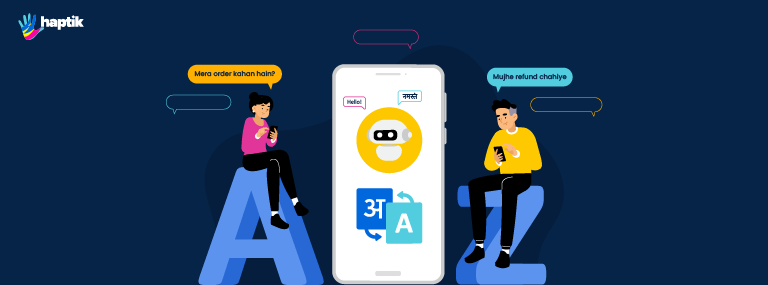
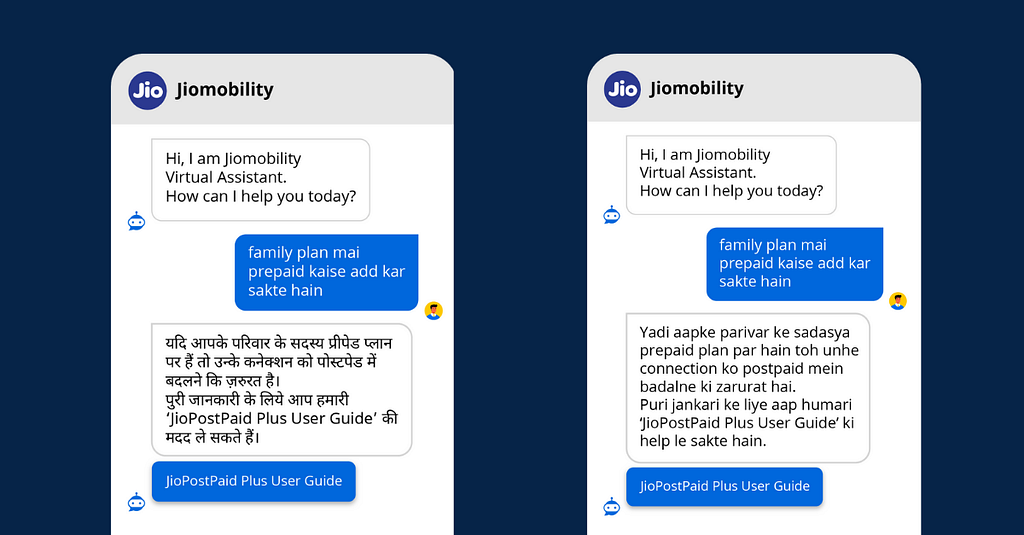
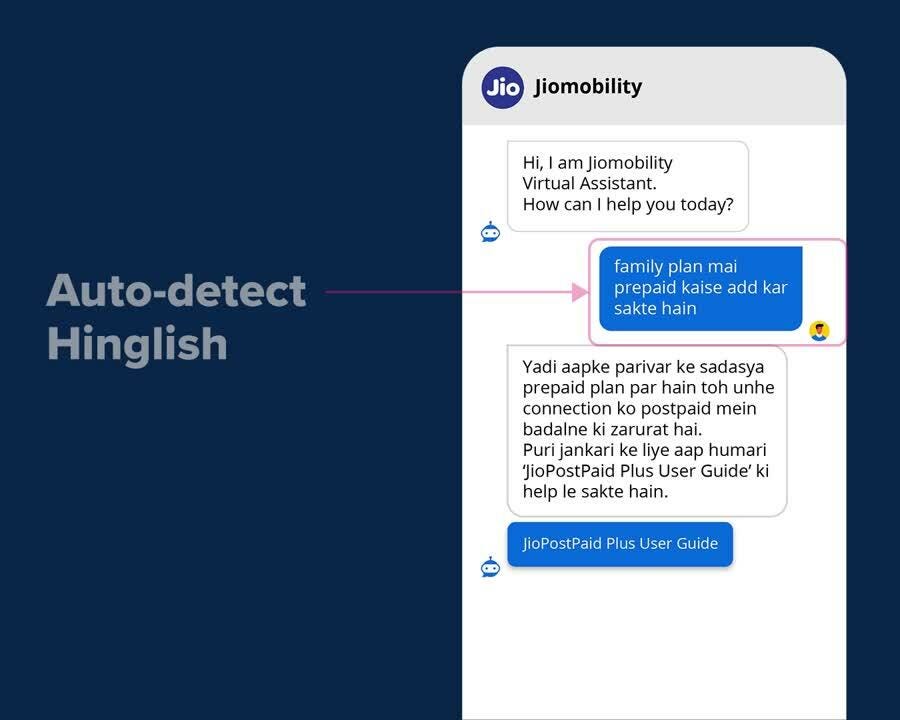
    Engati allows you to engage your customers over chatbots and live chat in 50+ languages. These include, but are not limited to, Hindi, Portuguese, Spanish, and Right-to-Left (RTL) languages like Arabic.

    To set up multilingual chatbots, select a bot, navigate to the ‘Configure’ section, go to ‘Languages’, and click on ‘Enable’.

    Now just choose the language from the dropdown list, download the language keys, edit them and reupload them.

    Choose from 50+ languages‍

    Data collection

    If you’re using your bot to generate leads, you might as well have the data stored and organized automatically too.

    When you integrate your Engati chatbot with Google Sheets, you’ll be able to add data to the sheets, update the data and even retrieve the data automatically.‍

    Scheduling appointments

    Your chatbot can help customers book appointments, consultations, and product demos.

    By integrating your chatbot with Google Calendar, you’ll be able to pull the available time slots and allow your customers to schedule their sessions.‍

    Payments

    By integrating your Engati chatbot with Stripe and other payment gateways, you’ll be able to drive sales and collect payments directly over your Telegram chatbot.‍

    Live Chat

    Engati offers you a power-packed, integrated solution that gives you both — speed and personalization.

    It merges automation and live chat into a single solution.

    But it gets even better.

    You can even integrate Engati Live Chat with your ticketing and CRM systems, including Salesforce, Zendesk, and Freshdesk .‍

    Third-party integrations

    Your Telegram chatbot can also be integrated with other platforms using Zapier and JSON API integrations.‍

    3. How to deploy your chatbot on Telegram

    Deploying your chatbot on Telegram is rather easy.

    In the Engati portal, go to the deploy workflow. Select Telegram from the list of channels.

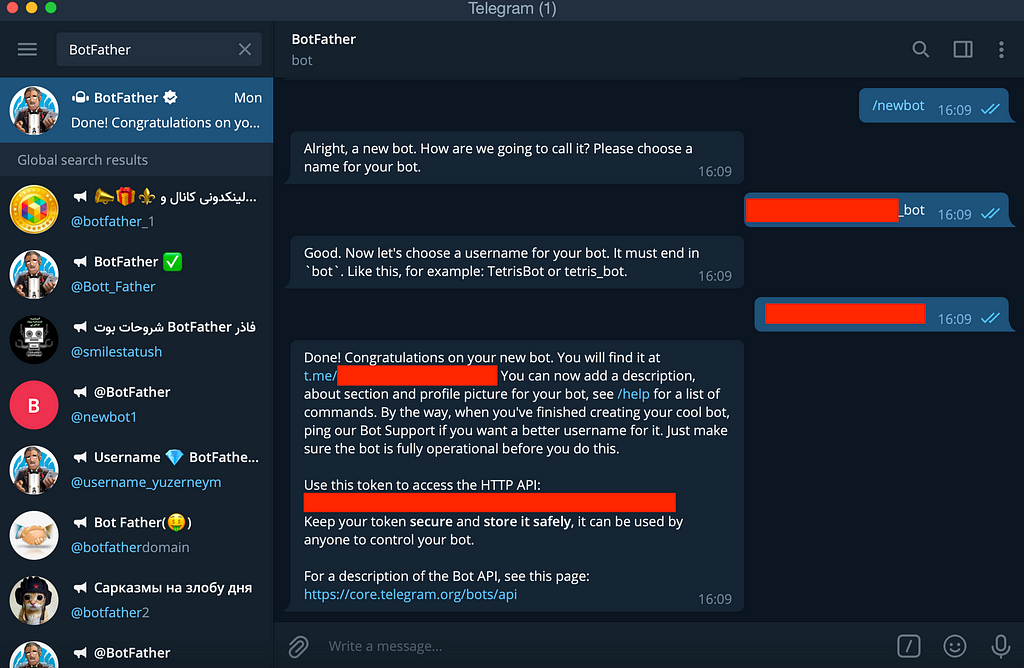
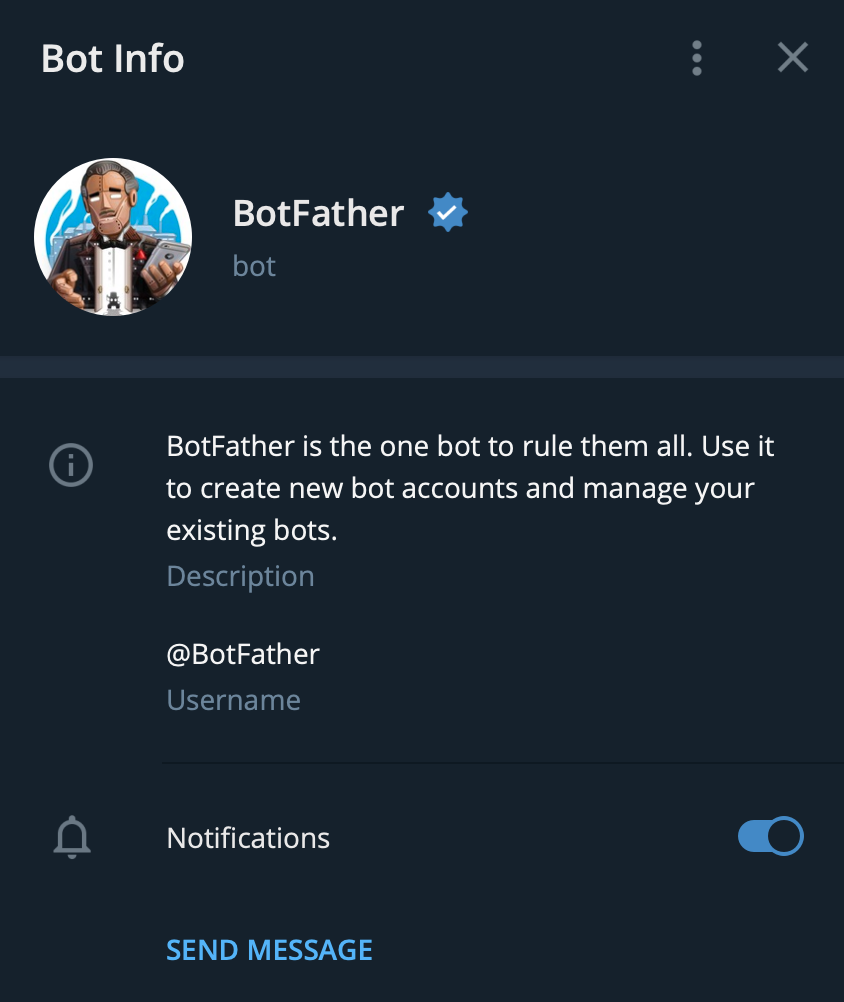
    Now, enter the Bot Father link (https:/telegram.me/botfather) in your browser or open the Telegram app and search for ‘Bot Father’ in the search field on the top of the chat page.

    The Bot Father will send you a list of commands that you can use to set up your chatbot.‍

    Telegram BotFather commands‍

    To create a new Telegram bot, enter “/newbot”.

    Create a new Telegram bot‍

    Now, you need to select a name for your bot.

    Give your Telegram bot a name‍

    After you select a name, it’s time for you to choose a username for your Telegram bot. This username must end with “bot”.

    Choose a bot username

    ‍Once you’ve chosen a username for your bot, the Bot Father will provide you with an access token.

    Telegram bot access token‍

    Copy this access token, head over to the Engati Portal and go to Deploy -> Telegram, and paste it in the Access Token field.‍

    Paste your access token in the Engati portal

    Just hit save and your bot is ready to be used on Telegram.

    It’s that simple. That’s all it takes to make and deploy a bot on Telegram.

    Case-study: Larsen & Toubro’s Telegram chatbot

    Larsen & Toubro has over 3,30,000 employees. With a workforce that large, it’s hard to engage your employees, answer their questions, and get progress updates from them.

    It realized that it needed to engage its employees over a chatbot. And, of course, it chose Engati.

    I loved how easy it was to use the Engati platform. In fact, L&T managed to build its entire integrated solution on its own, using Engati’s easy drag and drop conversational modeler with minimal intervention from Engati’s bot building experts.

    To strengthen its connection with its employees, L&T decided to opt for a multichannel approach to communicate with them

    It deployed its AI-driven chatbot on both — Telegram and WhatsApp.

    The bot is deployed at different construction sites to improve the communication between the on-site workers and off-site project managers. The remote workers send out daily reports to their managers through this bot by answering basic questions asked by the bot. Sending/ updating daily reports through the bot did not only save remote workers time but also made it much easier for project managers to track the progress on several projects.

    To make its employees’ lives even easier, it launched its chatbots in English as well as Hindi.‍

    Create your Telegram chatbot

    Now it’s time for you to build your own Telegram chatbot and engage your customers over the chat channel they prefer, in the language they prefer. Start now!

    Don’t forget to give us your 👏 !


    Create Telegram Chatbot was originally published in Chatbots Life on Medium, where people are continuing the conversation by highlighting and responding to this story.